

Tomaž Ebenšpanger is a Slovenian architect and founder of Skupaj Arhitekti, a Slovenia-based practice working primarily across residential architecture. The studio operates through a reduced and precise design language, engaging architecture through tectonic clarity, material logic, and a direct reading of the site.
House on the Edge of the Plain reflects this approach, where structure and material generate spatial organization, with reinforced concrete and local aggregates shaping both form and atmosphere. Skupaj Arhitekti’s work has been featured on platforms including Architecture Lab and regional architectural publications, positioning the practice within a context defined by restraint, construction precision, and a close relationship between architecture and landscape.

What inspires you?
I am inspired by the unknown—by what I have not yet encountered, tested, or understood. Novelty, experimentation, and discovery are essential drivers of my curiosity. At the same time, I am deeply drawn to what is beautiful in a precise and considered way: clarity, restraint, and logic. For me, elegance emerges from thoughtful simplicity and a disciplined approach to design.
What inspired you to become a designer?
As a child, I would half-jokingly say that I would become an architect. That idea stayed with me. I initially pursued a path in computer engineering, but the notion of architecture continued to resonate. Eventually, I decided to follow it—I took the entrance exams at the Faculty of Architecture in Ljubljana and, with a strong sense of enthusiasm, joy, and playfulness, became an architect. In a way, it was a return to something I had always intuitively known.
How would you describe your design philosophy?
Nothing is needed if it is excessive. If an element can be removed and the whole still functions, then that element was unnecessary. I strive for reduction, for stripping away everything that does not contribute to the essence. Logic, to me, is inherently beautiful. I am also deeply sensitive to materiality—I value materials that evoke a visceral response, those that can be felt, that raise the skin and engage the senses.
What is your favorite project?
I do not have a single favorite project. Any project that proposes solutions aligned with my own beliefs can become a favorite. If I had to single one out, it would be the Bruder Klaus Field Chapel by Peter Zumthor—an architecture of atmosphere, material presence, and profound spatial experience.
What is your favorite detail?
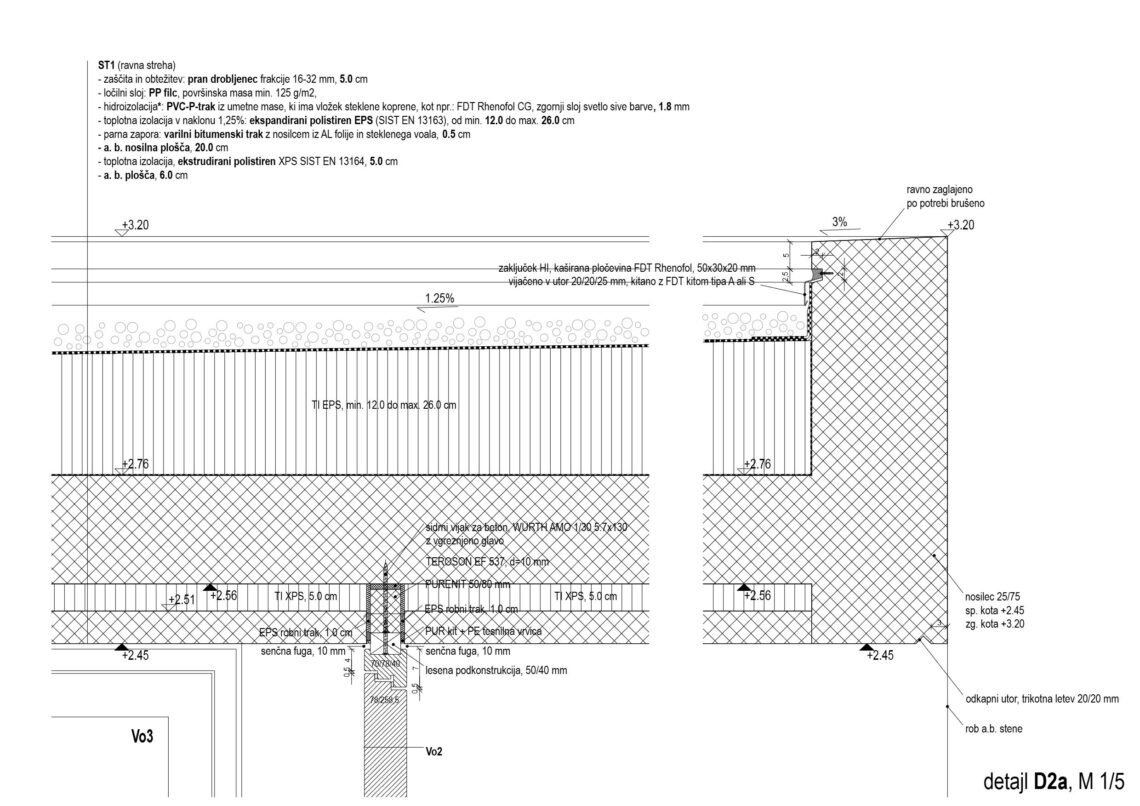
The shadow gap—especially in the articulation of joints between elements of different materiality. I am interested in how edges meet, how imperfections are resolved, and how transitions are controlled. Recently, I have also become increasingly engaged with the detailing of roof drainage systems—gutters, water management, and the quiet precision they require.
Do you have a favorite material?
Wood and concrete. One is firm, cool, and velvety; the other is warm, soft, and fragrant. Their apparent contradictions—and the dialogue between them—fascinate me.
What is your process for starting a new project?
The process always begins with a site visit—this is essential. To understand a place physically, atmospherically, and contextually is the foundation of any meaningful architectural response. From there, I focus on building a close relationship with the client. I try to understand them deeply, to connect on a personal level—almost to become a friend.
Trust is fundamental. Only through trust can architecture transcend the mere execution of a program or a list of requirements. Architecture must be approached as a total work of art. If it does not aspire to that level—if it remains only a response to function—then it ceases to be architecture in its truest sense.
How do you fuel your creativity?
Through distance and contrast. I seek inspiration in nature, in moments of disconnection, and in perspectives that exist outside conventional frameworks. Music—often unconventional, even disruptive—plays an important role, as do films and other forms of art.
Equally important is the direct experience of architecture itself. Visiting and inhabiting well-conceived spaces is irreplaceable. Architecture must be felt in reality, not only understood intellectually.
What inspired the House on the Edge of the Plain?
House on the Edge of the Plain emerged from a series of dualities. On one side, the condition of suburbia; on the other, the latent presence of urbanity. It also draws from the legacy of mid-20th-century modernist experiments in Murska Sobota, as well as the refined, low-rise pavilion typologies of high-quality residential architecture from the 1970s.
Another layer of inspiration comes directly from the ground itself—the gravel of the Mura River, which lies just beneath the surface. It is a material that is already there, waiting to be uncovered, excavated, and transformed—mixed with water and cement into something both elemental and architectural. The project, in this sense, is rooted as much in material memory as in spatial intention.


How did materiality shape the House on the Edge of the Plain?
Materiality was not applied to the House on the Edge of the Plain —it generated it. The spatial concept is organised around three reinforced-concrete cores that simultaneously act as structure and infrastructure, allowing the plan to remain open, adaptable, and free. Programmatically, the living and sleeping areas are oriented toward different gardens, while a liberated glass corner and a disappearing sliding façade dissolve the boundary between interior and exterior. In this way, construction is not concealed but articulated—its tectonic logic becomes the primary spatial and experiential driver.
On a material level, the project deliberately replaces refinement with depth. Exposed concrete, composed of local river gravel from the nearby Mura, carries within it traces of origin, reuse, and imperfection. It is a material that speaks of process and time rather than finish. This approach embeds a quiet, inherent sustainability into the building—one that does not rely on technological expression, but on continuity with place and resource.
The architecture resists neutrality. It is not smooth or polished, but textured, tactile, and temporal—open to aging, to weathering, and to occupation. Materiality, in this sense, does not merely define the appearance of the house; it shapes its atmosphere, its presence, and its relationship to both landscape and inhabitation.


What advice would you give to young architects?
Architecture requires a strong personal drive, perseverance, and the ability to persuade with subtlety—to guide and educate the client with care and conviction. It is realized through a holistic approach, where every aspect of the project is considered as part of a unified whole.
If you do not believe in this, it is better to choose another profession—you will likely be happier. But if you do, then architecture is one of the most rewarding disciplines imaginable.

