

Bhakti V. Loonawat and Suyash Sawant are Indian architects, designers, and co-founders of Anomalia Studio LLP, a Mumbai-based interdisciplinary practice established in 2022, working across architecture, material research, fabrication, and regenerative design. Positioned at the intersection of architecture, biotechnology, and circular material systems, the studio investigates how bio-based materials can reshape the future of construction through research-driven spatial experiments, installations, furniture, and architectural systems. Their work includes MycoMuseum, presented at the 19th International Architecture Exhibition of La Biennale di Venezia in 2025, and Grown Not Built: Wall of Public Life for the 5th Seoul Biennale of Architecture and Urbanism, developed in collaboration with Indonesian biomaterial innovators MYCL. Through projects exploring mycelium composites, agricultural waste, modular fabrication, and low-impact construction systems, Anomalia advances an architectural practice grounded in ecological responsibility, material intelligence, and cross-disciplinary collaboration.
What inspired you to become an architect?
What inspired us to become architects was the understanding that buildings are never just objects. They are intricate systems of structure, material, light, air, and movement, but they are also ecosystems that hold and nurture life. Architecture gave us a way to work between people and the planet, to create built environments that are meaningful, responsible, and deeply connected to the world around them.
How would you describe your design philosophy?
Our design philosophy is rooted in consciousness and balance. Every project sits within a larger ecosystem of people, place, material, environment, economy, and time. As designers, our role is to understand these different forces and respond with clarity, care, and responsibility.
For us, design is a tool to bridge disciplines and bring together architecture, material research, ecology, craft, technology, and community. We see every project as a collaboration between context, people, and possibility, where the outcome must feel meaningful, grounded, and connected to its surroundings.
What is your favorite project?
Our favourite project is “Grown Not Built: Wall of Public Life,” which we presented at the 5th Seoul Biennale of Architecture and Urbanism.
It is special to us for many reasons. Walls of Public Life was the first time we tested our mycelium composite blocks outdoors, in real public conditions, through heavy rain, storms, humidity, and constant human interaction. Until then, a lot of our work with mycelium had existed between research, prototypes, and controlled exhibition environments. Seoul Biennale made us believe that this material system could move beyond experimentation and begin to scale globally.
The project was also a beautiful act of collaboration. It was designed in Mumbai, India, grown in Bandung, Indonesia, and executed in Seoul, South Korea. Three geographies, many hands, and one shared spirit. That journey itself reflected the future we imagine for bio-based design, where knowledge, material innovation, and local making can come together across borders.


What made it even more meaningful was the opportunity to work and interact with Thomas Heatherwick and his team, who directed the Biennale. Their larger vision for a more human approach to architecture deeply resonated with our own work.
The most powerful part was that this was not a closed design event. The wall was placed in the public realm, open to the people of Seoul. Watching people touch it, walk around it, ask questions, smile, pause, and interact with a grown material was unforgettable. For us, that moment captured what architecture can do. It can create curiosity, connection, and wonder, while quietly opening up new possibilities for a more sustainable future.
Do you have a favorite material?
Our favourite material is not a single material, but the consciousness with which a material is chosen and used.
Every material came into existence as a response to a need. Some materials are shaped by technology, some by geography, some by culture, and some by local availability. A material that is appropriate in one context may not be responsible in another.
For us, the question is not whether one material is good or bad. The question is how aware we are of its source, its life cycle, its performance, its environmental impact, and the way it is consumed. When used with care and intelligence, every material has its own efficiency, purpose, and beauty.
That is what makes material research so important to our practice. It allows us to make more conscious choices, whether we are working with mycelium, waste, stone, metal, wood, earth, or newer bio-based systems. The responsibility lies not only in the material itself, but in how we design with it.
What is your favorite detail?
Our favourite details are often the simplest ones, the kind that quietly solve many problems at once.
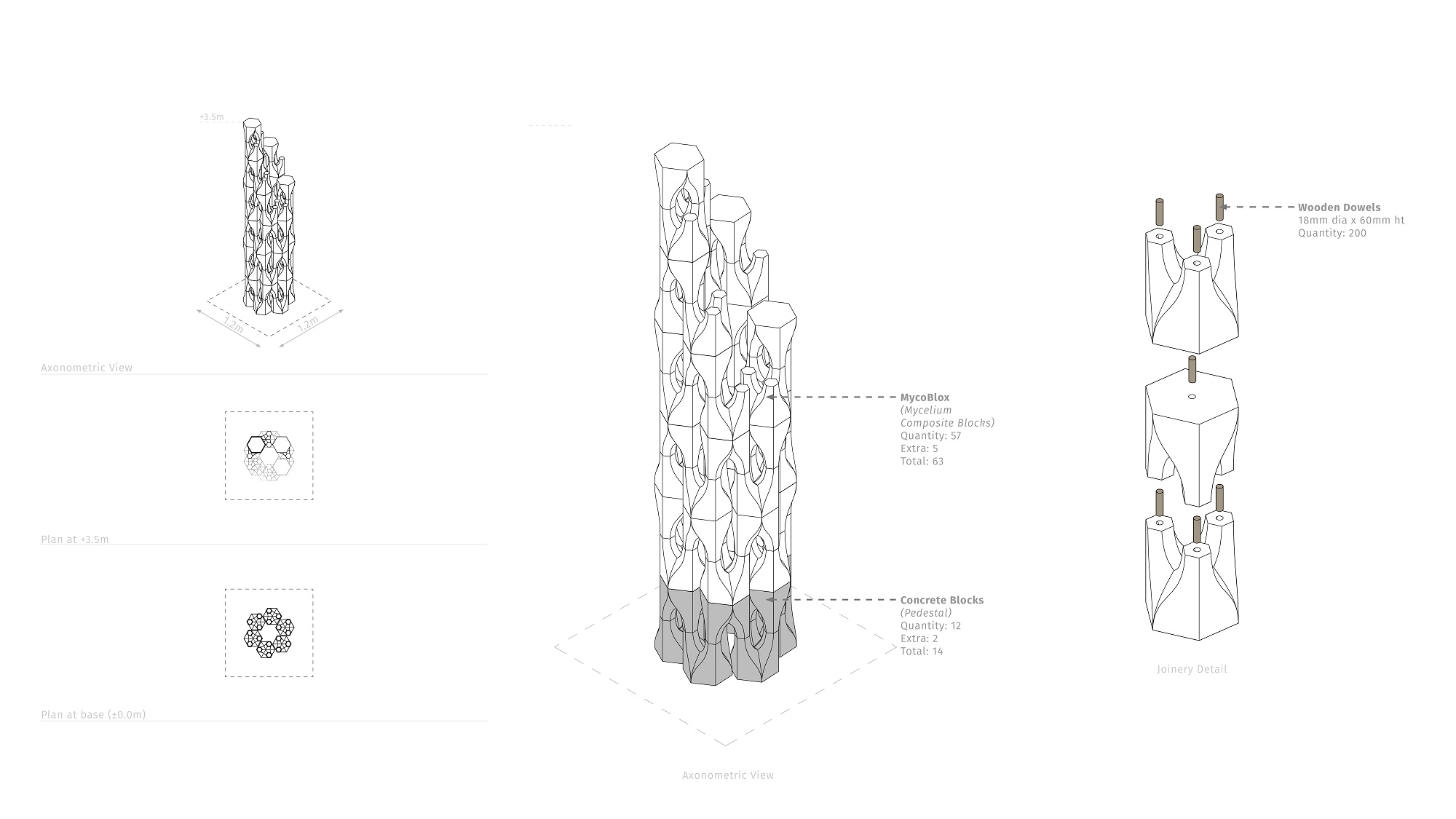
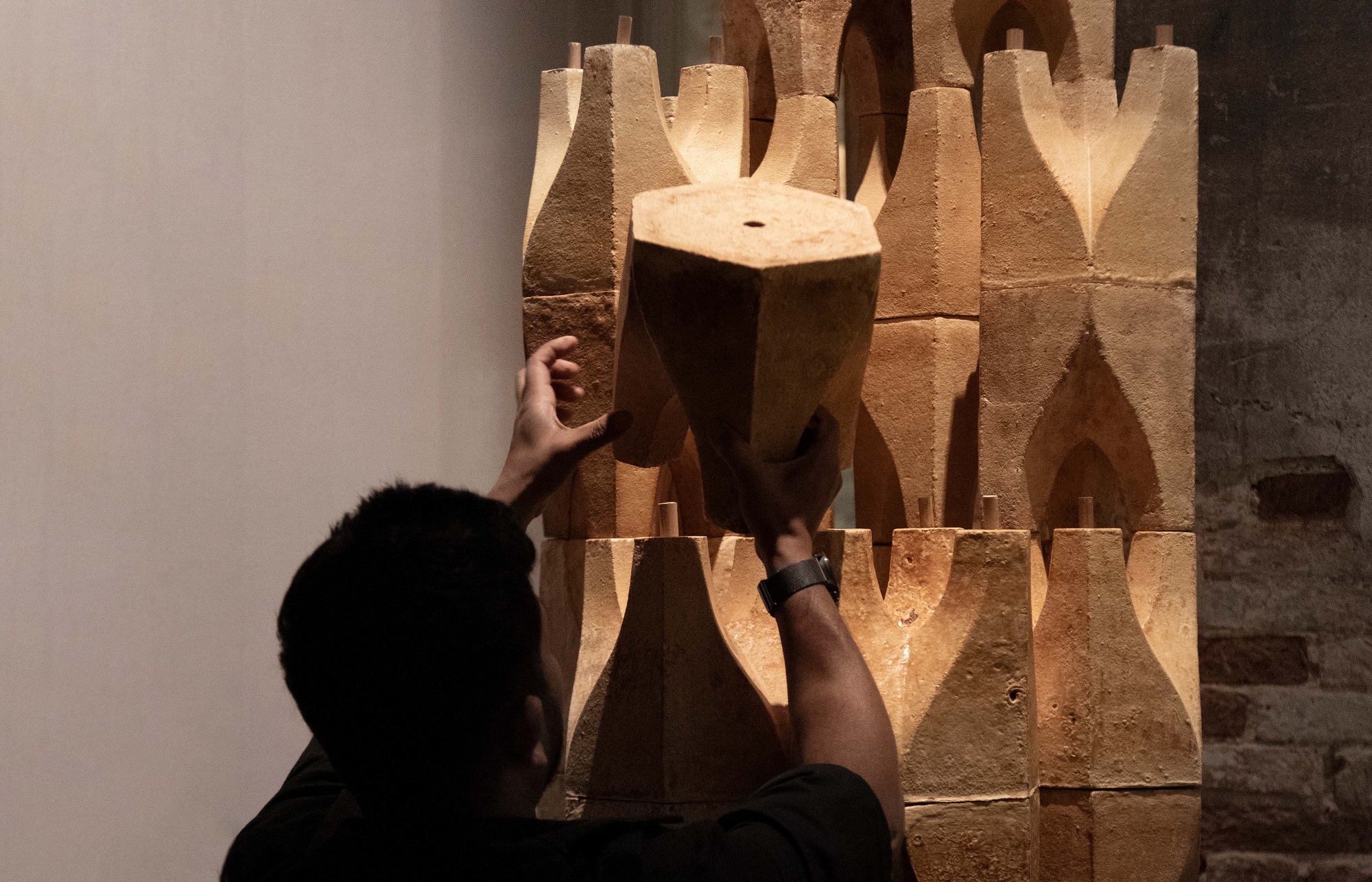
A good example is the fixing system for MycoBlox. The blocks interlock using simple wooden dowels, allowing them to come together as stable architectural elements without overcomplicating the assembly. It is a small detail, but it carries a lot of intelligence. It makes the system easy to assemble, disassemble, repair, transport, and replicate.
This detail has also allowed us to execute projects remotely across geographies, because the logic is clear and intuitive. The same principle extends from our walls to our furniture, from a large architectural installation to a stool.
For us, that is what makes a detail successful. It is simple, effective, scalable, and honest. It works because it understands the material, the maker, and the context.
What is your process for starting a new project?
Our process always begins with why, before we get to how.
We first try to understand the purpose of the project, the people it is meant for, the context it belongs to, and the time it will live in. Every project has its own reason for existing, and that reason becomes the starting point for us.
We usually begin with possibilities, questions, and the most radical ideas. At that stage, we allow the project to be open, ambitious, and slightly uncomfortable. Then, through research, dialogue, constraints, material thinking, budgets, and execution realities, those ideas are slowly refined into something clear, buildable, and meaningful.
It is a constant movement between imagination and responsibility. The strongest projects are often the ones where the original intent remains intact, even after passing through all the practical layers of design and making.
How do you fuel your creativity?
Through travel, curiosity, and direct engagement with people.
Travel opens up new ways of seeing through different cultures, materials, climates, building traditions, and ways of living. Taking our work to platforms like the Venice Biennale and the Seoul Biennale allowed us to interact with people globally and understand how our ideas can belong to a larger conversation.
A lot of our creativity also comes from material exploration. We are constantly intrigued by bio-based materials, how they grow, behave, and respond to their environment. Foraging, observing, testing, and studying these materials does not just fuel our creativity; it informs it.
What inspired the MycoMuseum?
Mycelium is the root network of mushrooms, grown from fungi, and for us, it opened up an entirely new way of thinking about design. We were interested in how it could move across scales, from one MycoBlox block to architectural systems, textiles, furniture, public installations, education, and future material research.
The idea behind MycoMuseum was to imagine a global collaborative platform around fungi and bio-based design. A place where designers, scientists, architects, students, makers, and communities could come together to explore how living materials can shape the future of the built environment.
It was also our way of bridging the gap between design, technology, and real-world application. We did not want the project to remain only as an experimental block or an exhibition object. We wanted it to suggest a larger ecosystem, where research can become architecture, material innovation can meet everyday use, and fungi can help us rethink how we build, make, and live.


How do you see mycelium shaping architecture?
The material has already moved far beyond early experimentation. Mycelium composites can now take many forms, from hard blocks and bricks to soft acoustic panels, surfaces, textiles, and insulation systems. This versatility is what makes it exciting for architecture. It is not a material with only one application. It can behave differently depending on how it is grown, processed, and combined with other materials.
We believe the future of mycelium in architecture will be hybrid. It may not always replace conventional materials entirely, but it can work alongside them in intelligent ways, as wall systems, facade elements, interiors, acoustic surfaces, furniture, temporary structures, and circular building components. More importantly, we see mycelium being used not just as isolated products, but as larger systems that connect waste, growth, construction, use, and return.
There are already powerful examples of this thinking, such as mycelium-based waterless toilet systems like the MycoToilet developed at the University of British Columbia, where fungi and mycelium help break down human waste into compost and liquid fertiliser without relying on water, chemicals, or electricity. For us, this shows that mycelium is not only a material for making objects. It can become part of infrastructure, ecology, and everyday life.
In architecture, that is where its real potential lies. Mycelium allows us to imagine buildings and systems that are lighter, more local, more circular, and more connected to natural processes. It shifts the role of architecture from simply consuming materials to participating in regenerative cycles.
What advice would you give to young architects?
Architecture is changing, and so is the role of the architect. The way we build, the materials we use, the systems we depend on, and the people we collaborate with are all evolving.
Young architects should stay open and work across disciplines. Engage with scientists, construction teams, policymakers, developers, finance institutions, material innovators, and operations-led businesses. Each of them reveals a different part of the ecosystem that architecture exists within.
The more you step outside the conventional boundaries of the profession, the more clearly you understand how design can create real impact. Architecture today is not only about designing buildings. It is about understanding systems, asking better questions, and finding meaningful ways to shape the future.

