
Donatien Dalous is a French architect and environmental engineer leading PDA Architecture, a Paris-based practice founded in 2002 and focused on the rehabilitation, transformation, and adaptive reuse of existing buildings. Educated in environmental engineering in Rennes and architecture at the École Nationale Supérieure d’Architecture de Versailles, Dalous developed his approach through a long collaboration with founder Pascal Dalous, combining architectural design, technical expertise, and environmental performance. Working across office, residential, hospitality, industrial, and mixed-use projects, the practice explores how existing structures can be extended and reimagined through low-carbon strategies, energy optimization, and long-term adaptability. Recent works include Virtuose, a 6,500-square-meter Haussmannian office building in Paris, alongside a growing portfolio of workplace and building rehabilitation projects that reflect the studio’s commitment to sustainability, architectural continuity, and the careful transformation of the built environment.
What inspires you?
The fact that we have reached a stage where a great deal has already been built, and we will have to work with what exists. Today, we have a rather different starting point: we are faced with an existing real estate stock that is not necessarily suited to new uses. Our challenge as architects is how we reinterpret these buildings, how we adapt them, how we enhance them, and how we collectively come to accept the wear of things. It is this complexity that led me to work with a raw material that is almost living, and all the questions it raises.
What inspired you to become an architect?
I am the son of an architect. It was my father who inspired me, through travel, through his open-mindedness, and the path he showed me. I first took a different route and became an engineer in eco-construction, because I had strong environmental convictions.
Parisian architecture and architecture in the Île-de-France region is a territory where an enormous amount has already been built. So how do you preserve open spaces? How do you contribute to the field in ways other than building new structures? That’s what got me thinking, showed me there was a role to play, that I needed to get involved.
How would you describe your design philosophy?
It is a collection of sensations, what you feel when you enter a building, the perception of volumes and spaces, the life that has passed through those places. All of this constitutes an initial set of raw materials to consider.
Then there is the relationship to materials—a fairly raw approach, a form of minimalism. Alongside that, there is the entire technical reality: the structure, the construction principles, safety requirements.
It is the meeting point between this sensibility and these technical constraints that produces something interesting: an architecture that is more discreet and lighter than building from new.
What is your favorite project?
Virtuose. It’s a building that has lived several lives, and what I admire most about it is its resilience. It was built with the constructive quality of its era: solid, generous, and made to last. Over the decades it absorbed heavy transformations, including the insertion of an underground car park at the end of the 20th century, an intervention that tells you a lot about the priorities of that time.
What matters most to me is the distance between that period and the way we work today. Our approach now is one of care, of looking after what is already there. A few years ago this wasn’t really on the agenda; the instinct was to transform, to add, and sometimes to erase.
Today, care has changed our understanding of what deserves to be protected. On Virtuose, our role was to intervene with restraint. To repair and reveal rather than to impose. The focus lies on natural light, shared spaces, and durable, bio-sourced materials, so the building can keep adapting to whoever uses it next.
To me, that is a beautiful lesson in architecture.
What is your favorite detail?
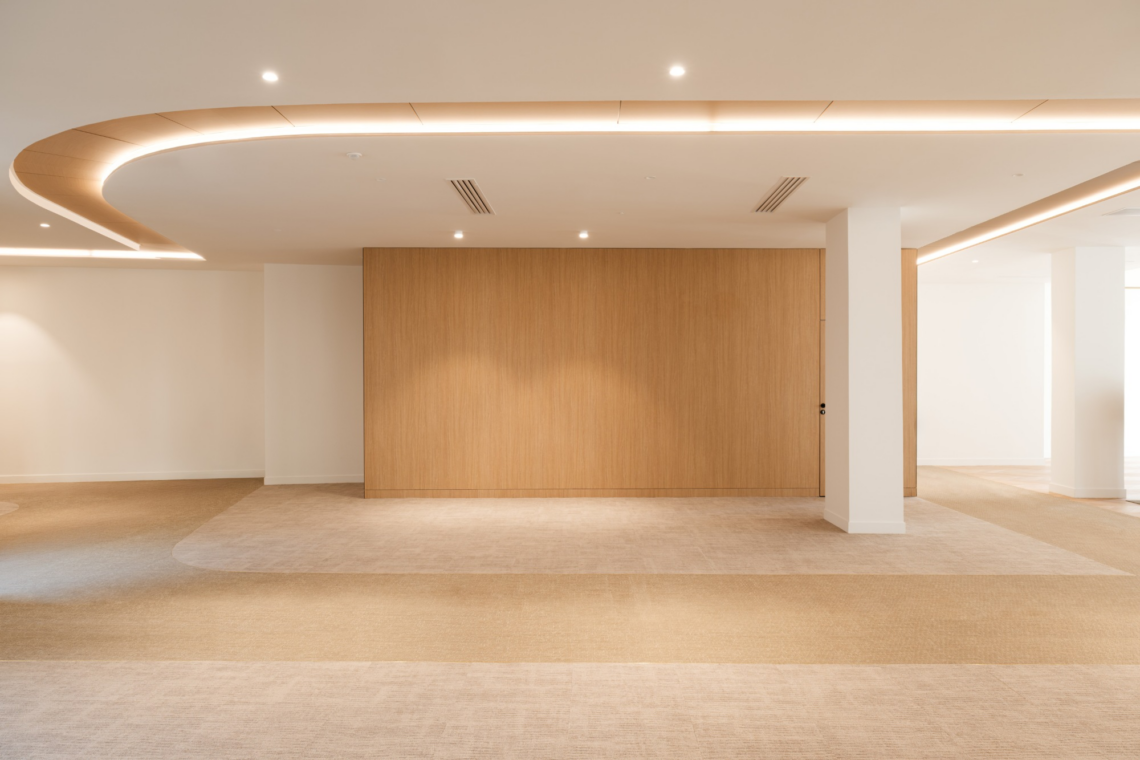
The thread of light that runs through all the common areas in Virtuose, together with the wooden panels marking the access to lifts, toilets, and waiting areas.
The idea is that the joints become invisible and the technical elements disappear. How materials work together, and how architecture conceals the technology.
Do you have a favorite material?
I would say it is the material of tomorrow.
There are many manufacturers, small businesses, and large industrial groups reinventing things: using fewer materials derived from natural resources and more materials from recycling, from products that have already had a life.
I love the idea of a building filled with second lives.
We also have strong convictions about the use of metal, which I find very problematic for the planet. What we are after is economizing the material, just as with energy: what you do not use is what you save the most.
Do less, to generally achieve more.
What is your process for starting a new project?
First, understand what the previous architect did, analyze their choices, learn to read the building.
At the agency, we never speak negatively about a building. We highlight what is beautiful, then identify what can be improved in terms of energy, technology, and alignment with today’s uses.
The goal is to be a passing architect: preserve the soul of the building, the original architectural gesture, so that a future architect can in turn continue its journey.
A successful project for us is one where, in a few years, that architect will see that we accompanied the building well and can carry on in the same spirit.
How do you nurture your creativity?
I have the good fortune of having a background as an eco-construction engineer, which encourages me to ask myself what more we could do: how to push the limits without over-promising, without committing to overly ambitious ideas that would not obtain everyone’s approval.
On Virtuose, for example, we integrated bioclimatic devices to manage heat waves.
But there is also a certain philosophy at the agency: we focus more on the content than the container. A successful project is one where the people inside feel good, and the architecture then becomes secondary.
It is this way of stepping back from the architect’s own work that I believe releases a great deal of creativity.
What mattered the most from the existing site in Virtuose?
At the start, we were able to interview people who had lived in the building. The unused courtyard, the almost nonexistent connection to the outside, very closed-off floors that did not encourage interaction, a basement used only once a year.
From these observations, we asked ourselves how to amplify things: acoustic treatments, creating green areas, water mist for heat peaks, and above all a canopy that encloses the building to retain a pocket of cool air.
We responded to usage problems with architectural solutions, while integrating a very heavy technical package without undermining the agency’s low-tech vision.


What do you find most limiting in adaptive reuse today?
We are lucky to have limitations.
A few years ago, we did not even have solutions. Today supply chains are being developed, but much remains to be done: the range of available materials, recycling networks are still incomplete, the expectations of users accustomed to new construction.
When I started out, environmental concerns were not at the heart of projects; today they are the cornerstone.
Every year we push the limits a little further. The momentum is very positive, even though there is a technical, financial, and economic inertia that we see everywhere.
What advice would you give to young architects?
Learn to build, learn to renovate, learn to listen to all those experts who will give you constraints so that, in the end, it is you who shapes the project.
You do not learn everything at school. The technical side comes mostly afterwards.
You have to be open to the fact that you are working in a highly technical environment with an artistic vision, and learn to combine the two to deliver a project collectively.

