

In Hong Kong, a city that once wore more neon than any other place on Earth, the lights are going out one rooftop at a time. The Buildings Department counted some 120,000 illuminated signboards in 2011; by the time a small preservation group called Tetra Neon Exchange finished a rough survey a decade later, fewer than 400 true neon signs were still standing. Most were never demolished by choice. They were taken down for want of a license, replaced by LED panels that mimic their glow at a fraction of the running cost, or simply left to flicker out, unrepaired, because the men who could bend glass into Cantonese characters were retiring faster than anyone was training their replacements.
In New York, four thousand miles to the east, the opposite problem exists by law. Since 1987, the zoning code governing Seventh Avenue and Broadway between 42nd and 47th Streets has required new buildings to carry large illuminated signs — not permitted them, required them. Times Square is the only district in the city where a dark, unlit facade is technically a code violation. A building there is obligated to glow.
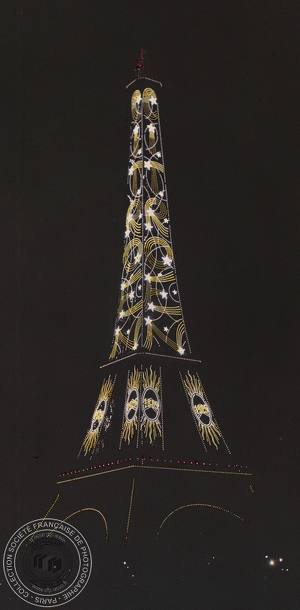
Between those two facts sits the whole strange career of neon: a French laboratory curiosity that became, for the better part of a century, one of the only building materials ever to be simultaneously outlawed and legislated into existence. It has been called vulgar, cheap, and seedy. It has also been called architecture.The Eiffel Tower under Citroën’s electric lettering, photographed by Léon Gimpel on the night of the display’s debut
I. Paris, December 1910
Neon itself was not invented; it was found. In 1898 the British chemist William Ramsay and his assistant Morris Travers, working through the residue left after liquefying air, isolated a gas so unreactive and so rare that they named it after the Greek word for “new” — neos. It did nothing in particular. It simply glowed, faintly, if you ran electricity through it.
The man who turned that curiosity into an industry was Georges Claude, a French chemist and engineer who had already made a fortune liquefying air for industrial use through the company he co-founded, Air Liquide. Neon was, in effect, a byproduct of his own business — gas left over from separating the atmosphere into its component parts. Claude’s contribution was not the gas but the tube: a sealed glass vessel, purged of contaminants, fitted with electrodes that would not corrode under sustained use. He filed his first patent in March 1910 and unveiled the result that December, lighting two thirty-eight-foot tubes of glowing red-orange gas along the colonnade of the Grand Palais for the Paris Motor Show. It was less a sign than a demonstration — proof that electrified gas could outline a building in a continuous, unbroken line of color, something neither incandescent bulbs nor gas lamps had ever quite managed. That capacity to be bent to order — into a name, a silhouette, a single unbroken signature of light — is what would soon make custom neon signs possible at all, the moment commercial lettering stopped being painted onto a surface and started being drawn directly in glowing gas.
The physics is almost embarrassingly simple, which is part of why it endures. Seal a noble gas inside a glass tube at low pressure, run several thousand volts through it, and the gas ionizes into a thread of glowing plasma. Pure neon burns red-orange. Argon burns a pale lavender-blue, and if you add a drop of mercury to the argon, the tube emits ultraviolet light that excites a phosphor coating on the glass — which is how a neon sign turns green, blue, gold, or white, despite containing no neon at all. This is worth pausing on, because it is the detail most often lost in the romance: the great majority of what people call “neon,” in any color but red, is technically something else — argon doing the work, neon getting the credit. The name became the genre.
Discovered and not developed.Christoph Ribbat, “Flickering Light: A History of Neon”
II. A Legend Outgrows Its Facts
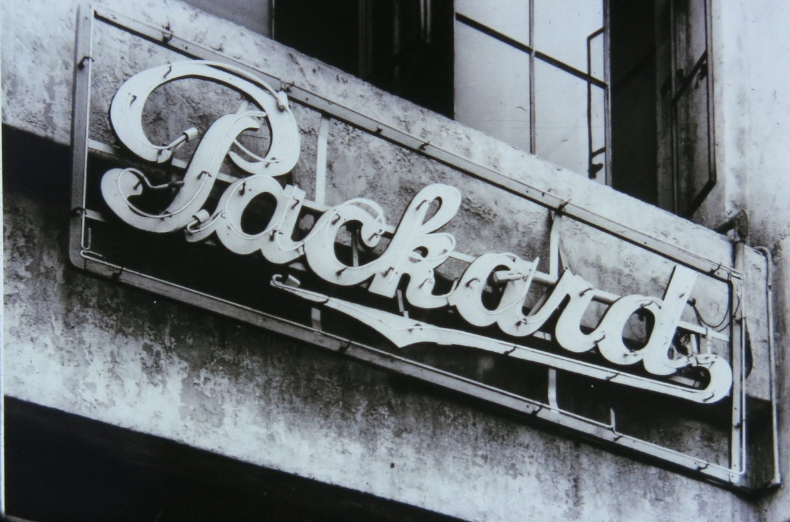
The gas crossed the Atlantic quickly. Claude licensed his patents through a company called Claude Neon, and the story most often told about its American arrival involves a Los Angeles Packard dealer named Earle C. Anthony, who supposedly bought two signs reading “PACKARD” in 1923 and watched traffic stop in the street to look at them.
It is a wonderful story, and large parts of it appear to be invented. The price varies wildly by source — $1,250 per sign in some accounts, $24,000 for the pair in others. The date drifts between 1922 and 1923. The historians Dydia DeLyser and Paul Greenstein, who spent years researching the period for their book Neon: A Light History, went looking for photographic evidence of the famous signs at their famous intersection and found none; they have called the 1923 traffic-stopping legend “a total red herring,” and suggested that neon-filled tubes may have been advertising the Ingersoll Watch Company as early as 1909. What can be said with confidence is narrower and less cinematic: Anthony’s Packard signs were among the earliest and most visible commercial neon installations in the United States, and they helped touch off a genuine boom. By 1924 a neon sign for Willys-Overland automobiles had reached Times Square. By 1940, according to the neon historian Rudi Stern, nearly every downtown in America was lit by it, and some two thousand shops nationwide existed solely to design and fabricate the tubes.
The discrepancy matters for reasons beyond pedantry. It is a small, useful lesson in how architectural folklore gets made — a vivid anecdote repeats often enough, in enough trade magazines and tourist brochures, that its precise numbers stop being checked and start being inherited. Neon’s whole history is full of these inherited numbers. They are worth treating with the same skepticism the gas itself deserves.
III. The Machine Age, Outlined in Light
What is not in dispute is how quickly neon found its architectural moment. The 1920s and ’30s were the decades of the Machine Age — of streamlined trains, transatlantic liners, and skyscrapers that wanted to look like they were already moving — and neon, a medium made of pure electrified line, fit that aesthetic with almost suspicious precision. Art Deco buildings were designed in setbacks, chevrons, and sunbursts; neon could trace every one of those forms in continuous color, turning ornament into something that glowed after dark as well as it photographed by day.
The single largest gesture of the era was not, strictly speaking, neon at all, but it set the template. In 1925, for the Paris exposition that gave Art Deco its name, the automaker André Citroën hired the engineer Fernand Jacopozzi to spell his company’s name down the side of the Eiffel Tower in some quarter-million electric bulbs, in letters over a hundred feet tall, visible from sixty miles away. Charles Lindbergh is said to have used it to navigate toward Le Bourget airfield in 1927. The tower had become, for nine years, an advertisement with a building hidden inside it — the inverse relationship between sign and structure that neon would later make literal.
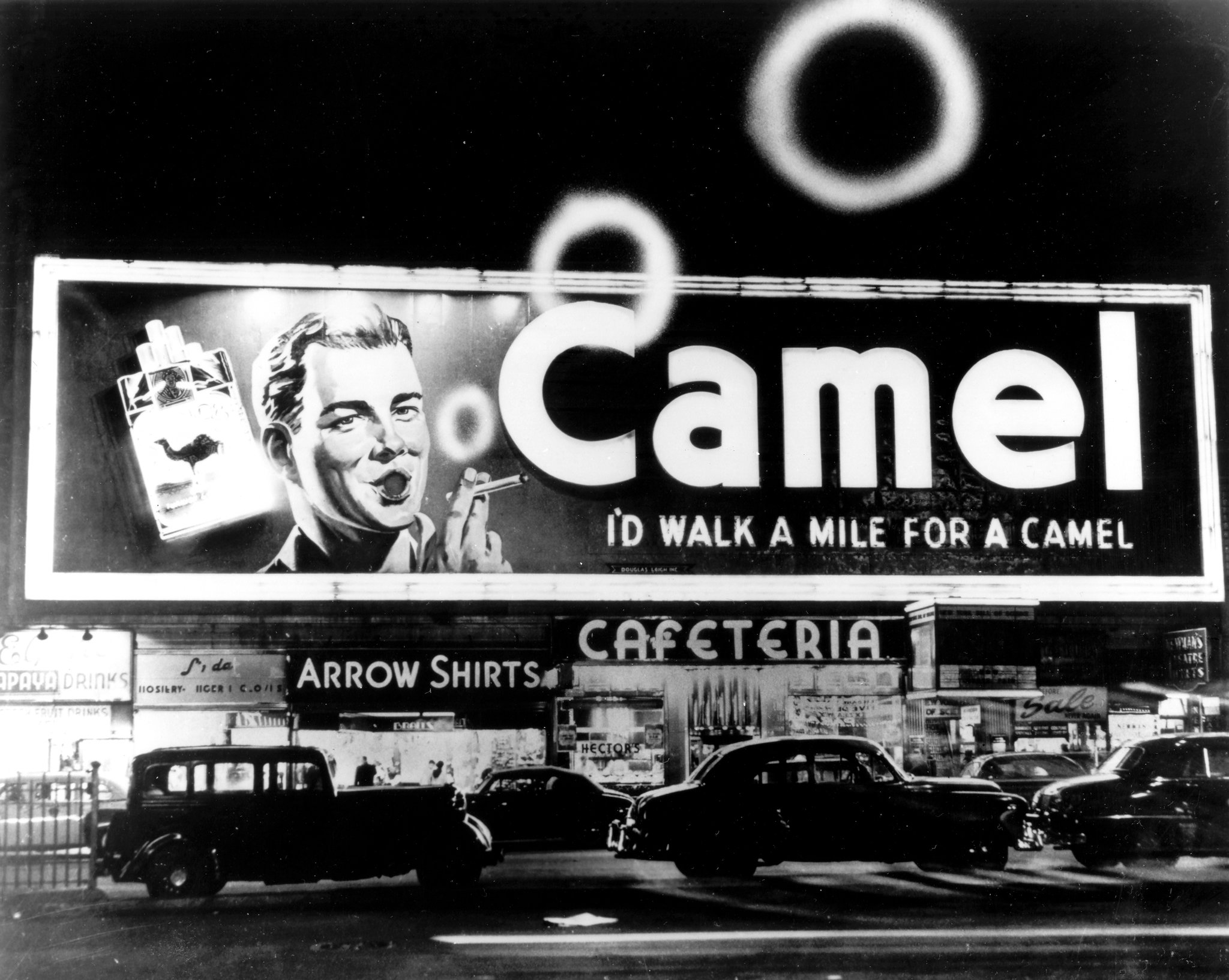
In American cities, neon did the more modest work of making buildings legible at night. Theater marquees got the most dramatic treatment: the Pomona Fox Theatre, which opened outside Los Angeles in 1931, carried three eighty-foot Art Deco letters outlined in alternating red and blue neon, visible for miles down the boulevard. In New York, the showman Douglas Leigh — nicknamed the Sign King of Times Square — spent the 1930s and ’40s building “spectaculars” that treated the whole square as a single illuminated room: the first animated electric sign, in 1937, and a Camel cigarettes billboard, from 1942, that blew real smoke rings out over Broadway. The architecture underneath these signs was, by comparison, almost incidental. The light was the point.A Times Square “spectacular” of the Douglas Leigh era — the marquee as a building-sized advertisement.
IV. The Strip
If neon had an architectural endpoint, it was the Mojave Desert. The Young Electric Sign Company — YESCO — was founded in Ogden, Utah, in 1920 and began working in Las Vegas in 1932, a year after Nevada legalized gambling. The first neon sign in the city is generally credited to the Overland Hotel, around 1928, but it was the postwar decades that turned neon from decoration into the only architecture that mattered.
Consider Vegas Vic. In 1951, YESCO erected a forty-foot neon cowboy above the Pioneer Club on Fremont Street — designer Pat Denner’s update of an older mascot, built with chief designer Ben Jones using roughly a third of a mile of glass tubing. Vic waved his arm, flicked a lit cigarette, and called out “Howdy Podner!” on a quarter-hour timer. He was not advertising a product so much as performing a welcome, and for years he was the most recognizable thing on the street, more recognizable than the casino he stood on.
Seven years later, YESCO designer Kermit Wayne wrapped the entire 216-foot front of the Stardust Hotel in a single sign — a solar system rendered in neon and incandescent bulbs, lettered in a space-age font, advertised at the time as the largest electric sign in the world. In 1968 the rival firm Ad-Art added Paul Miller’s 188-foot pylon of pastel starbursts beside it.
The sign was the building.Danielle Kelly, former director, The Neon Museum, on the Stardust
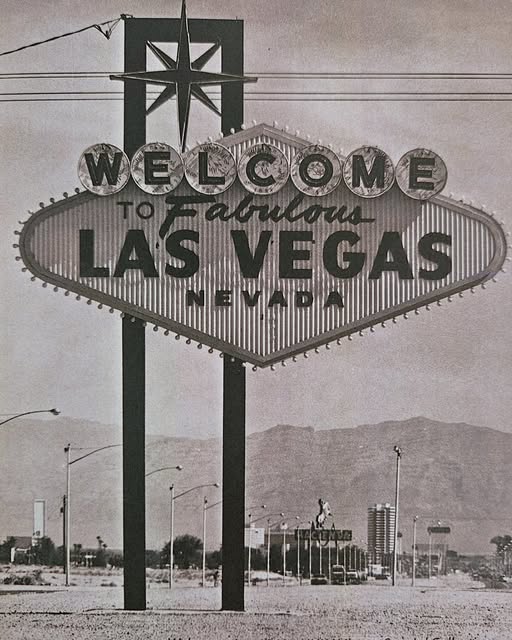
The most famous sign on the Strip is also its most modest. In 1959, a designer named Betty Willis — one of the few women working in a trade dominated by men — drew the diamond-shaped “Welcome to Fabulous Las Vegas” sign for about four thousand dollars. She never copyrighted it. She considered it a gift to the city, which is the only reason it now appears on every postcard, T-shirt, and bumper sticker sold within a hundred miles of it without anyone owing anyone a licensing fee.
It took architectural theory a little longer to catch up with the street. In 1968, Robert Venturi and Denise Scott Brown brought a studio of Yale students to study the Strip the way earlier generations of architects had studied Rome, photographing signs with the same seriousness usually reserved for cornices. The resulting book, written with Steven Izenour and published in 1972 as Learning from Las Vegas, gave architecture a new vocabulary: the “duck,” a building shaped like its own symbol, versus the “decorated shed,” an ordinary shed made meaningful entirely by what is hung on its surface. On the Strip, they argued, the sign had stopped decorating the building and started doing the building’s job. Tom Wolfe, writing around the same time, made the same observation with less theory and more relish, suggesting that Las Vegas was the first city on Earth whose skyline was made of neither stone nor trees but of signs — animated, oscillating forms that the existing language of art history had no good words for yet.
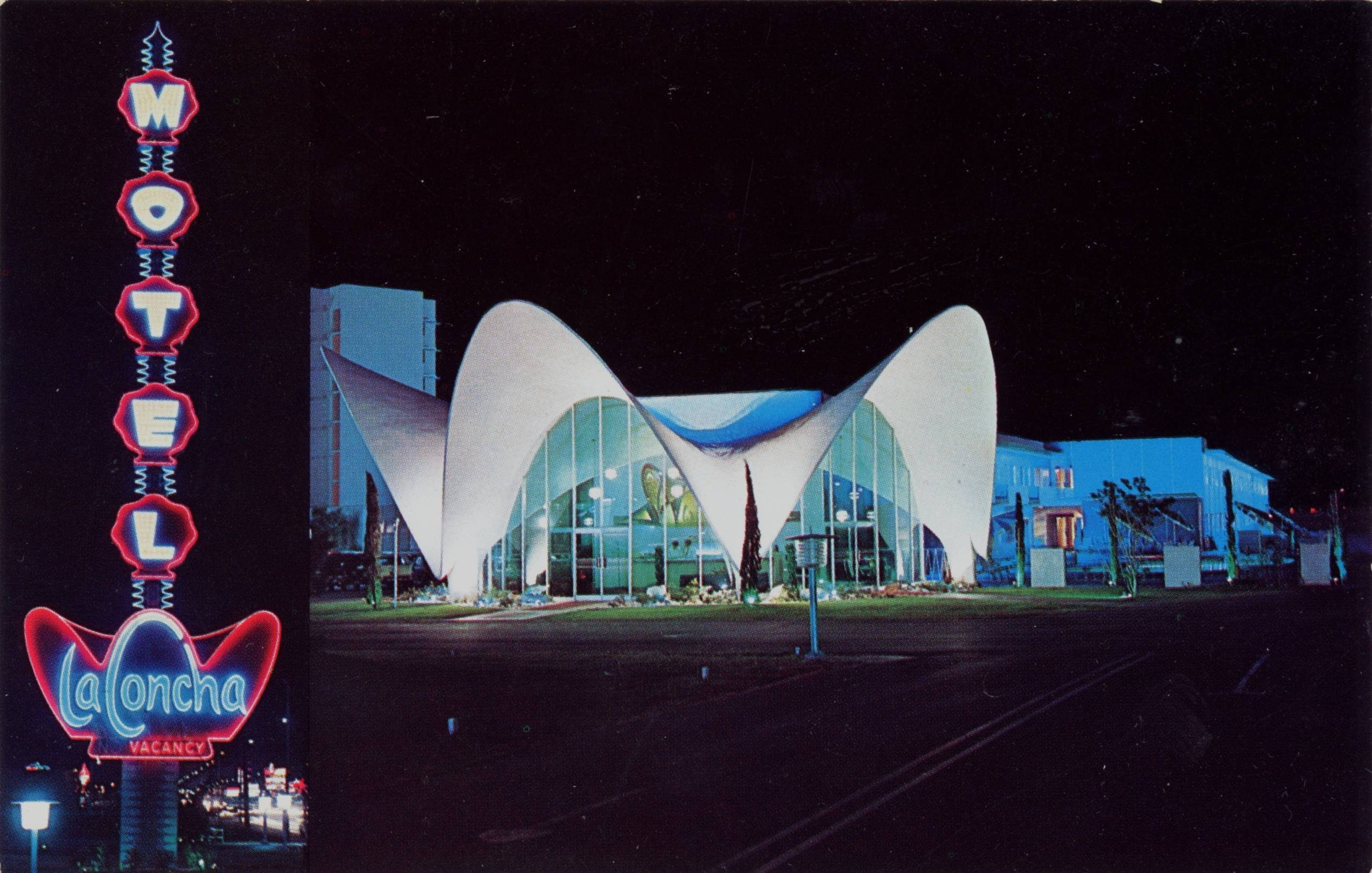
Some of those forms survive only because someone decided, against the ordinary economics of demolition, that they were worth keeping. The Neon Museum, a nonprofit founded in 1996, finally opened its outdoor collection — the “Neon Boneyard” — to the public in 2012, with a visitors’ center built inside the rescued lobby of the La Concha Motel. That shell-shaped 1961 building was designed by Paul Revere Williams, the first Black member and later the first Black fellow of the American Institute of Architects; faced with demolition in 2006, it was cut into eight pieces, trucked three miles down the Strip, and reassembled as a museum entrance. The museum’s yard now holds more than 250 signs, including the Hacienda’s neon horse and rider, restored in 1996 in what was effectively the institution’s founding act, and the rescued lettering of the Stardust itself, which cost more than $150,000 to save.
V. Kowloon
Hong Kong’s relationship with neon ran on the same logic as Las Vegas’s, arrived at independently and for entirely different reasons. The city’s first neon factory opened in 1932, and by the postwar decades, neon signs — cantilevered, double-sided, stacked floor over floor up the front of narrow tenement buildings — had become what the architecture historian Cecilia Chu has described as the actual skin of the city, the visible surface that mattered more than whatever concrete sat behind it. Hong Kong’s density made this almost inevitable: there was no room to set buildings back from the street, so advertising went vertical instead, turning entire facades into glowing, layered signage in a way no Western city ever replicated at the same scale.
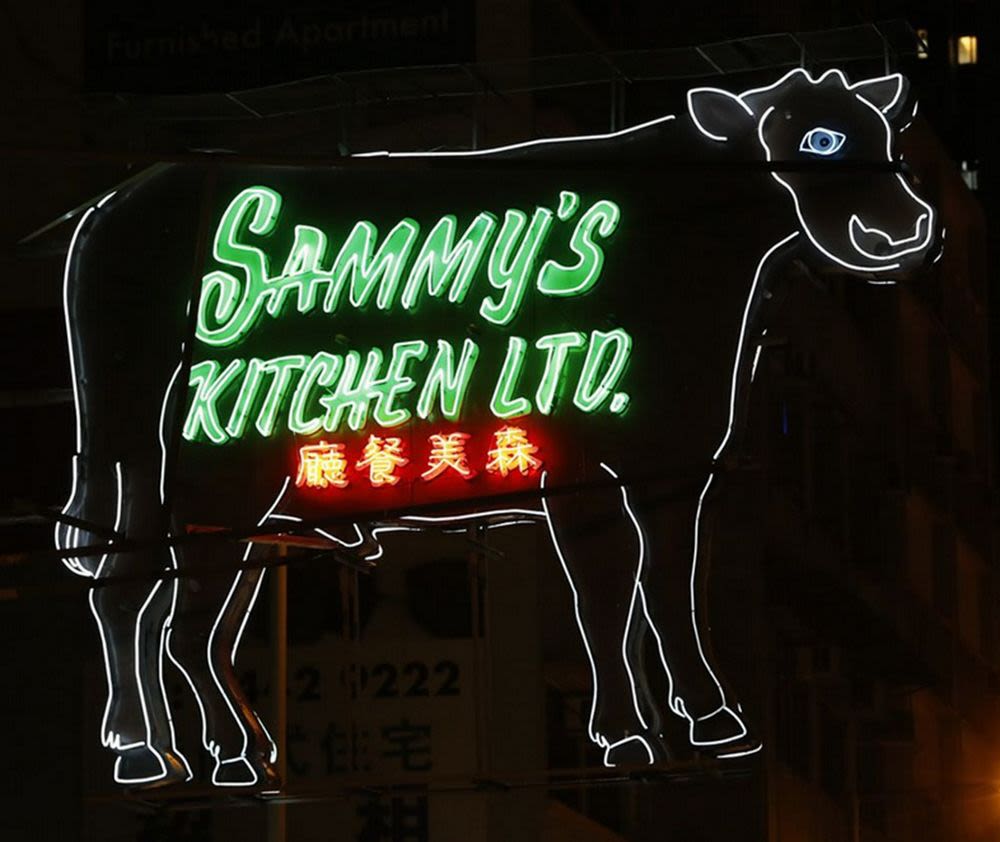
The unmaking has been just as systematic. A 2010 enforcement campaign against unauthorized projecting signboards, combined with the plain economics of LED, has pulled down sign after sign over the past decade and a half — from roughly 120,000 in 2011 to under 400 true neon installations by Tetra Neon Exchange’s 2022 count. The M+ museum began collecting them in 2013 and now holds, among other pieces, the Angus cow that hung for nearly four decades over Sammy’s Kitchen on Queen’s Road West, designed by the restaurant’s own proprietor and built by Fu Wah Neon, taken down in 2015.
Aric Chen, the curator who assembled much of that collection, has said simply that the light was inescapable in Hong Kong for as long as anyone could remember — and now it largely is escapable, which is exactly the problem. A handful of veteran benders, among them a craftsman named Wu Chi-kai, still know how to shape the glass; what they lack, increasingly, is anyone left to teach.
A few blocks of the old skyline persist by accident more than design — the Mido Café sign on Temple Street, hung around 1960, is one of the few still doing the job it was built for. Tokyo took the opposite approach to the same density problem: in Shinjuku’s Kabukichō district, signage climbs straight up the face of narrow buildings rather than spreading horizontally, stacking story over story until the architecture beneath all but disappears, an effect that has fed the West’s idea of the neon-soaked Asian megacity ever since Blade Runner.
VI. The Gallery
Neon’s other migration, parallel to its life on building facades, was into the museum. The two histories are sometimes confused, and it is worth separating them precisely. Dan Flavin, the artist most associated with glowing tubes in the public imagination, never actually worked in neon; his sculptures, including the celebrated Monument for V. Tatlin series, are made from off-the-shelf fluorescent fixtures, a different technology with a different look. The artist who actually established neon as a serious sculptural medium was Bruce Nauman, whose 1967 spiral piece The True Artist Helps the World by Revealing Mystic Truths turned a hand-bent sentence into a self-portrait of the artist as huckster and prophet at once. Tracey Emin later made a career partly out of her own handwriting in pink and blue tubing, and in February 2013 took over the giant screens of Times Square at midnight with her own neon text — the sign returning, for one month, to the exact district that had legislated its presence decades earlier, this time as art rather than advertisement.
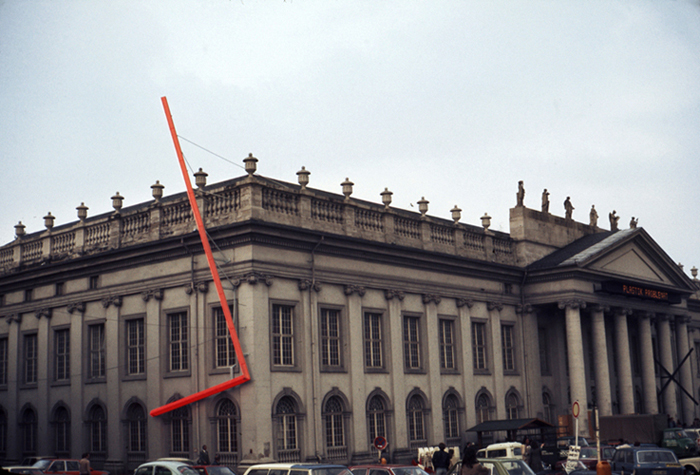
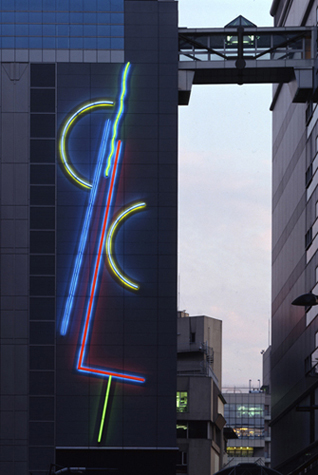
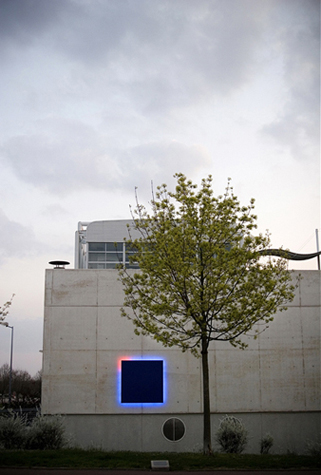
No artist treated neon as more genuinely architectural than Stephen Antonakos, a Greek-American sculptor who spent five decades building what he called “real things in real spaces” — more than fifty large neon works sited directly on buildings rather than in galleries. His incomplete neon square wrapped the facade of the Fridericianum in Kassel for documenta 6 in 1977; his Neons for the 59th Street Marine Transfer Station, completed in 1990, are still visible from the West Side Highway in Manhattan; he represented Greece at the 1997 Venice Biennale with a walk-in chapel built from iron and glowing tube.
Light and space cannot really be separated.Stephen Antonakos, sculptor
VII. The Comeback, in a Different Material
By the 1970s, neon’s glamour had curdled. What had looked futuristic in 1935 looked, by 1970, like the visual shorthand for motels nobody wanted to stay in and storefronts nobody wanted to enter — the lighting of film noir and skid row rather than the lighting of modernity. Christoph Ribbat, whose history of the medium remains the standard scholarly account, notes that neon had been discovered rather than theorized, and it was abandoned for equally untheorized reasons: cheaper plastic light boxes, municipal sign ordinances that flattened the streetscape, and eventually the arrival of LED, which did the same job for a fraction of the running cost and none of the fragility.
LEDs are taking over.Brian Currie, glass-bender, Burbank, California, working since 1978
Industry surveys captured the moment of the handoff almost exactly — neon’s share of the illuminated sign market fell from a third to under a fifth between 2007 and 2010 alone, while LED’s share nearly doubled over the same three years.
And yet the look never really left, which is the strangest part of the story. Since roughly 2015, custom neon — or more often, custom LED built to resemble neon — has come back hard, driven less by architects than by restaurateurs, hoteliers, and an Instagram audience that responds, predictably and reliably, to a glowing sign inside an otherwise dim room. The best of the new work treats the glow with the seriousness Antonakos would have recognized. At Kink, a bar and restaurant built into Berlin’s restored Pfefferberg brewery, the Swiss artist Kerim Seiler suspended more than a hundred meters of red neon tubing from an eight-meter ceiling, and the entire dining room was designed around that single sculptural gesture rather than the other way around. In Calgary, the designer Amanda Hamilton hung tangled blue neon above the bar at Strip Joint Chicken specifically to articulate the architecture beneath it. In London, the designer Z He built Bun House Disco around neon set against raw concrete and ceramic tile imported in deliberate homage to Hong Kong.
The whole place hums with a sexy glow.Z He, designer, on Bun House Disco, London
A short distance from Bun House Disco, in Walthamstow, the workshop God’s Own Junkyard carries on the lineage of Chris Bracey — known in his lifetime as the Neon Man, whose signs lit film sets for Blade Runner and Eyes Wide Shut — as both gallery and working fabricator. In New York, Lite Brite Neon Studio, founded by Matt Dilling, builds the architectural commissions and artist collaborations, including work for Glenn Ligon, that keep actual glass-bending alive as a trade rather than a memory.
What makes this revival different from every earlier chapter of neon’s history is the quiet substitution at its center. The aesthetic survived; the technology mostly didn’t. A material invented by accident in a London laboratory in 1898, commercialized by a French industrialist in 1910, and perfected by sign-painters in the Mojave Desert in the 1950s has outlived its own physics — the glow persists, built now from diodes rather than ionized gas, in rooms whose designers may never have touched a vacuum pump or a glass-bending torch in their lives. Architecture has done this before, of course: classical columns kept appearing on buildings for centuries after anyone needed them to hold up a roof. Neon may be the first building material in history to survive its own discontinuation as a technology by surviving, instead, as a look — proof that what a city remembers about a material is rarely the chemistry. It is the color it left on the wet pavement, two stories down, at one in the morning.

