

The swimming pools designed by famous architects occupy a rare intersection: water as structural argument, landscape as client, the body as the program. Moshe Safdie cantilevered 1.4 million litres over the Singapore skyline at Marina Bay Sands; PTW Architects and Arup wrapped five Olympic pools in Weaire–Phelan bubble geometry at Beijing’s Water Cube, where Phelps broke eight world records in eight days; Julia Morgan rebuilt the Neptune Pool at Hearst Castle three times before Hearst was satisfied, lining it in Vermont marble beneath a colonnade modelled on a fifth-century Ravenna mausoleum; Zaha Hadid grounded a double-curvature wave roof on three points above the London Aquatics Centre; and Lucien Pollet’s Piscine Molitor in the 16th arrondissement gave the world the bikini, a Booker Prize title, and five decades of Art Deco reverence before anyone thought to restore it. Deeper in the list: Peter Zumthor buried 60,000 slabs of Valser quartzite into an Alpine hillside at Therme Vals and was awarded heritage protection before the building was two years old; Frank Lloyd Wright fed his pool at Fallingwater from Bear Run itself, accessible through the living room floor; Ricardo Bofill stacked a casbah of crimson passages above the Costa Blanca and put a pool on top; Luis Barragán built one pool in Mexico City whose cobalt walls Pritzker judges called architecture — not decoration — and another in the countryside calibrated, by his own description, to the belly height of a horse; and John Lautner’s vanishing-edge pool at Silvertop in Silver Lake, designed in 1956, invented a typology now replicated in tens of millions of homes worldwide.
01. SkyPark Infinity Pool — Marina Bay Sands
Moshe Safdie · 2010 · Singapore
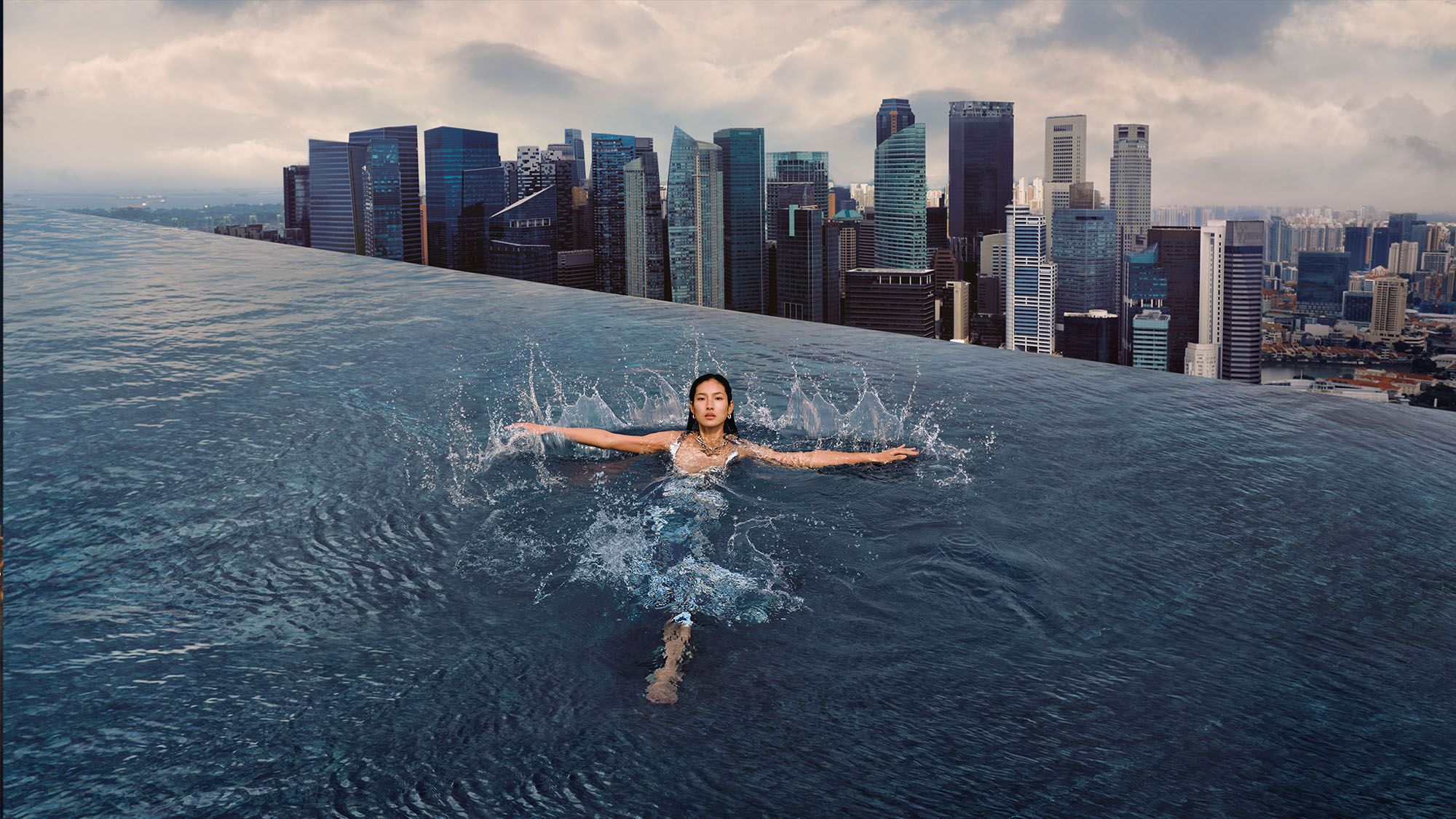
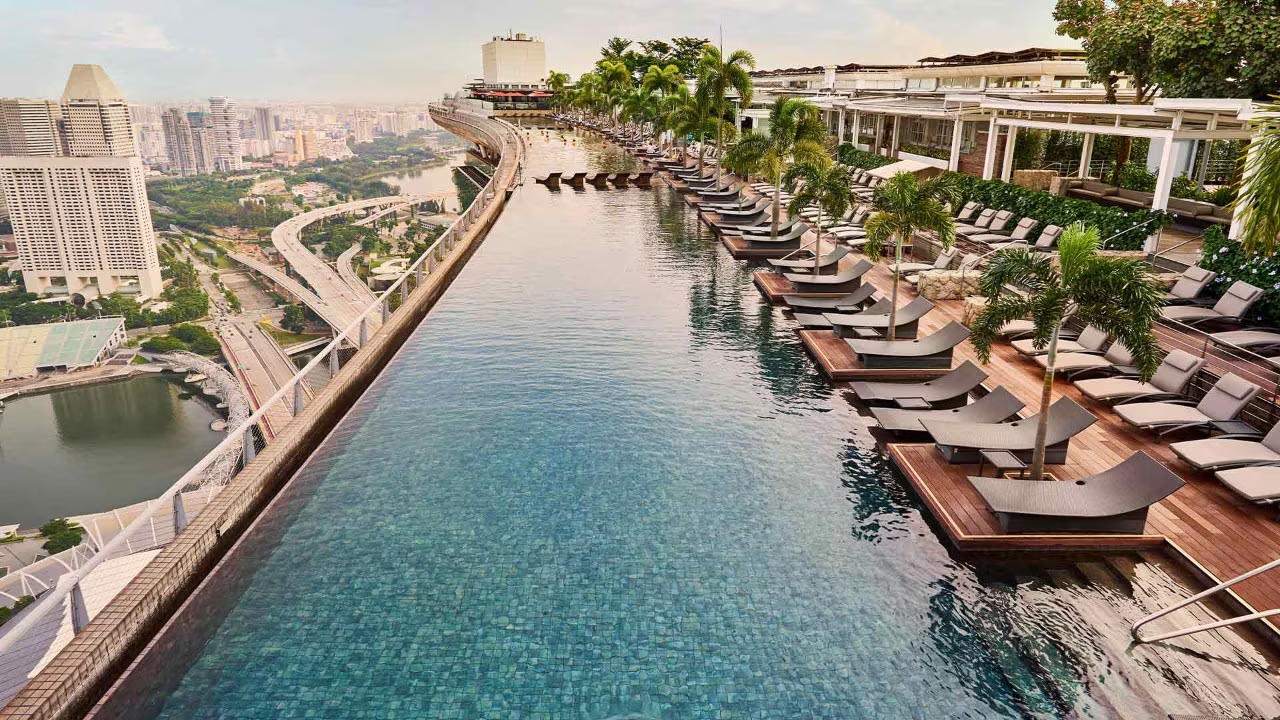
Positioned 191 metres above street level atop a 340-metre SkyPark bridging three 57-storey hotel towers, the infinity pool at Marina Bay Sands is almost certainly the most photographed swimming pool on earth. At 150 metres long, it holds approximately 1.4 million litres of water and cantilevers 66.5 metres beyond the north tower, looking out over the entire Singapore skyline.
Moshe Safdie (b. 1938), winner of the AIA Gold Medal 2015 and designer of Habitat 67 and Jewel Changi Airport, has admitted he is “a swimmer who can never get in the pool because there are so many people taking pictures.” The pool has become the visual shorthand for twenty-first-century Singapore — appearing on postage stamps, Lego sets, and every list of the world’s great architectural experiences. In Singapore Sign Language, Marina Bay Sands is represented by three raised fingers with another laid across the top.
02. Olympic Pools — The Water Cube – National Aquatics Centre
PTW Architects · Arup · CSCEC · 2003–2008 · Beijing, China
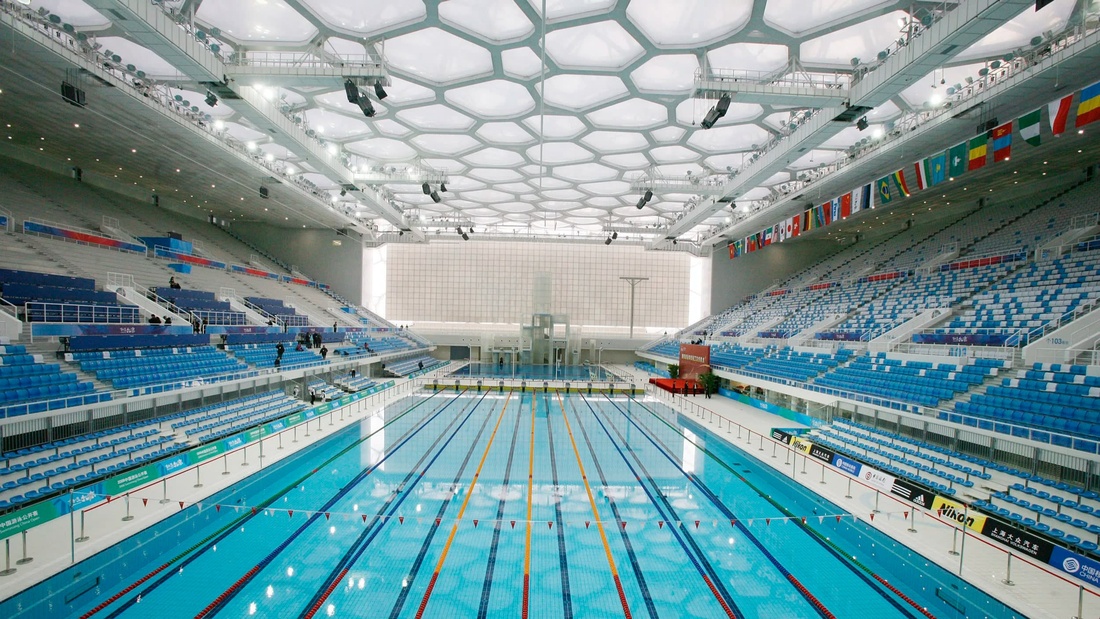
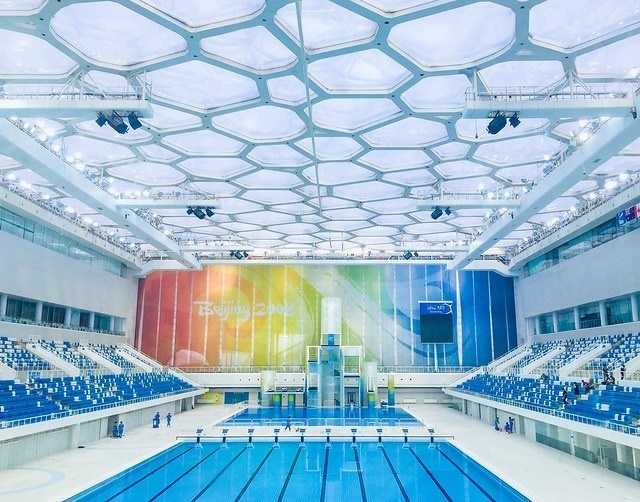
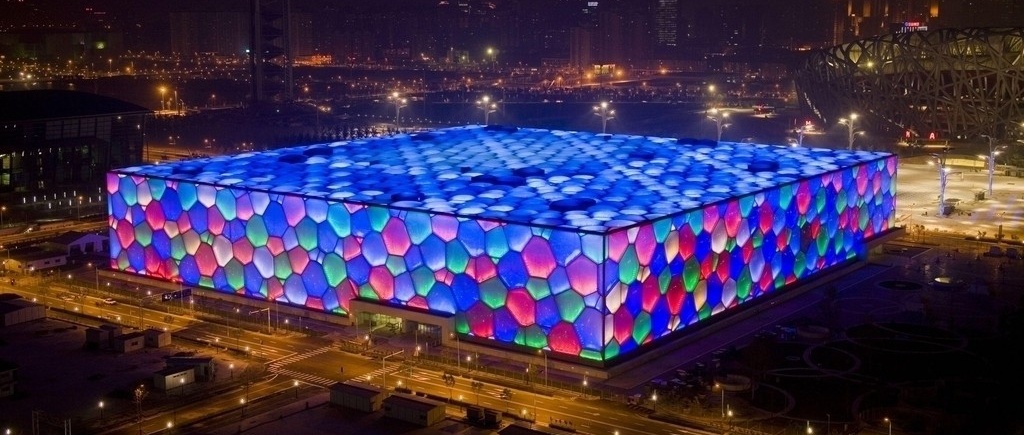
The Water Cube was broadcast to an estimated four billion people during the 2008 Beijing Olympics, where it hosted swimming, diving, and synchronized swimming and witnessed 25 world records broken — including Michael Phelps’s eight gold medals in a single Games. Its outer skin of over 100,000 square metres of ETFE cushions, each just 0.2 mm thick and patterned on the Weaire–Phelan geometric foam structure, makes it the largest ETFE structure in the world.
The cube sits in deliberate dialogue with Herzog & de Meuron’s Bird’s Nest stadium next door — together forming one of the most reproduced architectural pairings of the century. Funding came almost entirely from overseas Chinese donations. The ETFE skin recycles approximately 80% of rainwater and reduces lighting energy by 55%. Since 2022, it has doubled as the “Ice Cube” for curling at the Winter Olympics. The building won the Jørn Utzon Award for International Architecture (2008) and the RIBA International Award (2009).
03. Neptune Pool — Hearst Castle
Julia Morgan · 1924–1936 · San Simeon, California, USA
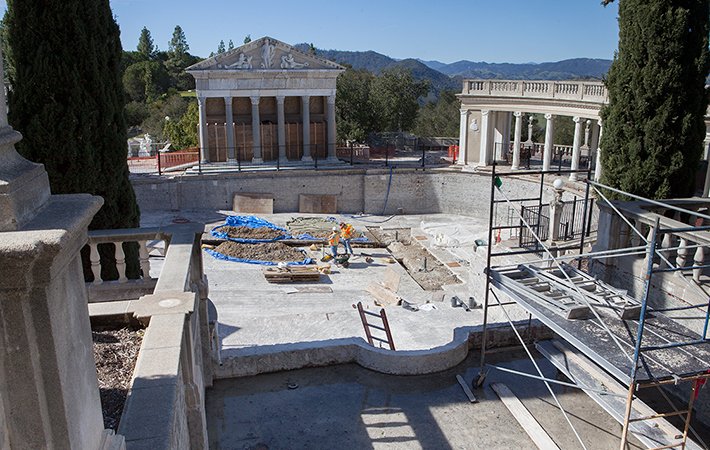
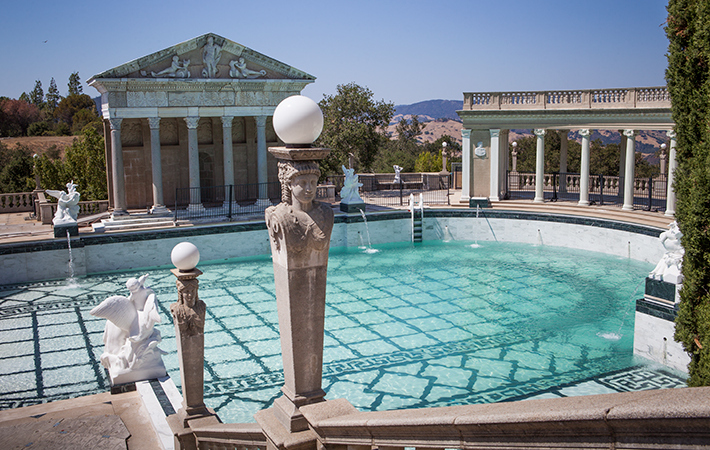
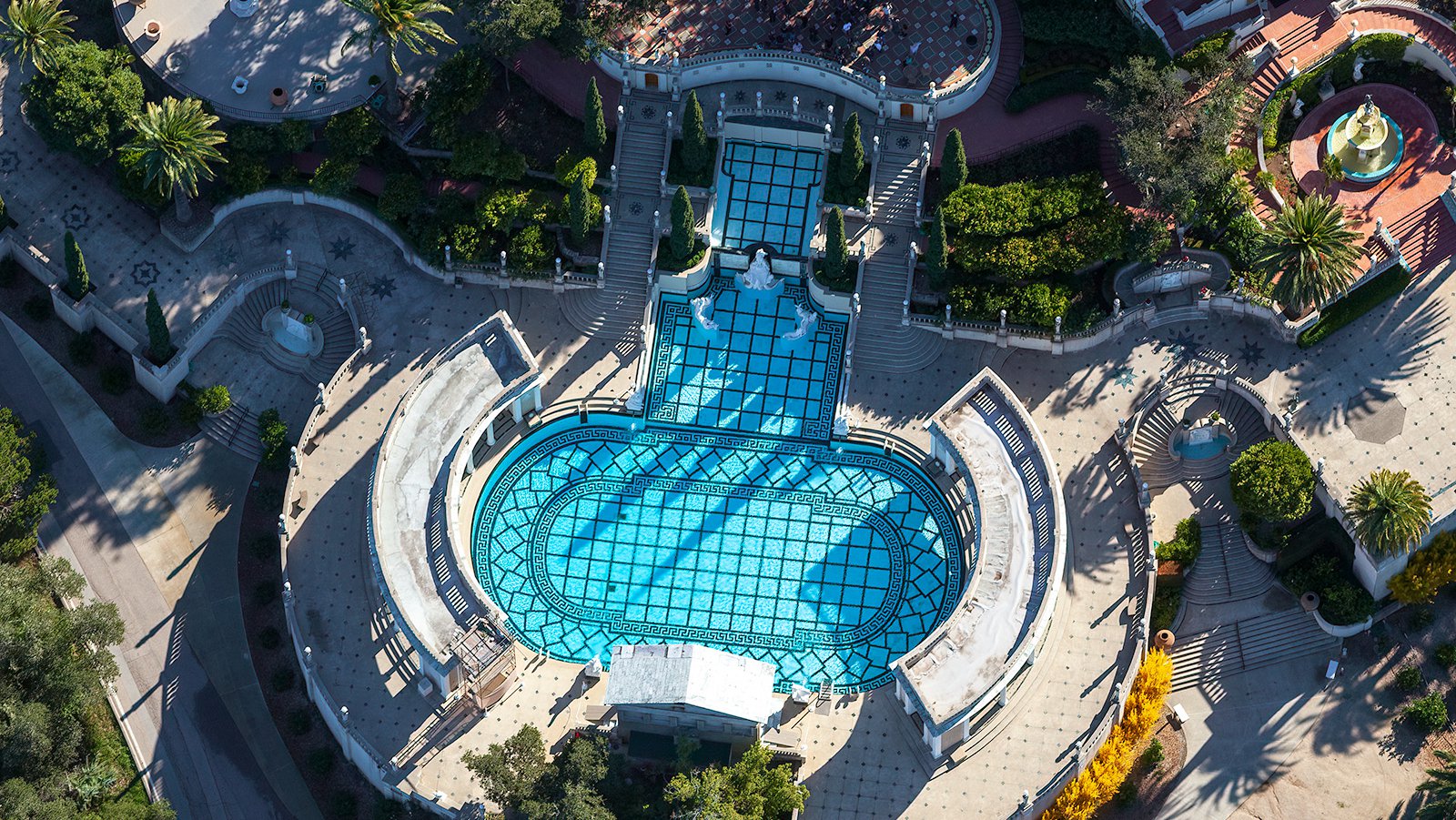
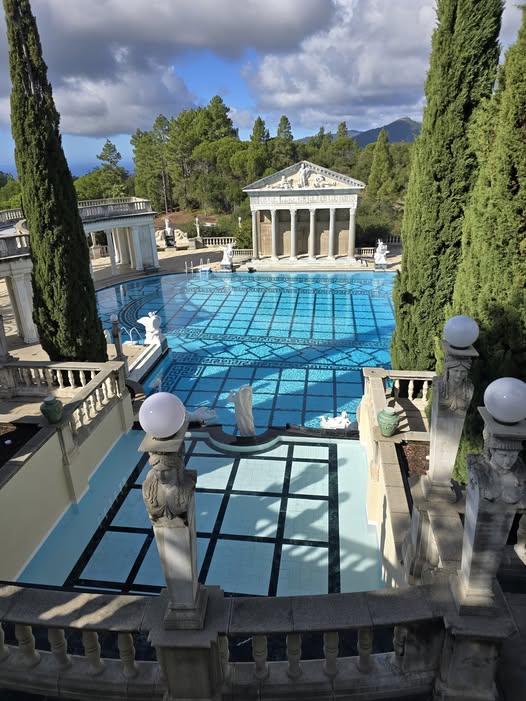
At 104 feet long and lined with white Vermont marble and Greek-key-patterned serpentine tile, the Neptune Pool is the archetypal image of American Gilded Age excess. Media magnate William Randolph Hearst commissioned it three separate times — begun in 1924 as a simple wading pool, rebuilt in 1927, and expanded again in 1936. A full-scale Greco-Roman colonnade, 17th-century statues of Neptune and the Nereids, and the Pacific horizon create the sensation of classical antiquity transplanted to the California coast.
The architect behind all of it — Julia Morgan (1872–1957) — was almost entirely erased from the property’s public history for decades. She made 564 documented trips to the site over 28 years and designed more than 700 buildings in her lifetime, yet when
Life magazine ran a 14-page spread on Hearst Castle in 1957, the year of her death; her name went unmentioned. The first woman to receive a certificate from the École des Beaux-Arts in Paris, she was awarded the AIA Gold Medal posthumously in 2014 — the first woman to receive it in the medal’s 107-year history. Hearst Castle welcomes 700,000–850,000 visitors per year.
04. Bondi Icebergs Ocean Pool
Lazzarini Pickering Architetti · TKD Architects (2002 rebuild) · Founded 1929 · Rebuilt 2002 · Bondi Beach, Sydney, Australia
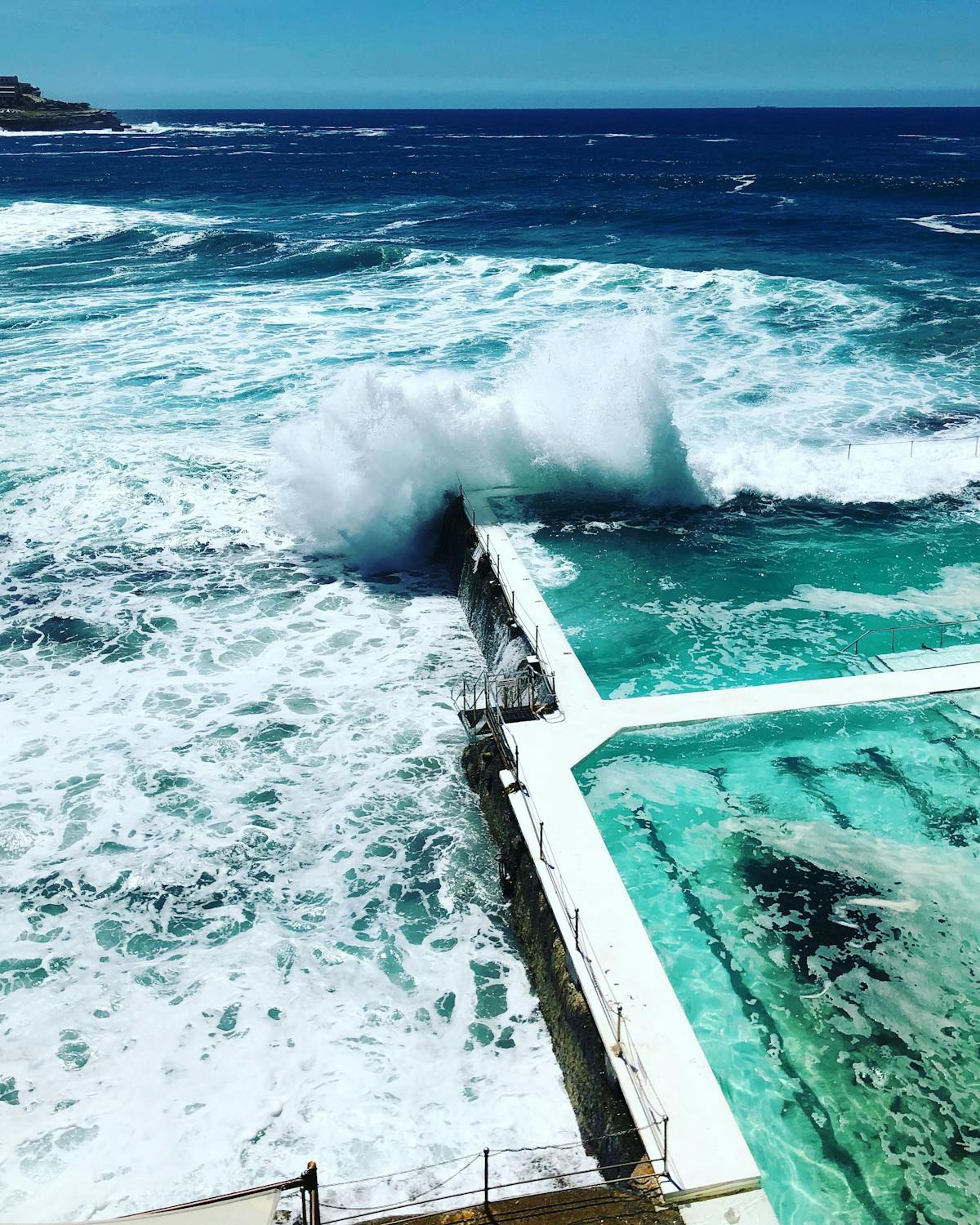
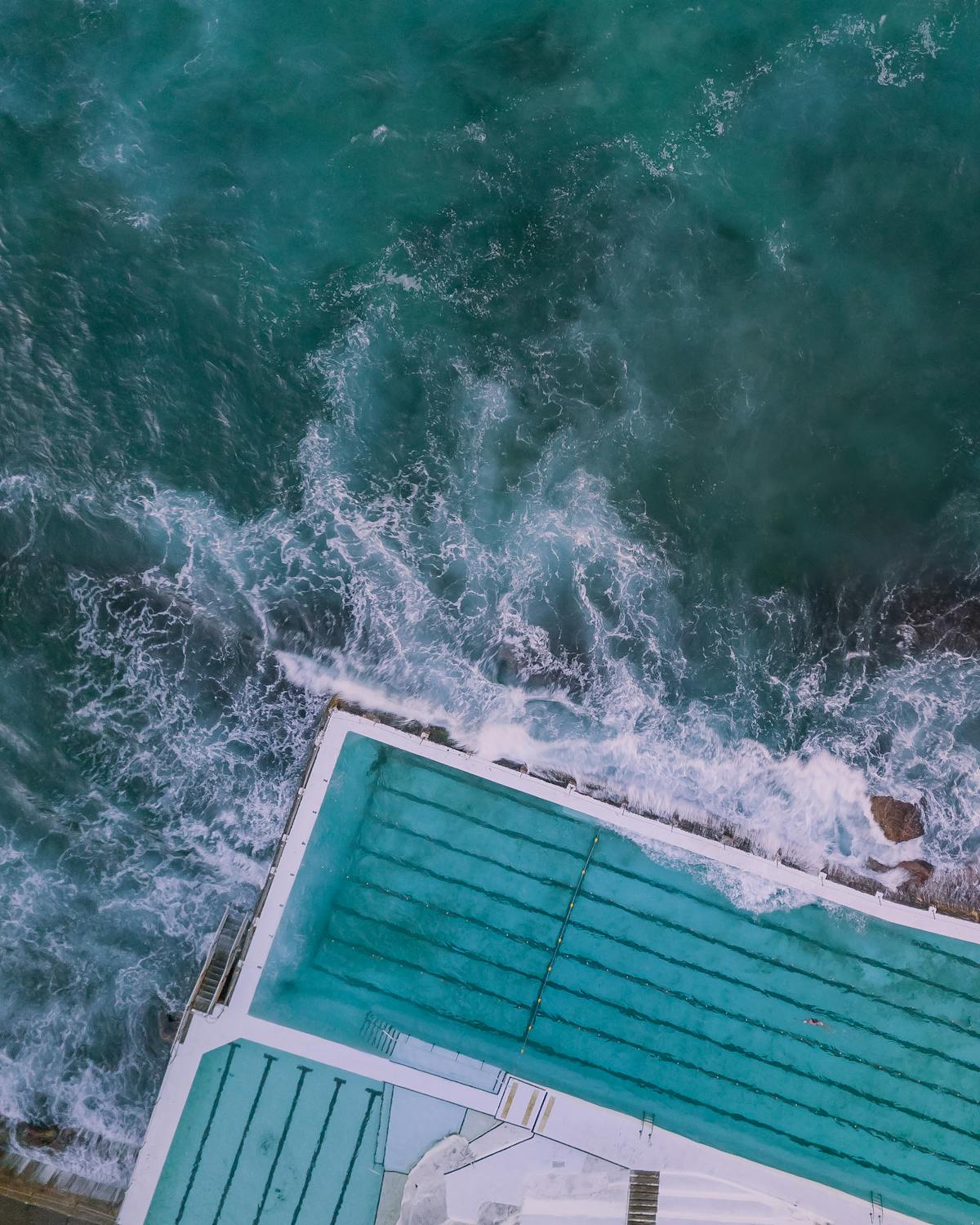
The Bondi Icebergs pool, carved into the rocks at the southern tip of Bondi Beach, is arguably the most photographed swimming pool in the world by sheer volume of social-media imagery. The 50-metre, eight-lane saltwater lap pool is fed continuously by Pacific waves that crash over its seaward wall. The current facility, including the cantilevered clubhouse by Italian-Australian architects Lazzarini Pickering with TKD, was completed in 2002.
The Bondi Icebergs Swimming Club, founded in 1929, enforces one of sport’s most unusual membership rules: to qualify as a full member, a swimmer must compete on at least three Sundays out of four for five consecutive winters. The pool’s white-edged rectangle of blue against Pacific surf has become the defining visual shorthand for Sydney itself, appearing in advertising campaigns and the 2024 documentary The Pool. Annual visitors number around 140,000.
05. Olympic Pools — London Aquatics Centre
Zaha Hadid Architects · 2005–2011 · Stratford, London, UK
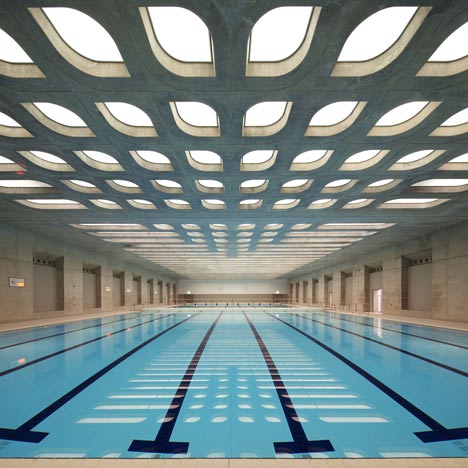
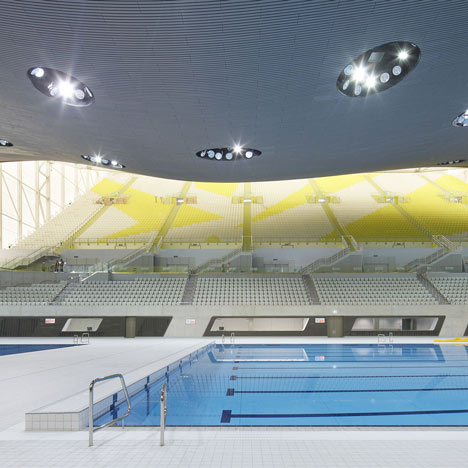
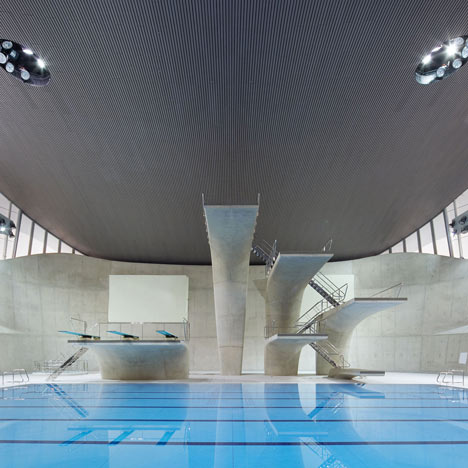
Designed in 2004 before London had even won the Olympic bid, the Aquatics Centre is defined by an undulating wave-form roof — inspired, Hadid wrote, by the fluid geometry of water in motion — enclosing two 50-metre competition pools and a 25-metre diving pool. The roof’s double-curvature geometry is grounded at just three structural points, while 628 panes of glass flood the hall with natural light. Final cost: £269 million.
Zaha Hadid (1950–2016) was the first woman to win the Pritzker Prize (2004) and the first to receive the RIBA Gold Medal in her own right (2016). During the 2012 Games, temporary wings expanded seating to 17,500; these were removed in 2014 and replaced with glazed facades, opening the centre to the public. Today anyone in London can swim in it.
06. Outdoor & Indoor Pools — Piscine Molitor
Lucien Pollet · 1929 · Rebuilt 2011–2014 · 16th Arrondissement, Paris, France
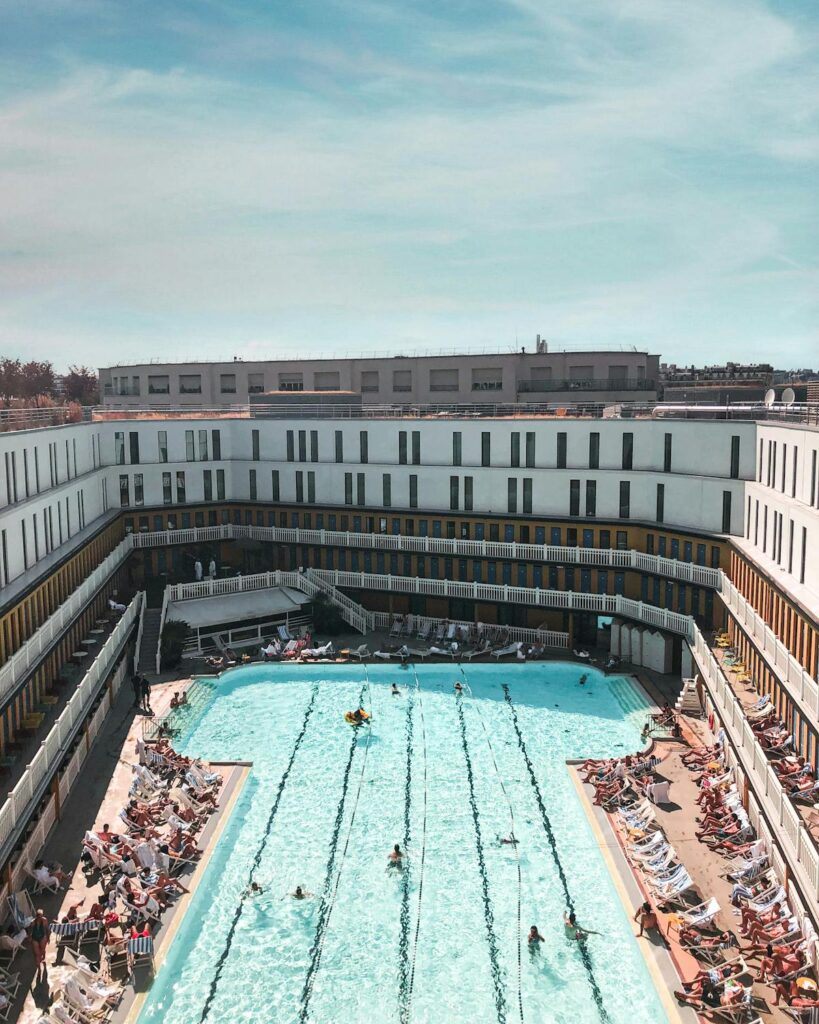
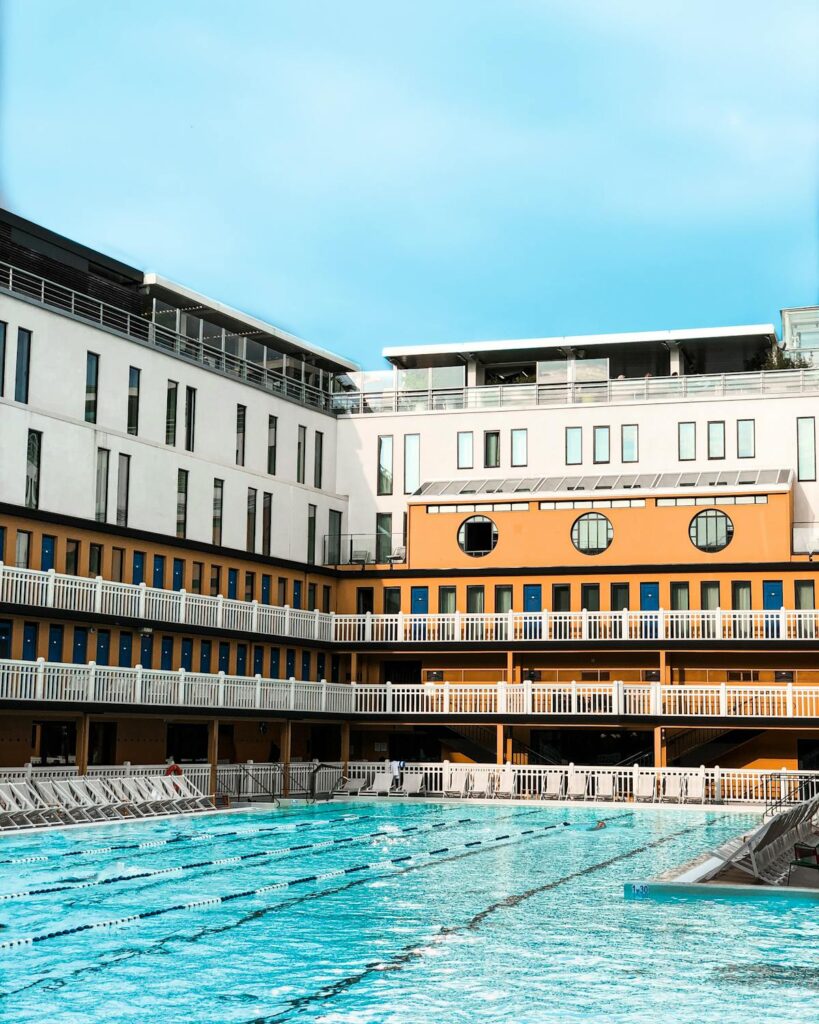
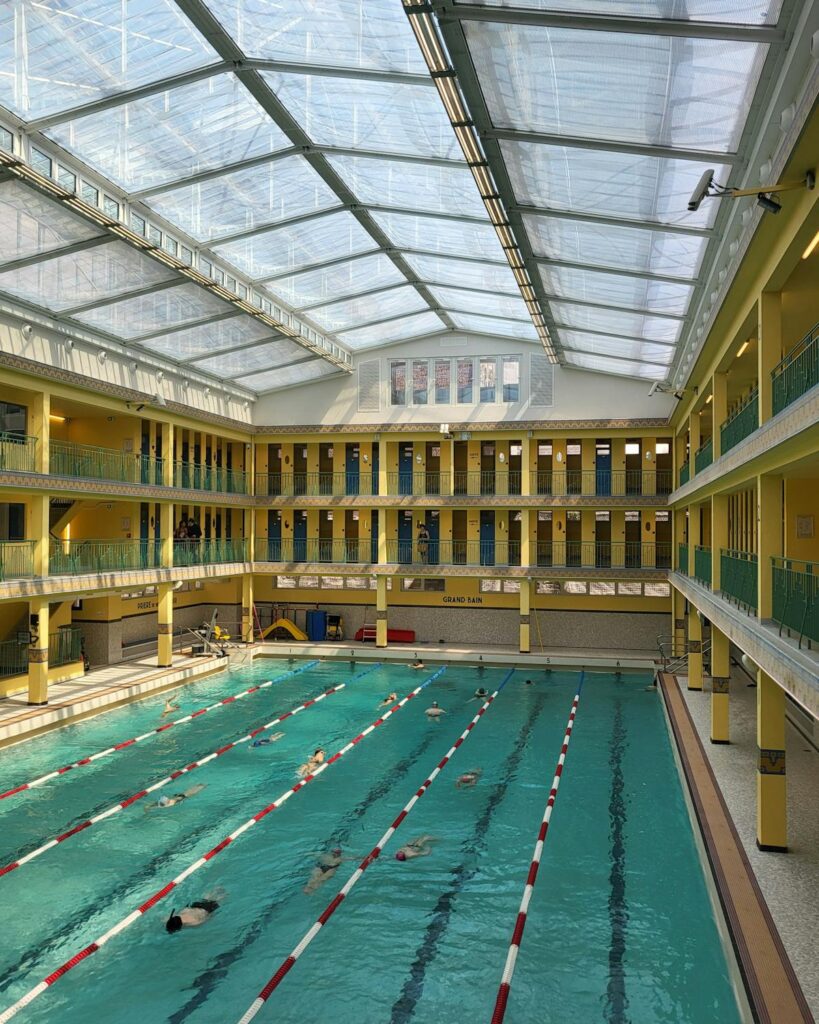
Opened in 1929, Piscine Molitor was inaugurated by Olympic champion and future Tarzan actor Johnny Weissmuller. Its two pools — a 33-metre covered indoor hall and a 50-metre open-air outdoor pool encircled by three tiers of ocean-liner-style changing cabins — made it the most glamorous public bathing facility in Europe. Nicknamed “the white ocean liner,” it served as a winter ice rink until the 1970s and was declared a Monument Historique in 1990.
The Molitor name entered world literature when Yann Martel named the protagonist of his Booker Prize-winning novel Life of Pi after it. It entered fashion history on 5 July 1946, when designer Louis Réard chose the pool deck for the world debut of the modern bikini. After closing in 1989 the derelict shell hosted a 5,000-person rave in 2001 before a meticulous €50-million reconstruction reopened it as the Hôtel Molitor in 2014.
07. Rooftop Pool — La Muralla Roja
Ricardo Bofill · Taller de Arquitectura · 1968–1973 · Calpe, Alicante, Spain
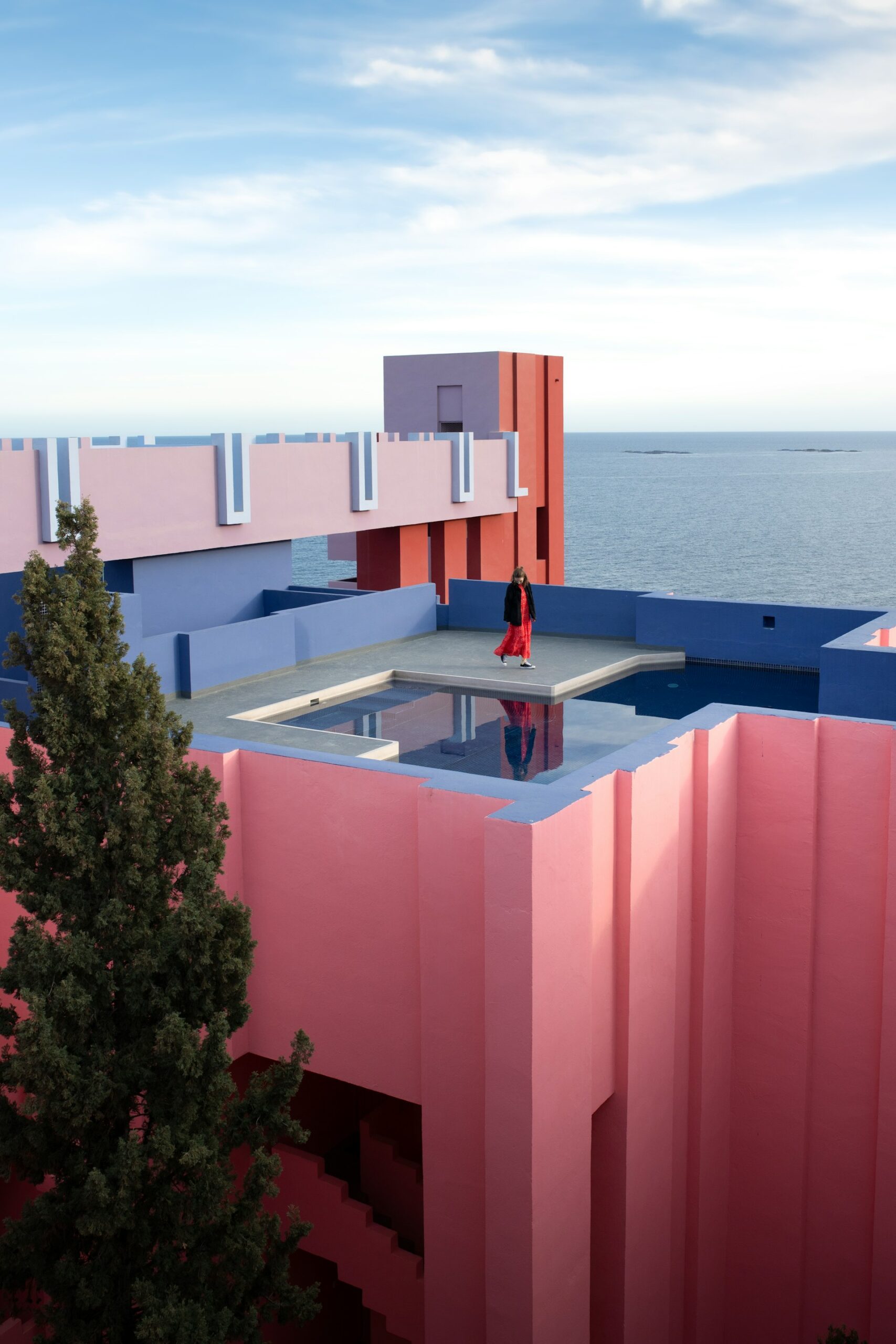
La Muralla Roja — The Red Wall — clings to the rocky cliffs of the Costa Blanca like a Moorish fortress reimagined by a postmodern illusionist. Designed in 1968 and completed in 1973, the 50-apartment complex is a labyrinth of passages, bridges, and staircases in shades of deep red, pink, blue, and violet. The deep reds intensify contrast with the arid landscape; the blue-to-indigo stairwells fuse visually with the sky. The rooftop pool and solariums, reserved for residents, float above the Mediterranean at the building’s summit.
Ricardo Bofill (1939–2022) founded the Taller de Arquitectura in Barcelona in 1963 and went on to complete over 1,000 projects across 50 countries. The building’s pastel-toned stairwells became globally viral after being cited by Squid Game’s production designers as a key visual reference, reaching an audience of hundreds of millions. Bofill’s stated intention for the project: “I wanted to create a powerful space to make normal people who know nothing about architecture realize that architecture exists.”
08. Thermal Baths — 7132 Hotel (Therme Vals)
Peter Zumthor · 1993–1996 · Vals, Graubünden, Switzerland
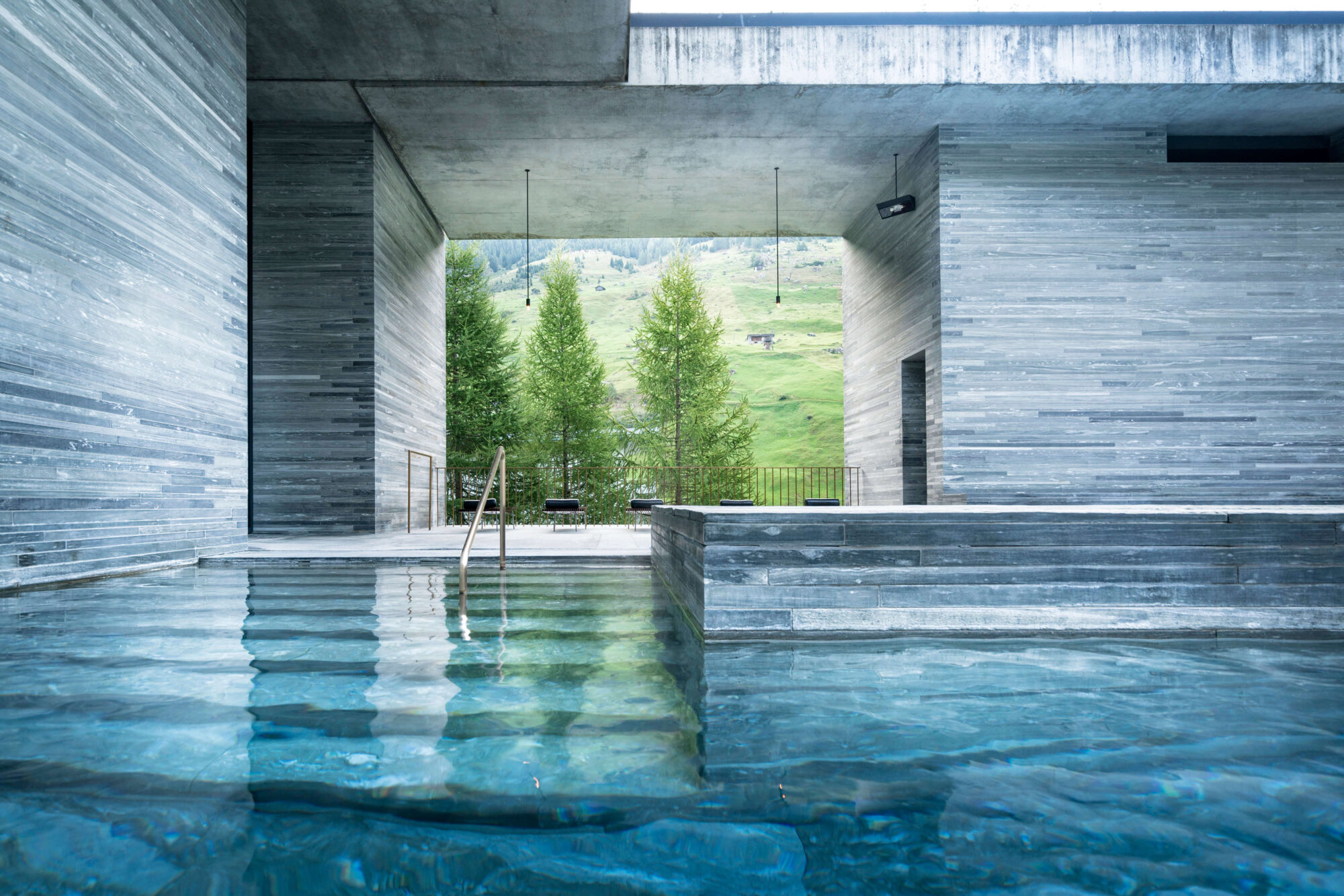
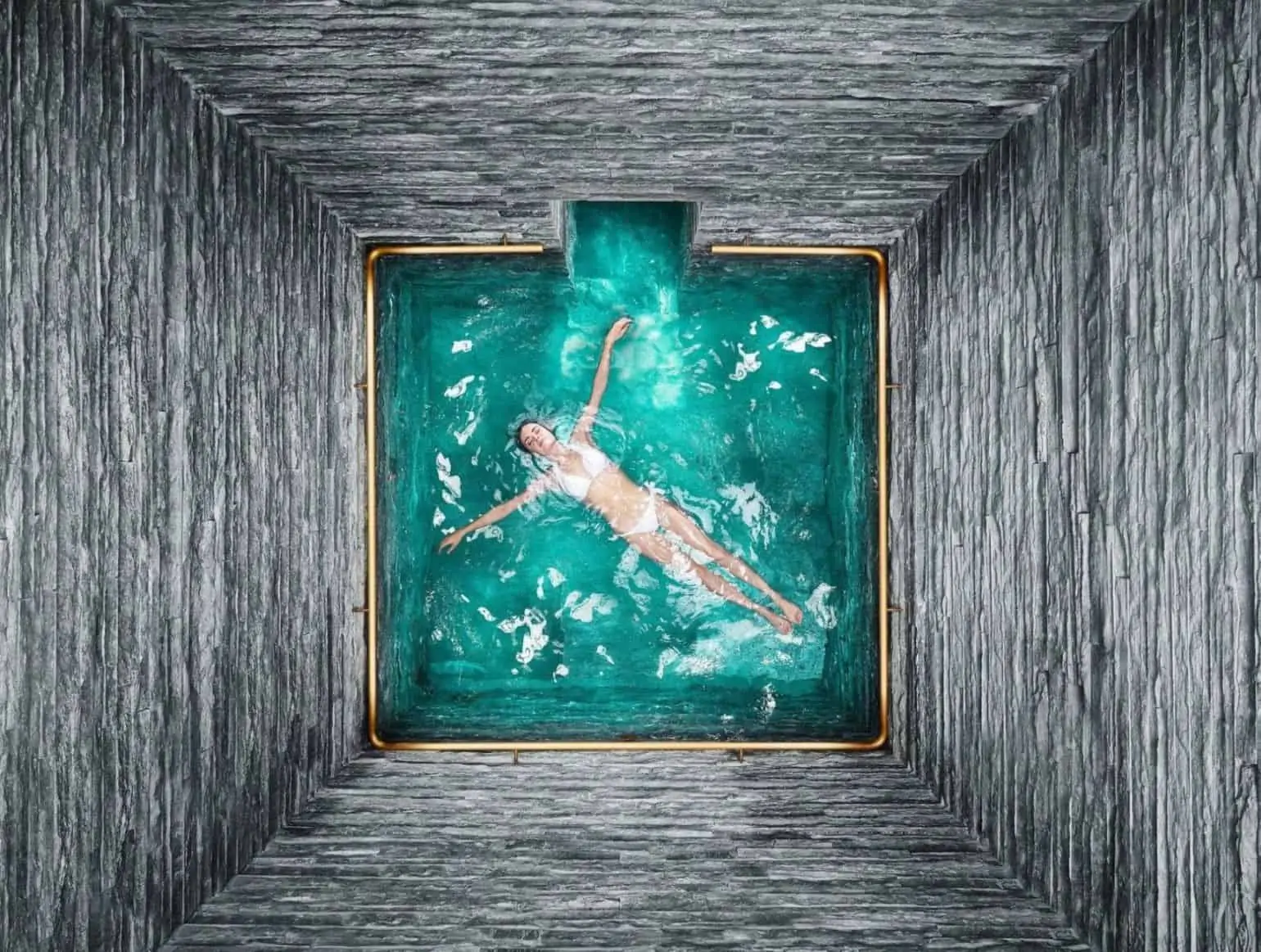
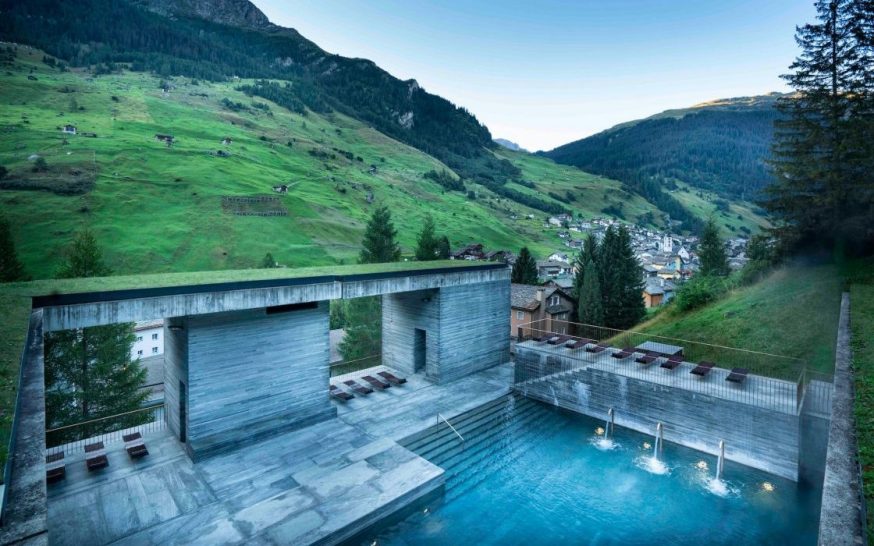
Built in a remote Alpine valley 1,200 metres above sea level, Therme Vals was designed around a single ambition: that the building should feel as if it predates everything around it — as if it were a cave quarried out of the mountain by water over millennia. Sixty thousand slabs of local Valser quartzite, each one metre long, were laid in horizontal strips recalling geological strata. Thin glass slits between roof sections admit cuts of Alpine light that track across the stone as the sun moves. The thermal spring emerges at 26°C.
Peter Zumthor (b. 1943), winner of the Pritzker Prize in 2009, originally refused to install any clocks inside — time, he believed, should be suspended. Two were eventually fitted three months after opening. The building was classified as a protected historical monument just two years after it opened, an almost unprecedented designation. It has become one of the great architectural pilgrimages of our era, inspiring a 2017 French graphic novel, Swimming in Darkness by Lucas Harari, set entirely within its walls.
09. Spring-Fed Pool — Fallingwater
Frank Lloyd Wright · 1935–1939 · Mill Run, Pennsylvania, USA
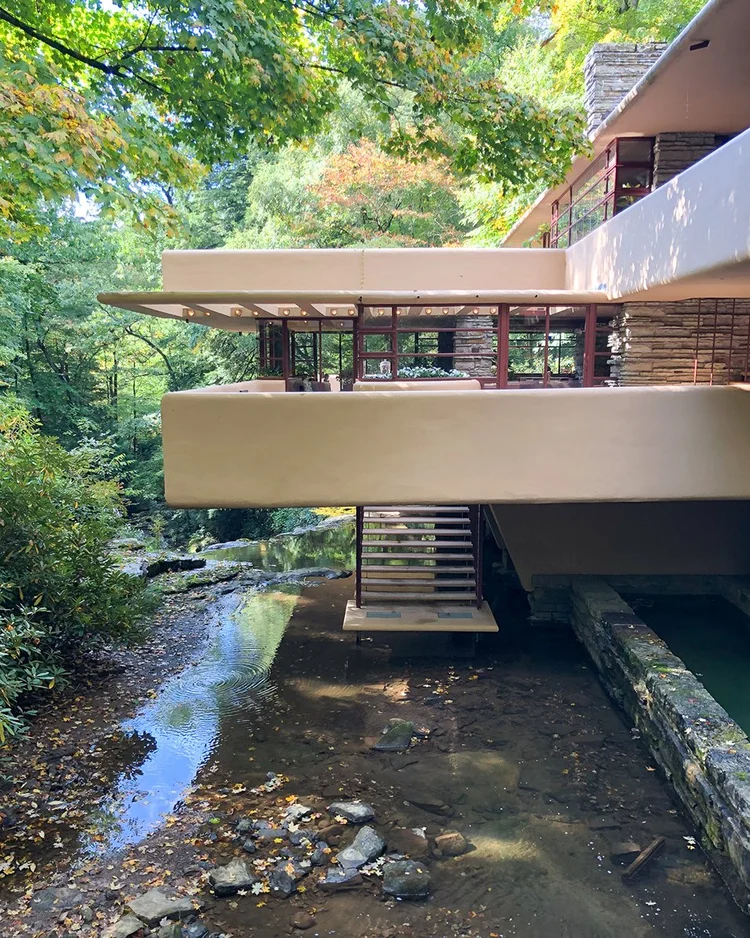
The pool at Fallingwater is fed directly by Bear Run — the same stream that rushes beneath the house’s famous cantilevered terraces in the Pennsylvania Highlands. A hatch set into the living room floor opens onto a suspended stairway that descends to stream level, making every entry into the pool a small architectural event, dissolving the boundary between interior domesticity and wild nature. Frank Lloyd Wright did not design the house to overlook the waterfall; famously, he positioned it directly over it.
Commissioned in 1934 by Pittsburgh department-store magnate Edgar J. Kaufmann Sr., Fallingwater was named the AIA’s best all-time work of American architecture and inscribed as a UNESCO World Heritage Site in 2019. It receives approximately 150,000 visitors per year.
10. Indoor Pool — Casa Gilardi
Luis Barragán · 1975–1977 · San Miguel Chapultepec, Mexico City, Mexico
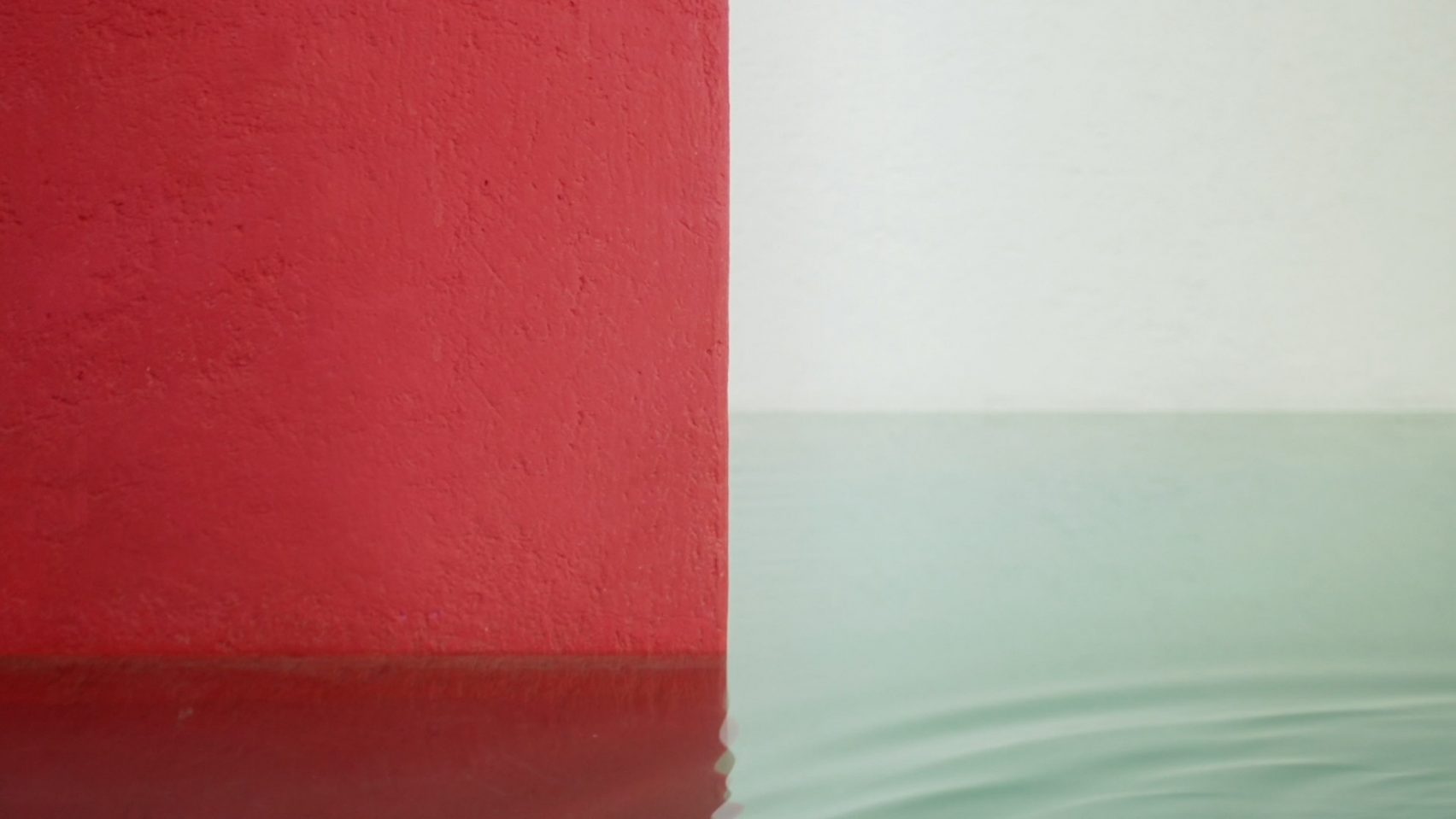
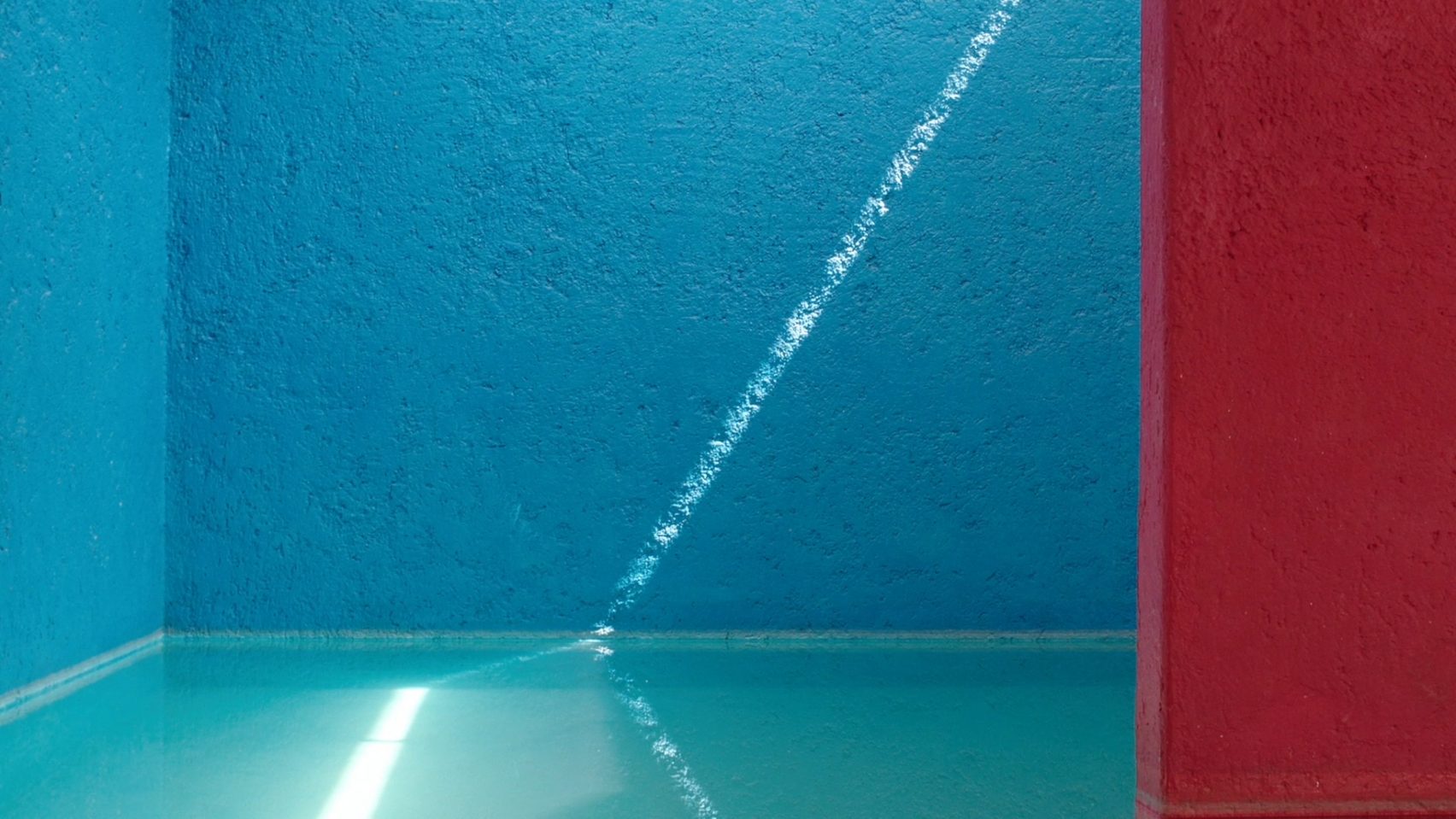
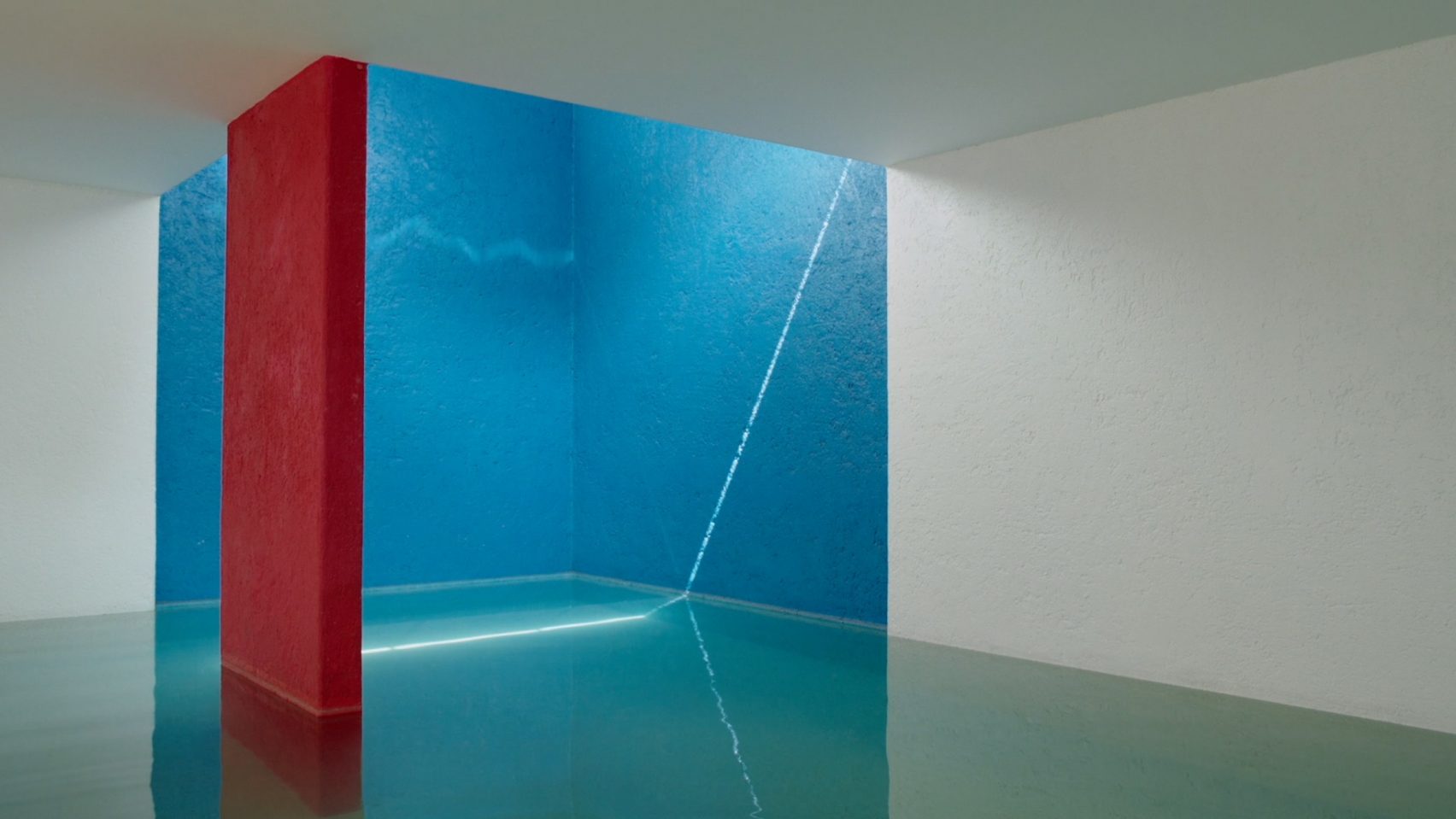
At 80 years old and after a decade of near-inactivity, Barragán accepted his final residential commission: a narrow 10×35-metre urban plot for two advertising executives who wanted to keep a jacaranda tree in the courtyard and to have an indoor pool. The tree became the spatial protagonist of the entire house. The pool, reached via a long yellow corridor filtered by vertical apertures, occupies a room whose cobalt blue, deep red, and white surfaces reflect the water in patterns that shift hour by hour throughout the day.
Luis Barragán (1902–1988) is the only Mexican architect to have won the Pritzker Prize (1980). At Casa Gilardi, his lifelong conviction that colour is architecture — not decoration — reaches its most distilled expression. One architect who visited described the experience: “Colour isn’t just applied here. It’s as important as the volumes.” The house is privately occupied but accessible by appointment.
11. Piscina das Marés — Ocean Swimming Pools
Álvaro Siza Vieira · 1961–1966 · Leça da Palmeira, Matosinhos, Portugal
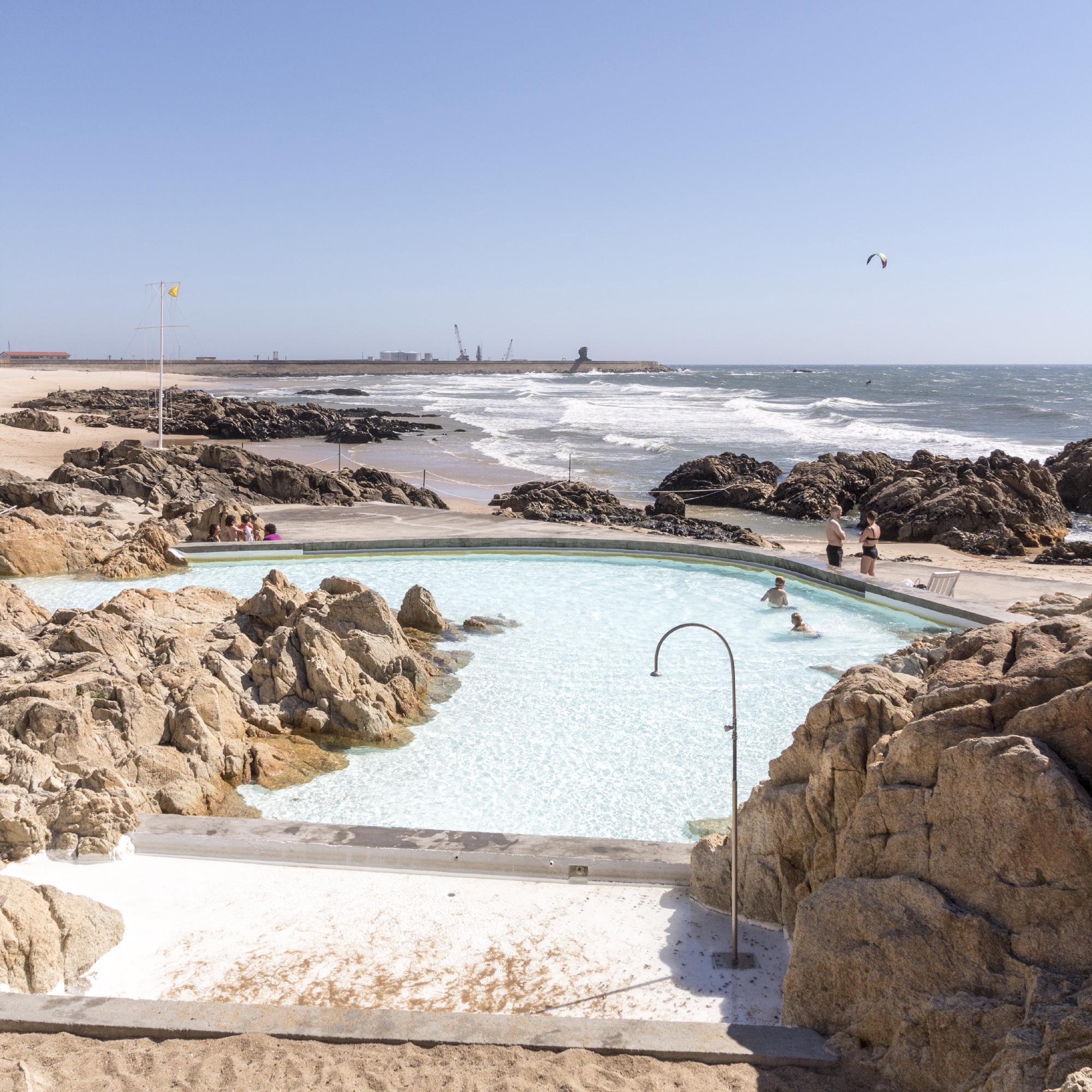
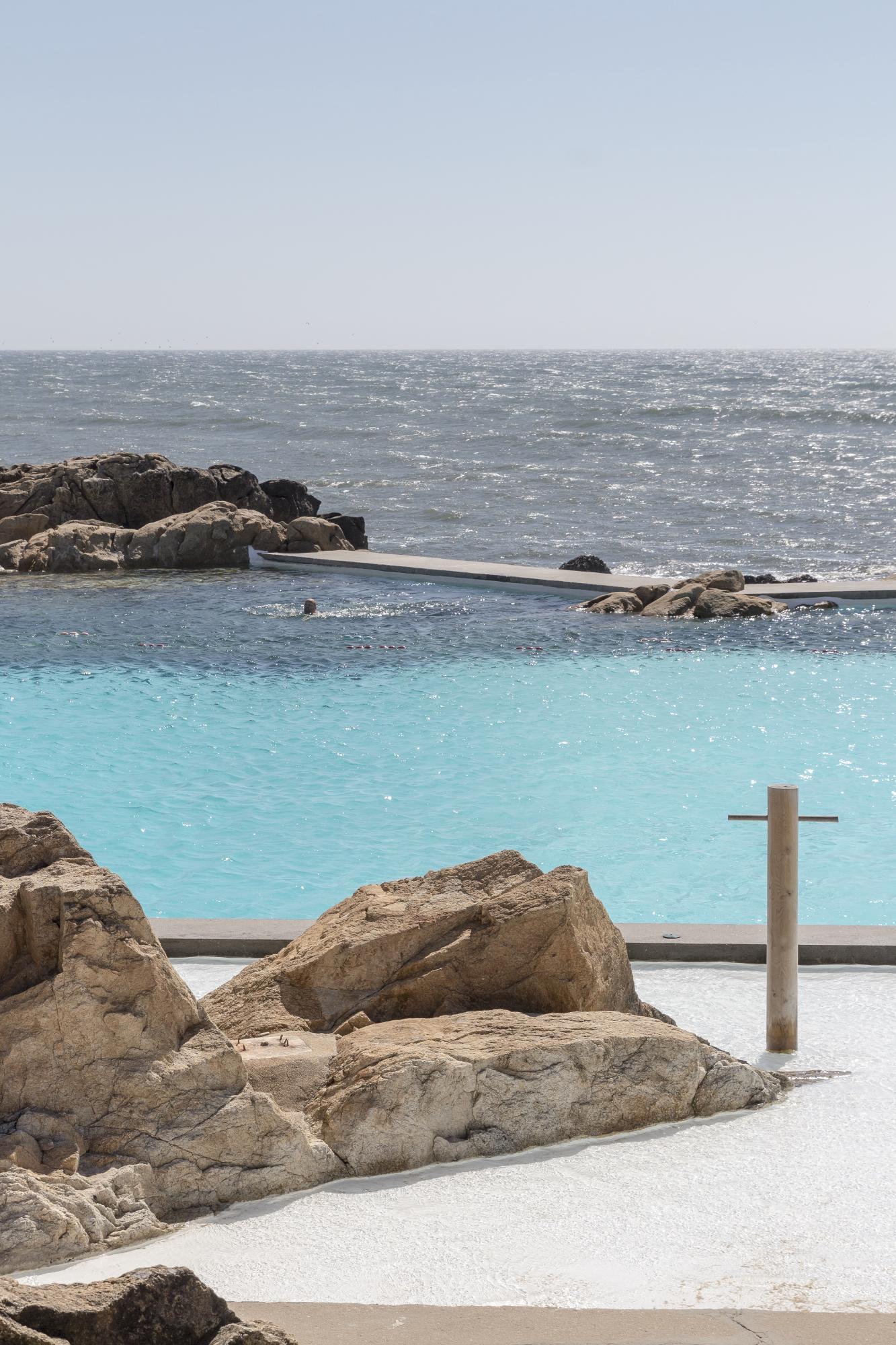
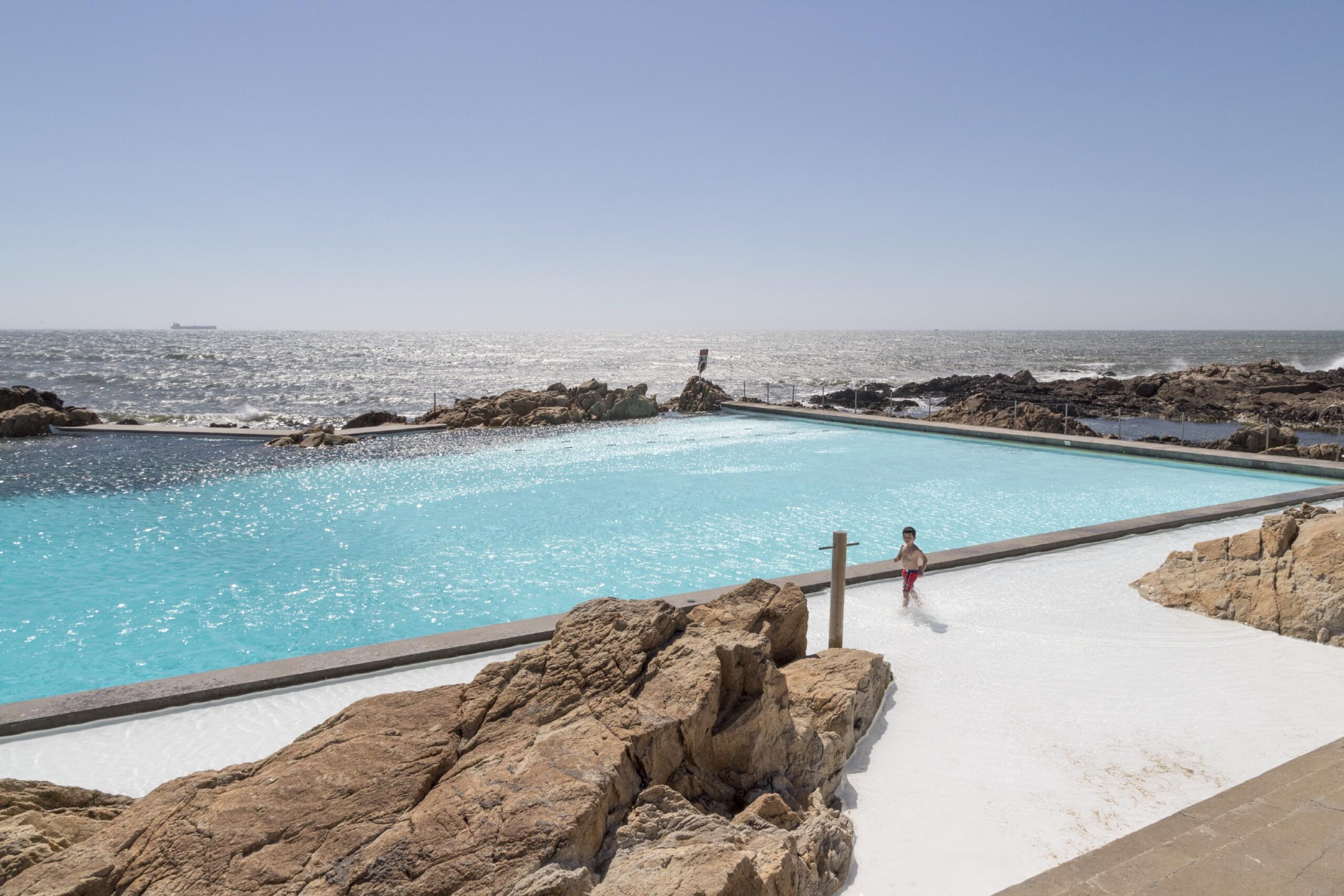
Built on the site of a former lobster nursery along a rocky stretch of Portugal’s Atlantic coast, Piscina das Marés also known as Leça Swimming Pools, are two concrete pools filled with fresh seawater are among the most quietly radical architectural works of the twentieth century and they were designed by Siza when he was in his late twenties. The complex sits entirely below street level so that the ocean view from the road remains unobstructed. Concrete walls integrate with existing rock formations; the architecture buries itself, offering itself to the landscape rather than competing with it.
Álvaro Siza Vieira (b. 1933), winner of the Pritzker Prize in 1992, created here a building that draws visiting architects from across the globe who make the pilgrimage specifically to understand how little intervention a great work of architecture actually requires. Classified as a Portuguese National Monument in 2006, the pools are open seasonally from June to September.
12. Sinusoidal Pool — Casa das Canoas
Oscar Niemeyer · 1951–1953 · Barra de Tijuca, Rio de Janeiro, Brazil
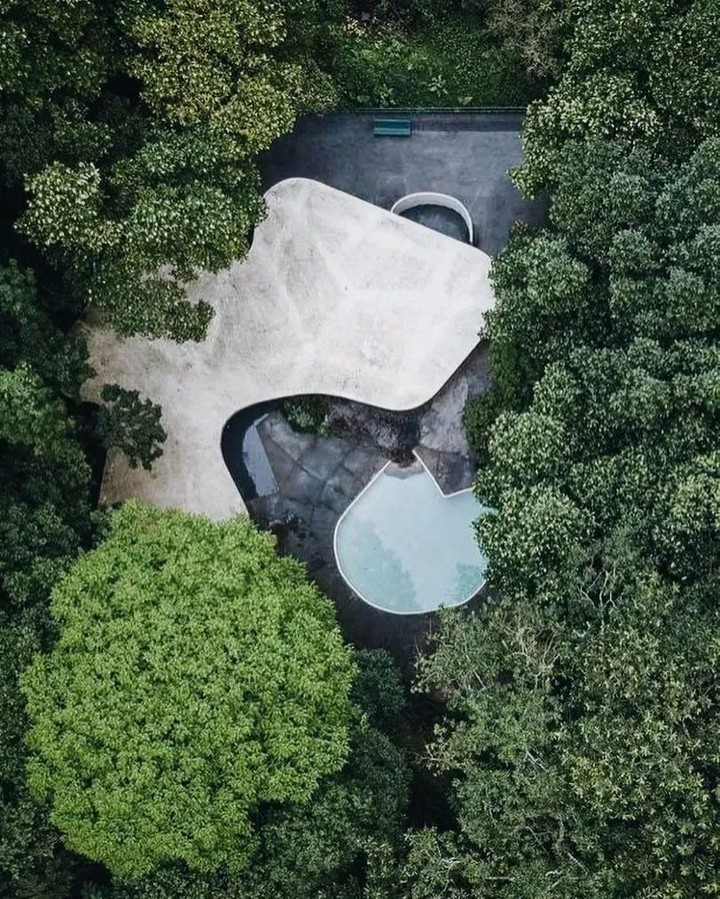
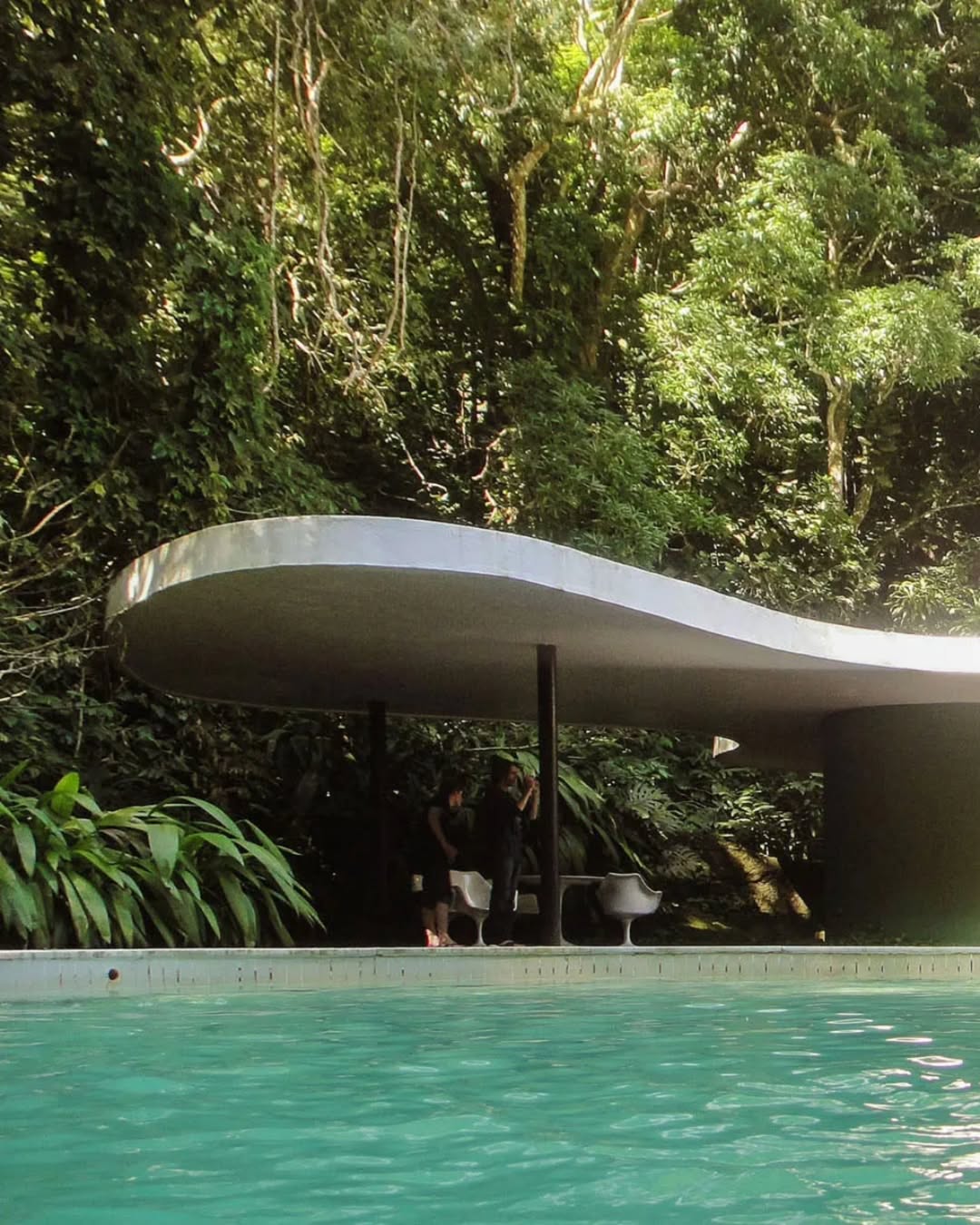
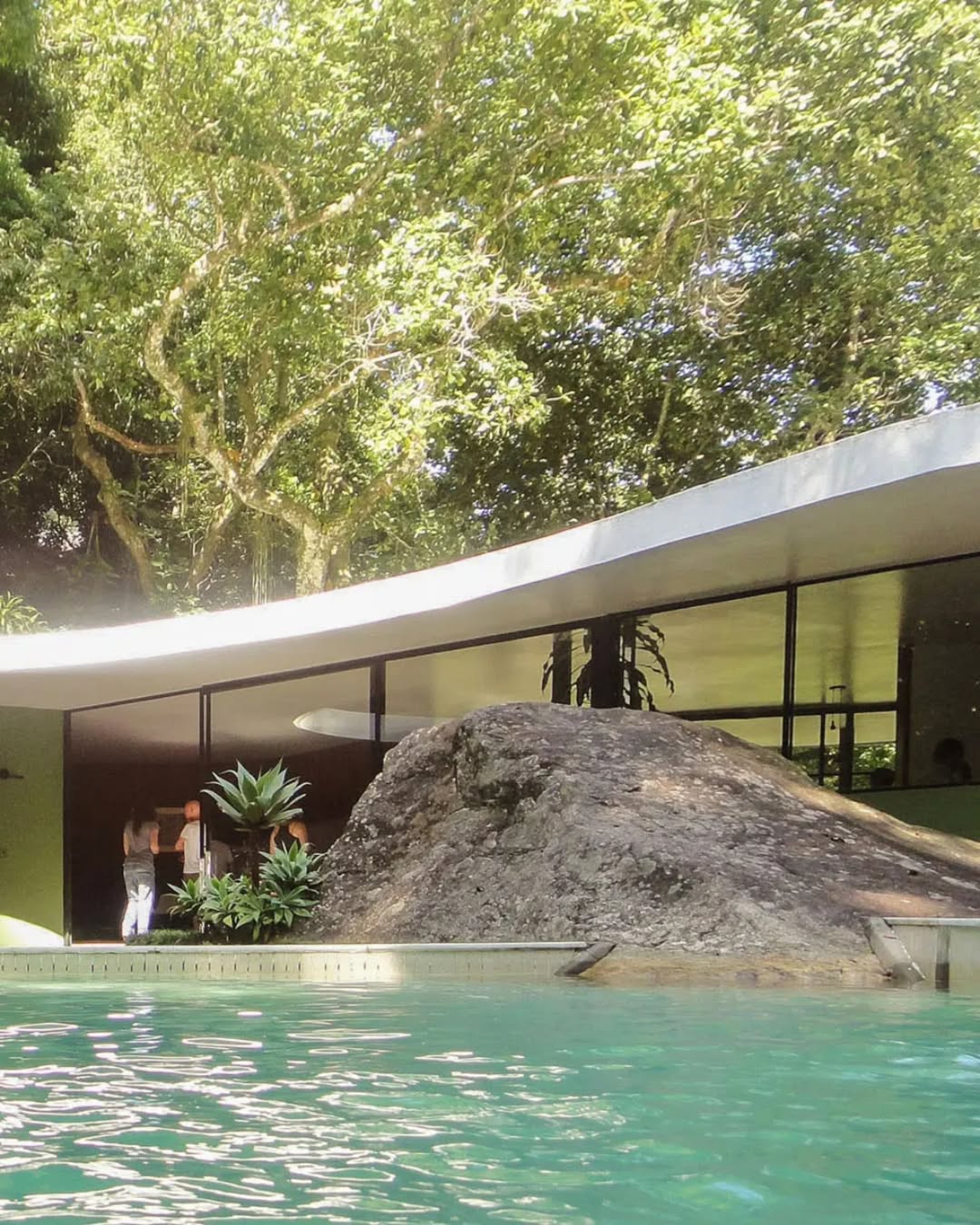
Casa das Canoas was Niemeyer’s own family home — built on a jungle hillside above Rio with no client to answer to. The pool is its most arresting feature: a free-form sinusoidal body of water that curves around a massive natural boulder, which also pierces the glass living room wall and passes directly through the house. The boulder was not a compromise but the organizing principle of the entire design. Sculptor Alfredo Ceschiatti’s figures stand at the pool’s edge; the garden is by Roberto Burle Marx.
Oscar Niemeyer (1907–2012) won the Pritzker Prize in 1988 and lived and practised until the age of 104. In September 1956, the newly elected president of Brazil, Juscelino Kubitschek, visited him here. On the drive back to Rio, he told Niemeyer: “Oscar, this time we will build the capital of Brazil.” Brasília was the result. The house is now open to the public through the Oscar Niemeyer Foundation.
13. Cantilevered Pool — Casa Monterrey
Tadao Andō · 2011–2013 · Monterrey, Nuevo León, México
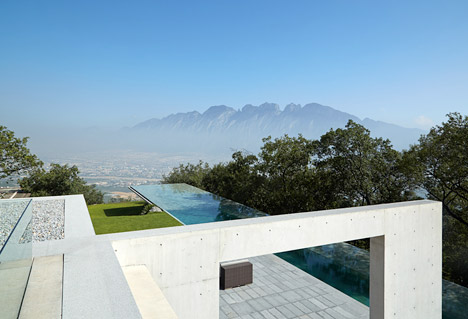
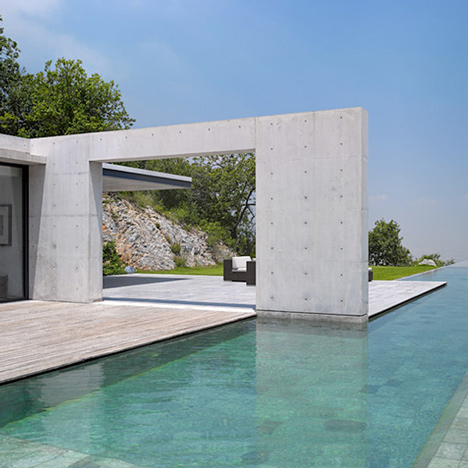
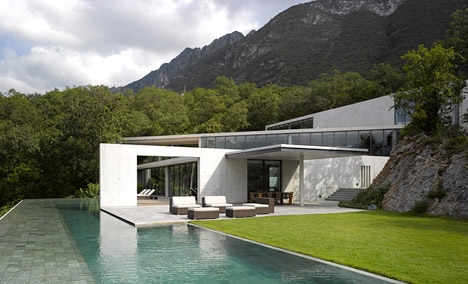
The pool at Casa Monterrey begins as a conventional rectangular form at the rear of the house, then extends over the edge of a hillside as a pure cantilever, projecting into the panorama of the Sierra Madre Oriental mountains. The water in the cantilevered section appears suspended in mid-air, its surface aligned with the mountain horizon and the sky beyond — a body of water that belongs simultaneously to the building and to the landscape. Andō’s signature exposed concrete, polished and precise, provides the structural frame.
Tadao Andō (b. 1941), a former professional boxer from Osaka, taught himself architecture through travel and the intensive study of buildings. He won the Pritzker Prize in 1995; the jury noted he had “achieved with concrete what Louis Kahn sought to do with brick.” Throughout his career — from the Church of the Light in Osaka to the museums of Naoshima Island — water has been his primary spatial tool.
14. Horse Pool — Cuadra San Cristóbal
Luis Barragán · Andrés Casillas · 1966–1968 · Los Clubes, State of Mexico, Mexico
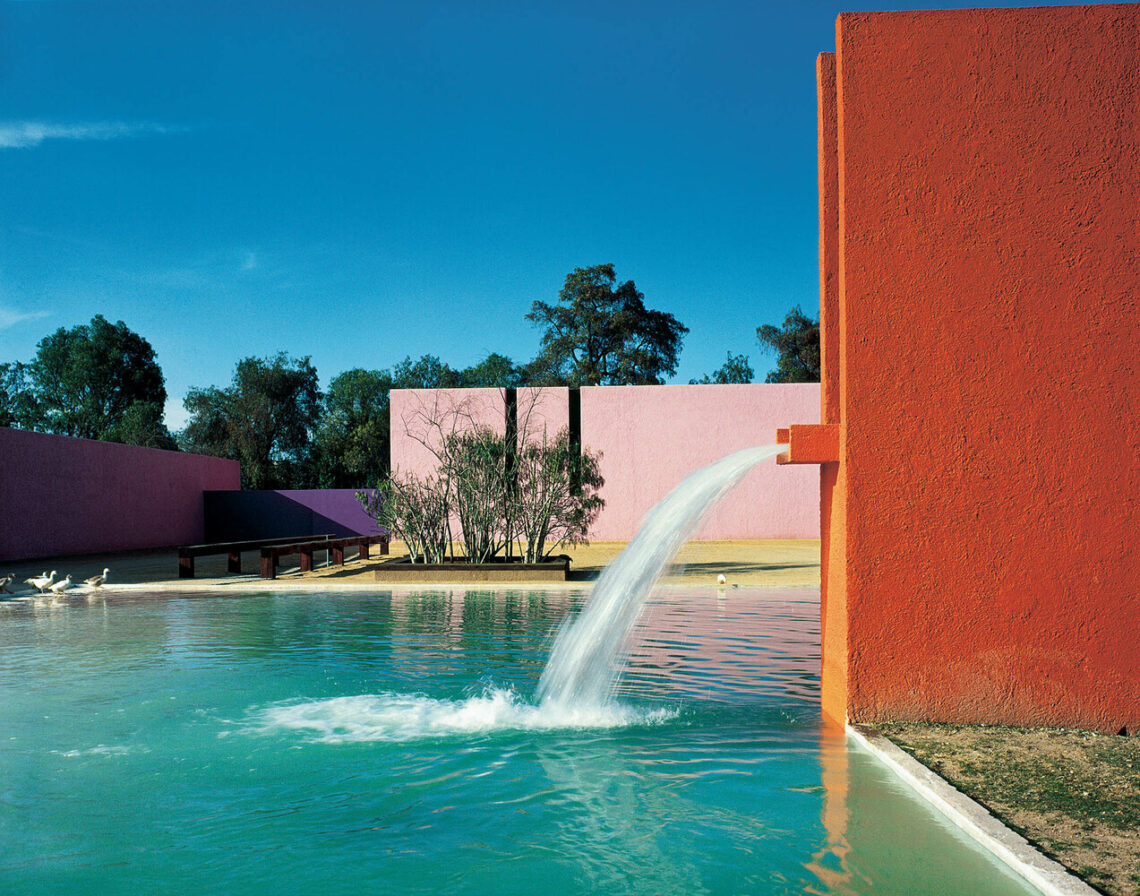
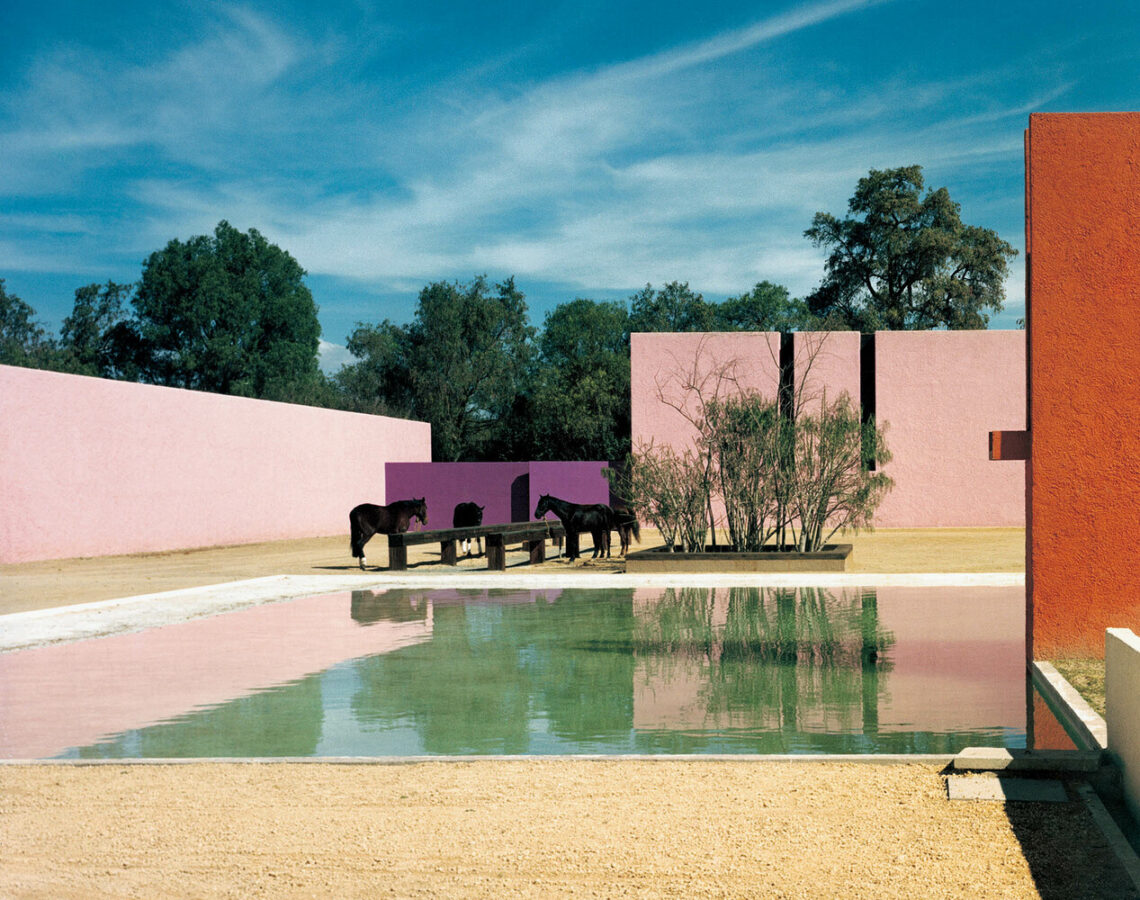
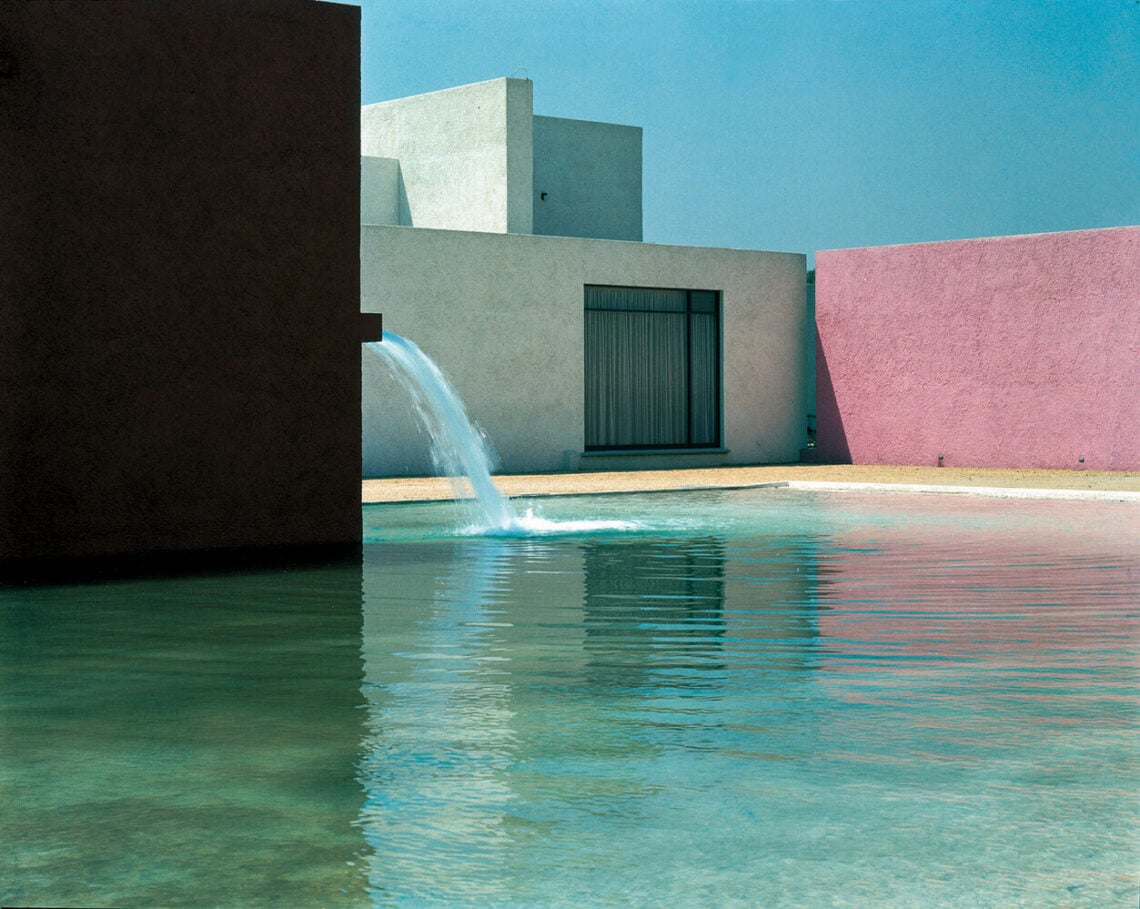
This pool was not designed for human beings. Its depth, Barragán explained, was “calculated for passing the horse to reach the water to the belly.” Built for Swedish equestrian and businessman Folke Egerström, the estate organizes stables, gardens, a granary, and a residence around pink stucco walls, a dramatic wall-mounted water spout, and this shallow horse pool as its theatrical center. The iconic pink tones were chosen by Barragán’s artist friend Chucho Reyes to mirror the bougainvillea in bloom; the sound of the cascade announced arrival before anything was visible.
The estate was acquired in 2024 by the Fundación Fernando Romero, which began its transformation into a public cultural campus in 2025. Barragán won the Pritzker Prize in 1980 — the only Mexican architect ever to do so.
15. Infinity Pool — Silvertop – Reiner–Burchill Residence
John Lautner · 1956–1963 · Silver Lake, Los Angeles, USA
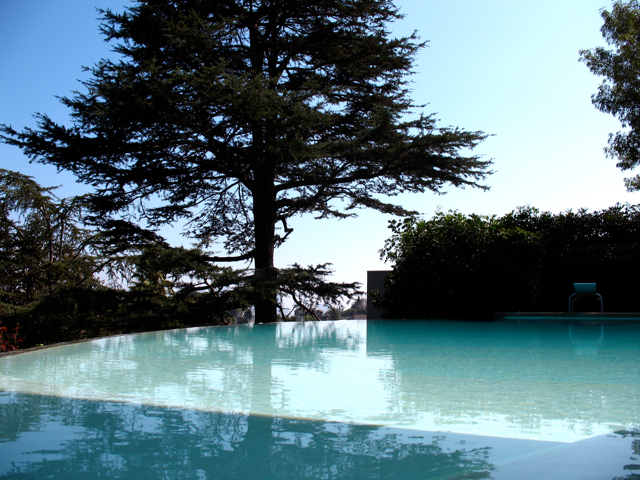
Widely credited as America’s first true infinity-edge swimming pool, the Silvertop pool was designed by Lautner to appear to overflow directly into the Silver Lake Reservoir in the valley below — a concept his office called “the Lautner Edge.” Commissioned by industrialist Kenneth Reiner, the house was John Lautner‘s first major use of post-tensioned concrete for architectural expression; its thin shell roof floats above full-height glass walls, and a motorized glass panel descended entirely into the floor at the touch of a button.
What Lautner could not have anticipated was the global industry his vanishing-edge concept would eventually spawn. Today, infinity pools are among the most replicated residential features on earth, maintained by everything from specialist dive teams to robotic pool cleaners that navigate curved surfaces and knife-edge overflow channels with programmed precision — technologies that would have seemed like science fiction to the engineers who first built Silvertop in the late 1950s. A former apprentice of Frank Lloyd Wright, Lautner set up his own practice in Los Angeles in 1940. The house was meticulously restored by Bestor Architecture in 2019.
Resources
- Safdie Architects – “Marina Bay Sands: Hotel and SkyPark” (safdiearchitects.com)
- Wikipedia – “Marina Bay Sands” (en.wikipedia.org)
- CNN Style – “Moshe Safdie on icons, idealism and redefining Singapore’s skyline” (cnn.com)
- Wikipedia – “Water Cube (National Aquatics Centre), Beijing” (en.wikipedia.org)
- PTW Architects – “Watercube — National Swimming Centre” (ptw.com.au)
- Arup – “National Aquatics Center (Water Cube)” (arup.com)
- ArchDaily – “Watercube — National Swimming Centre by PTW Architects” (2011)
- Hearst Castle State Historic Monument – “The Swimming Pools” (hearstcastle.org)
- Pioneering Women of American Architecture – “Julia Morgan” (pioneeringwomen.bwaf.org)
- Architectural Digest – “7 Incredible Pools Designed by Famous Architects” (2022)
- Victoria Kastner – Hearst Castle: The Biography of a Country House (Abrams, 2000)
- Wikipedia – “Bondi Icebergs Club” (en.wikipedia.org)
- Bondi Icebergs Swimming Club – Official website (icebergs.com.au)
- Seana Smith – “Icebergs Pool at Bondi Beach” (seanasmith.com)
- Zaha Hadid Architects – “London Aquatics Centre” (zaha-hadid.com)
- ArchDaily – “London Aquatics Centre for 2012 Summer Olympics / ZHA” (2011)
- Wikipedia – “Piscine Molitor” (en.wikipedia.org)
- Hôtel Molitor Paris – Official history (mltr.fr)
- ArchDaily – “AD Classics: La Muralla Roja / Ricardo Bofill” (archdaily.com)
- Ricardo Bofill Taller de Arquitectura – Official project page (ricardobofill.com)
- 7132 Hotel – “Architecture” (7132.com)
- ArchDaily – “Thermal Baths in Vals / Peter Zumthor” (archdaily.com)
- Lucas Harari – Swimming in Darkness (Seuil, 2017)
- Frank Lloyd Wright Foundation – “Fallingwater” (franklloydwright.org)
- Western Pennsylvania Conservancy – Official Fallingwater site (fallingwater.org)
- UNESCO World Heritage Centre – “The Architectural Work of Frank Lloyd Wright” (2019)
- Barragán Foundation – “Gilardi House, Mexico City, 1975–1977” (barragan-foundation.org)
- ArchDaily – “Architecture Classics: Gilardi House / Luis Barragán” (2023)
- ArchDaily – “Architecture Classics: Leça Swimming Pools / Álvaro Siza” (archdaily.com)
- Instituto da Habitação e da Reabilitação Urbana – IHRU National Monument designation (2006)
- Oscar Niemeyer Foundation – “Casa das Canoas” (niemeyer.org.br)
- ArchDaily – “Casa das Canoas / Oscar Niemeyer” (archdaily.com)
- Archiscene – “Casa Monterrey by Tadao Ando” (archiscene.net)
- PLAIN Magazine – “The Enduring Beauty of Tadao Ando’s Casa Monterrey” (plain-magazine.com)
- Barragán Foundation – “Cuadra San Cristóbal, Atizapán de Zaragoza, 1966–1968” (barragan-foundation.org)
- Dwell – “The Untold Stories Behind the Legendary Homes of Luis Barragán” (2019)
- ArchDaily – “Silvertop / John Lautner” (archdaily.com)
- John Lautner Foundation – Project documentation (johnlautner.org)
- Bestor Architecture – “Silvertop Restoration” (bestorarchitecture.com, 2019)

