

Americans spend 90 percent of their lives in buildings breathing air that is two to five times more polluted than the air outside. There is no federal law governing it. There is no agency responsible for it. And a pandemic that briefly made this visible has, for most institutions, already been forgotten.
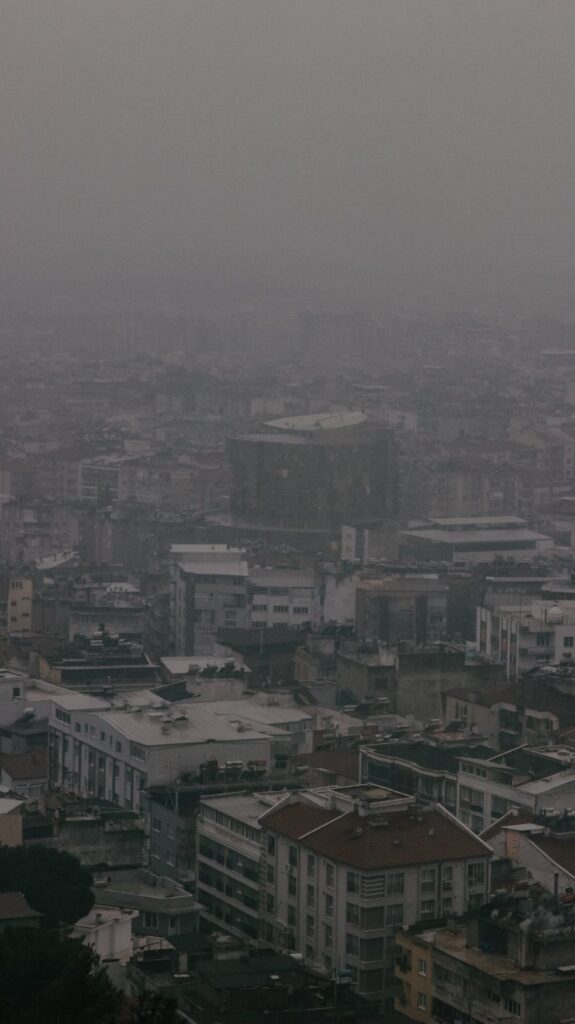
On the morning of June 7, 2023, a school district in New Jersey cancelled outdoor activities. An office tower in midtown Manhattan sent workers home. An air quality alert covered seventeen states. The sky above New York City had turned the color of an old bruise, the sun a flat orange disc filtered through smoke from Quebec wildfires burning twelve hundred miles away. The air had a color. It had a smell. And for people who study indoor air quality, the spectacle was equal parts vindication and despair — vindication because it illustrated, in the most theatrical possible terms, what researchers had spent decades arguing; despair because, within weeks, the conversation had moved on. The sky cleared. The monitors were packed away. Nothing changed.
This is not a COVID story, though COVID is part of it. It is a story about infrastructure — the oldest and most neglected piece of infrastructure in the built environment. The pipes that carry clean water to taps, the standards that govern what factories can emit: these represent political decisions, made over decades, that the public has a right to breathe and drink in a protected environment. Indoor air has never received that decision. It remains the last dimension of the built environment in which almost anyone can expose almost anyone to almost anything, and nobody is legally responsible for what happens next.
Americans spend approximately 90 percent of their lives indoors — a figure drawn from a National Human Activity Pattern Survey led by Neil Klepeis at Lawrence Berkeley National Laboratory, still the most comprehensive of its kind. The EPA’s own data finds indoor air pollutant concentrations two to five times higher than outdoor levels under normal conditions, reaching one thousand times higher during activities like paint stripping. The EPA’s Science Advisory Board has placed indoor air pollution among the top five environmental risks to public health for over thirty years. There is still no federal law governing it.
What Is Actually in the Air
Volatile organic compounds — VOCs — off-gas continuously from furniture, carpet adhesives, paints, cleaning products, and engineered wood products. The EPA estimates indoor VOC concentrations are consistently up to ten times higher than outdoors. Formaldehyde, classified by IARC as a Group 1 known human carcinogen, is emitted by particleboard, MDF, composite flooring, and upholstered furniture at concentrations that routinely exceed California’s chronic exposure limits in newly furnished spaces. Radon, a radioactive gas that seeps through foundation cracks, is the second leading cause of lung cancer in the United States after smoking and the leading cause among non-smokers — the EPA estimates it kills approximately 21,000 Americans annually. There is no federal requirement to test for it.
PM2.5 — fine particulate matter smaller than 2.5 microns in diameter — penetrates deep into the lungs and enters the bloodstream. Indoors, it is generated by cooking, candles, smoking, and, increasingly, wildfire smoke infiltrating through building envelopes. A pan-frying session in a residential kitchen can produce peak PM2.5 concentrations exceeding 200 micrograms per cubic meter — forty times the WHO annual guideline. Research by Rob Jackson and colleagues at Stanford, published in Science Advances in 2024, linked gas stove nitrogen dioxide emissions to 200,000 current cases of childhood asthma, with an annual societal cost of one billion dollars. Carbon dioxide, produced by human respiration, accumulates in poorly ventilated spaces and impairs cognition at levels ordinary offices reach every afternoon. PFAS — forever chemicals released from carpets, textiles, and building coatings — are documented in indoor air at four to six times outdoor concentrations. Ultrafine particles from laser printers emit at rates of 10 to 100 billion particles per minute. Mold, affecting 15 to 50 percent of indoor environments, raises respiratory disease risk by up to 75 percent.
The picture is not one of a single toxin requiring a targeted regulation. It is a systemic condition produced by how buildings are designed, built, furnished, and operated — addressed in the United States almost exclusively by voluntary guidelines that most buildings do not follow and that no agency is charged with enforcing.
COVID as Cautionary Tale
The pandemic did not create the indoor air quality problem. It illuminated it, briefly, like lightning over a landscape that had always been there. For the first six months of COVID-19, global health authorities insisted the virus spread through large respiratory droplets requiring close contact. The CDC did not acknowledge aerosol transmission until October 2020 and has still not used the word “airborne” in official communications. The WHO waited until December 2021. As Richard Corsi, Dean of Engineering at UC Davis and chair of the National Academies’ subsequent committee on indoor PM2.5, put it: “The resistance was thick. The walls of the silo were thick. It’s been frustrating as hell from the very start.”
When the science was finally accepted, it produced an unprecedented moment of political attention. In May 2023, the CDC issued its first-ever ventilation target: at least five air changes per hour in occupied spaces. In June 2023, ASHRAE published Standard 241, the first professional standard governing the control of infectious aerosols in buildings, developed in an unprecedented 116-day sprint. Congress allocated $189.5 billion in school relief funds, a fraction designated for ventilation improvements. Joseph Allen, director of the Healthy Buildings Program at Harvard’s T.H. Chan School of Public Health, called the CDC target “a monumental shift. We haven’t had health-based ventilation standards.”
“These targets need to be codified. They need to go into building codes. That is not happening.” — Joseph Allen, Harvard T.H. Chan School of Public Health
Three years later, the assessment is sobering. ASHRAE Standard 241 remains a voluntary guideline adopted by no building code. The CDC recommendation carries no legal force. A 2024 CDC survey found only 34 percent of school districts had upgraded HVAC systems using pandemic relief funds, and only 8 percent had installed UV germicidal irradiation. Allen’s October 2024 article in the American Journal of Public Health was titled “Recommitting to Ventilation Standards for Healthy Indoor Air Quality” — the word “recommitting” doing considerable work. A major review in Science, signed by more than forty international researchers including Linsey Marr at Virginia Tech and Lidia Morawska at Queensland University of Technology, concluded that pre-pandemic research “did not lead to major changes in ventilation design, operation, and maintenance — the opposite was the case,” and called for mandatory indoor air standards in all public buildings. The buildings continued operating as designed. The pathogen was new. The failure of infrastructure was decades old.
The Cognitive Toll
The most underappreciated finding in the indoor air quality literature concerns not disease but thinking. In the landmark COGfx Study, published in Environmental Health Perspectives in 2016, Joseph Allen and colleagues at Harvard placed 24 professional workers in a controlled laboratory under three blinded conditions: conventional indoor air, a green building environment, and a green-plus environment with enhanced ventilation and lower VOC concentrations. Cognitive scores measuring crisis response, information usage, and strategic thinking were 101 percent higher in the green-plus condition versus conventional. A 400 ppm increase in CO2 — the difference between a well-ventilated office and one mid-afternoon with the windows sealed — was associated with a 21 percent decrease in cognitive performance. A 2021 global follow-up tracking 302 workers across six countries found that for every 500 ppm increase in CO2, work throughput dropped by 2.1 to 2.4 percent, with no lower threshold at which air quality improvement ceased producing cognitive benefit.
In schools, the implications are stark. Haverinen-Shaughnessy and colleagues, studying 70 elementary schools with 3,109 students, found schools with above-average ventilation had 13 to 14 percent higher proportions of students scoring satisfactorily in mathematics and reading. William Fisk’s 2017 review in Indoor Air, synthesizing eleven studies, described the association as “compelling,” with gains ranging from a few percent to fifteen percent. A 2024 systematic review of 125 studies found the median CO2 concentration across 2,444 classrooms globally was 1,487 ppm — 81 percent exceeding the recommended 1,000 ppm threshold. The classrooms are not unusual. They are representative.
“A 400 ppm increase in CO2 — the difference between a well-ventilated room and an ordinary office on a busy afternoon — is associated with a 21 percent decrease in cognitive performance.”
None of these effects register as an emergency. Nobody collapses. Nobody coughs. The productivity loss, the sluggishness, the difficulty retrieving information — these are attributed to the work, to the hour, to how much coffee was consumed. The building is invisible as a cause precisely because its effects feel like ordinary life.
Climate Changes the Calculation
The 2023 Canadian fire season burned over 18 million hectares — more than seven times the historic annual average. On June 7, New York City recorded a daily mean PM2.5 of 100.9 micrograms per cubic meter against a WHO annual guideline of 5. The AQI exceeded 400 in parts of the city — the worst air quality in the world that day. Emergency department asthma visits jumped 43 percent above baseline. Approximately 123 million people were under air quality alerts. People were told to stay inside. Many of them were already inside. And research by Lawrence Berkeley National Laboratory shows that staying inside is not the protection it sounds like.
LBNL modeling found that 33 to 44 percent of outdoor PM2.5 increases penetrate indoors even in homes with central air and closed windows. In homes with typical infiltration and no central air, the figure rises to 64 to 80 percent. An Alberta campus study published in ACS ES&T Air in 2024, monitoring 24 mechanically ventilated buildings during wildfire events, found 71 percent exceeded Canada’s daily PM2.5 limit despite closed windows and running HVAC. The difference between MERV-8 and MERV-13 filters — a specification choice costing perhaps $20 more per change — was an indoor-to-outdoor PM2.5 ratio of 0.28 versus 0.12. The filter grade is not incidental. It is the architecture.
The trajectory is not improving. A landmark study in Nature in September 2025 by Minghao Qiu at Stony Brook and Marshall Burke at Stanford projected wildfire smoke PM2.5 exposure will increase two to three times by 2050 relative to the 2011–2020 baseline. Under a high-warming scenario: 71,420 excess deaths per year from wildfire smoke by 2050, cumulative excess deaths of 1.9 million between 2026 and 2055, and monetized annual damages of $608 billion. Climate Central’s 2025 analysis found every county in the contiguous US now experiences at least sixteen wildfire smoke days per year; per-person exposure was four times higher during 2020–2024 than the prior fifteen years.
The January 2025 Los Angeles fires added a dimension most public discourse has not absorbed: the indoor air problem does not end when the fire does. The LA Fire HEALTH Study, anchored by Harvard’s Healthy Buildings Program with sensor data from over 1,000 homes, found PM2.5 penetrating indoors throughout the basin with effects extending more than two miles from burn areas. Post-fire field measurements of nineteen homes found lead concentrations exceeding EPA dust clearance levels on window sills and floors weeks after the fires were out.
Climate change also creates a failure that runs in the opposite direction. During extreme heat events, occupants close windows, HVAC systems reduce outdoor air intake under thermal load, and elevated temperatures accelerate VOC off-gassing from building materials. The logic of heat adaptation — seal the building, run the air conditioning — is the logic of indoor air degradation. The two problems are in direct conflict. Most buildings are equipped to address neither.
Schools: The Deferred Emergency
If one wanted to design a setting that maximized the adverse effects of poor indoor air on the largest number of people, a school would be a strong candidate. High occupancy density in small rooms. HVAC systems installed before the modern environmental movement. Children, who breathe more air per unit of body weight than adults and whose developing lungs, cardiovascular systems, and brains are more vulnerable to pollutant exposure. And parents who cannot see what is happening inside the building where their children spend six hours a day.
The GAO’s 2020 report found 41 percent of US school districts needed to update or replace HVAC systems in at least half their schools — approximately 36,000 buildings. The ASCE 2025 Infrastructure Report Card noted the average age of main instructional buildings in US public schools is 49 years, with 38 percent built before 1970. Lawrence Berkeley National Laboratory researchers studying 104 classrooms that had recently been retrofitted with new HVAC units found only 15 percent met California’s minimum ventilation standard. The retrofits had been installed. The systems were running. They were not delivering the air the standard required. A related LBNL study found that raising all California classrooms to state standard would decrease illness absence by 3.4 percent, increase attendance-linked funding by $33 million annually, and cost approximately $4 million to implement. The benefit-to-cost ratio was over eight to one. The upgrade was not made.
In the United Kingdom, the government distributed 300,000 CO2 monitors to schools from December 2021 — one of the few concrete IAQ improvements to survive the return to normal. A 2025 nationwide study of 322 schools found mean ventilation rates of 5.3 litres per second per person, well below the recommended minimum, with schools in poorer areas performing consistently worse. The air inside a school is not just an environmental quality measure. It is an equity measure.
What the Evidence Says About CO2 and Learning
| CO2 Level (ppm) | Conditions / Effect | Source |
| < 800 | Good ventilation indicator; target for schools | UK Govt; ASHRAE 62.1 |
| 1,000 | ASHRAE action threshold; cognitive effects begin | ASHRAE; COGfx Study |
| 1,200 | Belgian mandatory action level; drowsiness common | Belgian IAQ Law, 2022 |
| 1,487 | Global median across 2,444 classrooms (systematic review) | Buildings, Dec. 2024 |
| > 1,500 | Poor ventilation; UK high-concern threshold | UK #CleanAirSchools |
| 2,000+ | Significant cognitive decline; headaches | Allen et al., EHP 2016 |
| 5,080 | 99.9th percentile daily max in Boston Public Schools | Fabian et al., 2025 |
Source: COGfx Studies (Harvard/Syracuse); Boston University–BPS partnership; 2024 Buildings systematic review; Belgian Federal Law of 6 November 2022; UK government CO2 monitor programme.
Patricia Fabian at Boston University partnered with Boston Public Schools to install 3,659 commercial IAQ monitors across 125 buildings over the 2022–2023 school year, generating 245 million CO2 measurements. The average school-day reading was 841 ppm — a figure that sounds reassuring until you consider that over half of Boston’s school buildings predate the 1940s, and that the 99.9th percentile of daily maximum readings reached 5,080 ppm. For parents and administrators who want to understand what is happening in their own buildings before waiting for institutional action, air quality monitors and testing kits have become an accessible first line of evidence. The EPA estimates poor indoor air quality contributes to nearly 14 million missed school days annually due to asthma alone.

The Regulatory Vacuum
There is no comprehensive federal indoor air quality law. OSHA has jurisdiction over specific chemicals but does not regulate general air quality. The EPA regulates outdoor air under the Clean Air Act and provides voluntary IAQ resources. It does not regulate indoor air as an environment. ASHRAE sets ventilation standards adopted in some states at time of construction — but these require no monitoring or compliance verification once occupancy begins. The Federal Interagency Committee on Indoor Air Quality, established by Congress in 1983, coordinates research. It sets no enforceable standards.
The contrast with clean water and outdoor air is instructive. An RMI analysis from October 2023 calculated that Clean Air Act enforcement reduced outdoor pollutant emissions 78 percent from 1970 to 2020, with benefits exceeding costs by more than thirty to one — $2 trillion in avoided health costs in 2020 alone. The authors estimated that parallel indoor air protections could produce comparable reductions in illness, death, and absenteeism. They would require a legal framework that does not exist.
State governments are beginning to move. New York introduced five separate IAQ bills in 2025. Massachusetts introduced model legislation based on Johns Hopkins’ framework. California’s Title 24 already requires MERV-13 filtration. The most significant precedent internationally is Belgium, which enacted a comprehensive indoor air quality law in November 2022 and issued an implementation decree in May 2024. Belgian law requires CO2 below 900 ppm in all public buildings by 2027, with mandatory monitors, documented action plans, and public certification. It is the first law of its kind in the Western world — passed not in response to a gradual scientific consensus but because a pandemic made the cost of inaction impossible to ignore. The United States has not made that decision. The Indoor Air Quality and Healthy Schools Act, introduced in the 118th Congress, did not pass. As Linsey Marr put it: “There was a flurry of activity about indoor air inspired by the pandemic, and now we need to take the next step.” That next step has not been taken.
What Architecture and Design Can Do
The absence of regulation does not mean the absence of solutions. It means the solutions are made selectively — by clients who know to ask, designers who know to specify, and buildings that get certified to voluntary standards most buildings never encounter. The technical toolkit is mature. The problem is not knowledge. It is distribution.
Ventilation is the foundation. Energy Recovery Ventilators, which recover both heat and moisture from exhaust air before bringing in fresh outdoor air, achieve sensible recovery efficiencies of 70 to 85 percent, reducing the energy penalty of ventilation by 20 to 40 percent. Heat Recovery Ventilators achieve similar thermal efficiency without moisture transfer, and how heat recovery systems work is worth understanding before any commercial ventilation brief is written. These are standard components of Passive House construction and are increasingly specified in commercial renovation. The barrier is specification — the decision, made early in design, to include performance targets and the mechanical systems that meet them.
MERV filter ratings — the specification that determined building performance during the 2023 wildfire events — deserve close attention. Most commercial buildings operate with MERV-8 filters, largely ineffective against PM2.5. The EPA, CDC, and ASHRAE now recommend MERV-13 as a minimum for occupied commercial spaces. MERV-13 captures at least 50 percent of particles in the 0.3 to 1 micron range that dominate wildfire smoke and penetrate deepest into the lungs. The cost differential is $15 to $25 per filter change. The barrier is that systems designed for MERV-8 cannot simply accept MERV-13 without engineering review of the additional airflow resistance, which is precisely why excellent HVAC specification at the design stage costs a fraction of what any meaningful retrofit demands later.
The Corsi-Rosenthal Box deserves mention as the most democratically significant innovation in indoor air quality history. Developed in August 2020 by Richard Corsi and Jim Rosenthal of Tex-Air Filters, the device is four or five MERV-13 filters arranged in a cube, sealed with duct tape, and topped with a 20-inch box fan. Assembly takes fifteen minutes; cost is $50 to $150. Research from UC Davis found clean air delivery rates of 600 to 850 cubic feet per minute — comparable to commercial air purifiers costing ten times as much. A Brown University study found the boxes reduced indoor PFAS concentrations by 40 to 60 percent and phthalates by 29 to 62 percent. At the 2022 White House Summit, Corsi stated: “These units can provide upwards of seven additional air changes per hour in a traditional classroom, at a cost of about one venti Caramel Frappuccino per student, per year.” The box is not a substitute for building-level ventilation. It is an illustration of how large the gap between available technology and actual deployment has become.
Green building certifications represent the most systematic effort to make indoor air quality a design constraint rather than an afterthought. WELL v2 designates air as its first concept, requiring PM2.5 below 15 micrograms per cubic meter, formaldehyde below 50, and CO2 maintained below 900 ppm, with all claims verified through annual on-site testing. The challenge is coverage: certified buildings remain a small fraction of occupied building stock, and the vast majority of schools, offices, and homes have never been assessed against any air quality standard.
One point should be made plainly, because it continues to circulate widely and to substitute for actual intervention: indoor plants do not clean the air. A 2019 analysis by Cummings and Waring at Drexel University, synthesizing 196 experiments across 30 years, calculated that achieving the ventilation equivalent of opening two windows would require between 10 and 1,000 plants per square meter of floor space. Plants provide genuine psychological and aesthetic benefits. Specifying them as an IAQ strategy is a displacement of attention from interventions that work.
The Economic Argument
Joseph Allen’s economic analysis estimated that doubling ventilation rates costs between $14 and $40 per person per year — dropping to $1 to $18 with energy-efficient equipment including heat and energy recovery ventilators. The corresponding productivity benefit, derived from the COGfx cognitive improvements, reaches $6,500 per person per year. Benefits exceed costs by a factor of more than 150. William Fisk at LBNL estimated $40 to $200 billion in annual US economic benefits from improved IAQ across respiratory disease reduction, sick building syndrome mitigation, and direct worker performance improvements, with benefits exceeding costs by factors of eight to fourteen.
The wildfire projections harden this calculation significantly. If Qiu and Burke’s Nature findings hold, wildfire smoke alone will impose $608 billion in annual economic damages in the United States by 2050. The building stock — its filter grades, ventilation rates, and envelope integrity — is the primary variable determining how much of that outdoor burden becomes an indoor burden. Upgrading commercial building filters to MERV-13 and specifying energy recovery ventilators in new construction would collectively reduce indoor wildfire smoke exposure by 60 to 80 percent at a cost that, amortized across a building’s life, is a fraction of one year’s projected damages.
“Clean indoor air is a human right. We have national ambient air quality standards for outdoor air, but nothing similar for indoor air.” — Joseph Allen, Harvard T.H. Chan School of Public Health
The argument that indoor air quality is too diffuse or too expensive to regulate does not survive the numbers. What it reflects is a distributional calculation: the costs of poor air fall across millions of individuals as sick days, impaired decisions, chronic illness, and shortened lives, while the costs of improving it are concentrated in buildings and institutions that must pay for the upgrade. This is the same calculation made about water treatment before the Safe Drinking Water Act and about outdoor air before the Clean Air Act. In both cases, the eventual decision was that distributed harm was real and political will was achievable. Indoor air is waiting for that decision.
The Infrastructure Decision
Linsey Marr has described the problem with the precision of a physicist: the particles are small, the pathways are invisible, and the harm is delayed. Nobody can point to the air they breathed last Tuesday and identify the specific VOC from new carpet contributing to their child’s asthma. The cause-and-effect chain is real but statistical rather than individual, and political institutions are poorly equipped to act on statistical harm to populations when the costs of prevention are concrete and immediate.
The scientific evidence is unambiguous. The economic case is documented. The tools exist. Belgium has passed a law. The CDC has issued a target. ASHRAE has written a standard. Forty international researchers have published a call to action in Science. What remains is the political decision: that the air people breathe in public buildings — in schools, offices, hospitals, transit stations, restaurants — is not a private matter between a building owner and an insurance company. It is infrastructure. It requires infrastructure standards.
The children in the classrooms where CO2 reaches 5,000 ppm on Tuesday afternoons are not having a bad day. They are being exposed to an infrastructure failure that is as real as a lead pipe and as preventable as a contaminated well. The difference is that nobody can see it. And, so far, nobody is required to fix it.
Resources
- Allen, J.G. — Recommitting to Ventilation Standards for Healthy Indoor Air Quality, American Journal of Public Health, 114(10), 991–993 (2024)
- Allen, J.G., MacNaughton, P., Satish, U., et al. — Associations of Cognitive Function Scores with Carbon Dioxide, Ventilation, and VOC Exposures in Office Workers, Environmental Health Perspectives, 124(6), 805–812 (2016)
- Allen, J.G., MacNaughton, P., Pegues, J., et al. — Economic, Environmental and Health Implications of Enhanced Ventilation in Office Buildings, International Journal of Environmental Research and Public Health, 12(11), 14709–14722 (2015)
- ASHRAE — Standard 241-2023: Control of Infectious Aerosols (June 2023)
- Belgian Federal Government — Law of 6 November 2022 on Indoor Air Quality / Royal Decree of 12 May 2024, mandatory standards effective January 1, 2027
- Chan, W.R., et al. — Ventilation Rates in California Classrooms: Why Many Recent HVAC Retrofits Are Not Delivering Sufficient Ventilation, Building and Environment, 170, 106602 (2020)
- Climate Central — Climate Change Worsens Wildfire Smoke, annual analysis update (2025)
- Cummings, B.E., and Waring, M.S. — Potted Plants Do Not Improve Indoor Air Quality, Journal of Exposure Science & Environmental Epidemiology, 30, 253–261 (2019)
- Dal Porto, R., et al. — Characterization of Corsi-Rosenthal Box Air Cleaners for Use Against SARS-CoV-2, Aerosol Science & Technology, 56(6), 524–539 (2022)
- EPA / Wallace, L.A. — Total Exposure Assessment Methodology (TEAM) Study, EPA/600/6-87/002a (1987)
- Fabian, P., et al. — Decision Tools for Schools Using Continuous Indoor Air Quality Monitors: A Case Study of CO2 in Boston Public Schools, Lancet Regional Health – Americas (2025)
- Fisk, W.J. — The Ventilation Problem in Schools: Literature Review, Indoor Air, 27(6), 1039–1051 (2017)
- Fisk, W.J. — Estimates of Potential Nationwide Productivity and Health Benefits From Better Indoor Environments, Lawrence Berkeley National Laboratory, LBNL-48218 (2000, updated 2011)
- U.S. Government Accountability Office — K–12 Education: School Districts Frequently Identified Multiple Building Systems Needing Updates or Replacement, GAO-20-494 (2020)
- U.S. Government Accountability Office — K–12 Education: School Districts Reported Spending Initial COVID Relief Funds, GAO-24-106913 (2024)
- Haverinen-Shaughnessy, U., and Shaughnessy, R.J. — Effects of Classroom Ventilation Rate and Temperature on Students’ Learning Performance, PLOS ONE, 10(8) (2015)
- Kashtan, Y.S., et al. — Gas and Propane Combustion From Stoves Emits Benzene and Increases Indoor Air Pollution, Science Advances, 10(18) (2024)
- Klepeis, N.E., et al. — The National Human Activity Pattern Survey (NHAPS), Journal of Exposure Science & Environmental Epidemiology, 11(3), 231–252 (2001)
- Laurent, J.G.C., Allen, J.G., et al. — Associations Between Acute Exposures to PM2.5 and Carbon Dioxide Indoors and Cognitive Function in Office Workers: A Multicountry Study, Environmental Research Letters, 16(9) (2021)
- Lawrence Berkeley National Laboratory — IAQ Science: Wildfires, Indoor Environment Group, ongoing research compilation
- Mendell, M.J., et al. — Association of Classroom Ventilation With Reduced Illness Absence, Indoor Air, 23(6), 515–528 (2013)
- Morawska, L., Allen, J.G., Bahnfleth, W., Marr, L.C., Miller, S., et al. — Mandating Indoor Air Quality for Public Buildings, Science, 383(6690), 1418–1420 (2024)
- National Academies of Sciences, Engineering, and Medicine — Health Risks of Indoor Exposure to Fine Particulate Matter and Practical Mitigation Solutions, DOI: 10.17226/27341, chaired by Richard Corsi (2024)
- Qiu, M., and Burke, M. — Wildfire Smoke Exposure and Mortality Burden in the USA Under Climate Change, Nature (2025)
- Rocky Mountain Institute — The Need for US Indoor Air Quality Guidelines (October 2023)
- WHO — Guidelines for Indoor Air Quality: Dampness and Mould, WHO Regional Office for Europe (2009)
- Yale School of Public Health / Chen, K., et al. — Canadian Wildfire Smoke Associated With Increased Asthma Cases in NYC (2024)

