

The bathroom sink — termed the lavatory sink, or simply the lavatory, in plumbing codes, manufacturer specifications, and most architectural drawings — is one of the most frequently specified fixtures in residential and commercial design, yet it is also one of the most variable. The two terms describe the same fixture: “bathroom sink” is the everyday, consumer-facing name, while “lavatory sink” is the term used on construction documents, fixture schedules, and accessibility standards. Installation method, material, and basin geometry combine into dozens of possible configurations, each with distinct implications for plumbing, accessibility, maintenance, and cost.
Eleven installation types account for nearly every bathroom sink — or lavatory sink — in circulation today: undermount, drop-in, vessel, wall-mounted, pedestal, console, integrated, trough, corner, farmhouse/apron-front, and semi-recessed. Each is examined below for its defining characteristics, typical materials, ideal applications, advantages and limitations, price range, and current popularity.
1. Undermount Sink
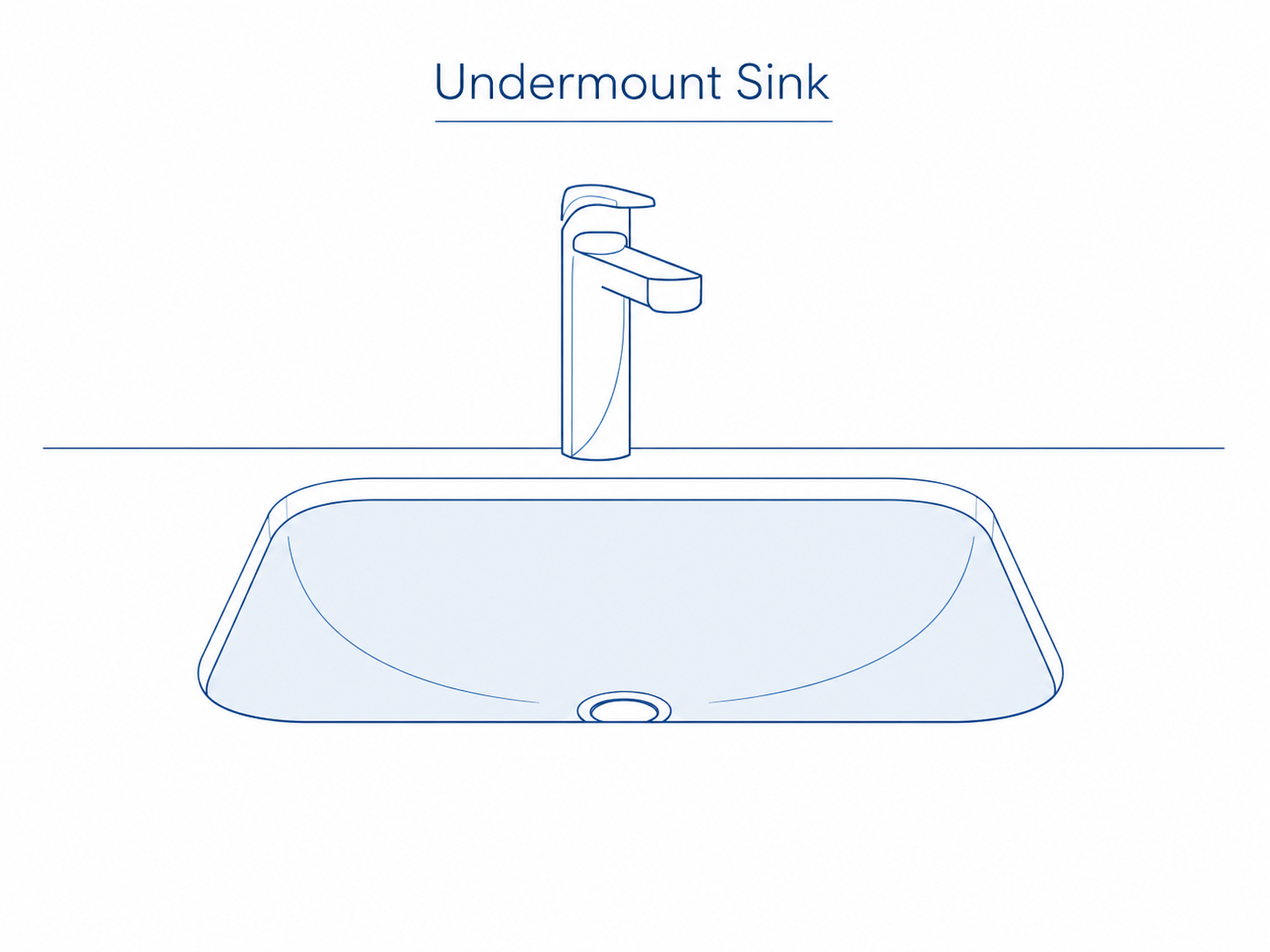
An undermount sink is fixed beneath the countertop so that the basin’s rim sits below the surface, leaving no lip or seam at counter level. The cutout is precision-finished and polished, and the basin is secured from below with clips, brackets, and a continuous silicone seal. Two reveal styles are used in fabrication: a “positive reveal,” where a small strip of counter edge remains visible around the opening, and a “flush” or “zero-reveal” detail, where counter and basin meet without interruption.
Undermount Sink
Classic · DominantMaterials — Vitreous china, fireclay, solid surface, stainless steel, and natural stone, paired with a solid, non-porous counter such as quartz, granite, marble, or solid surface.
Best For — Primary bathrooms and mid-to-high-end guest baths in contemporary and transitional schemes.
Advantages
- Debris and water wipe directly into the basin without catching on a rim
- The visible counter surface is maximized
- Reads as higher quality and tends to support resale value
Limitations
- Requires a compatible solid-surface or stone counter and professional fabrication
- Replacement later is more involved than with a drop-in
- The silicone joint requires periodic inspection and re-caulking
Unit Price
$100–$1,000
Installed
$250–$1,600
2. Drop-In / Self-Rimming Sink
The drop-in sink — also called self-rimming or top-mount — is lowered into a counter cutout from above, with a finished rim that overlaps and rests directly on the countertop surface. The rim itself bears the weight of the fixture, which is why this remains the simplest and most universally compatible installation method: it works with laminate, tile, solid surface, and stone alike.
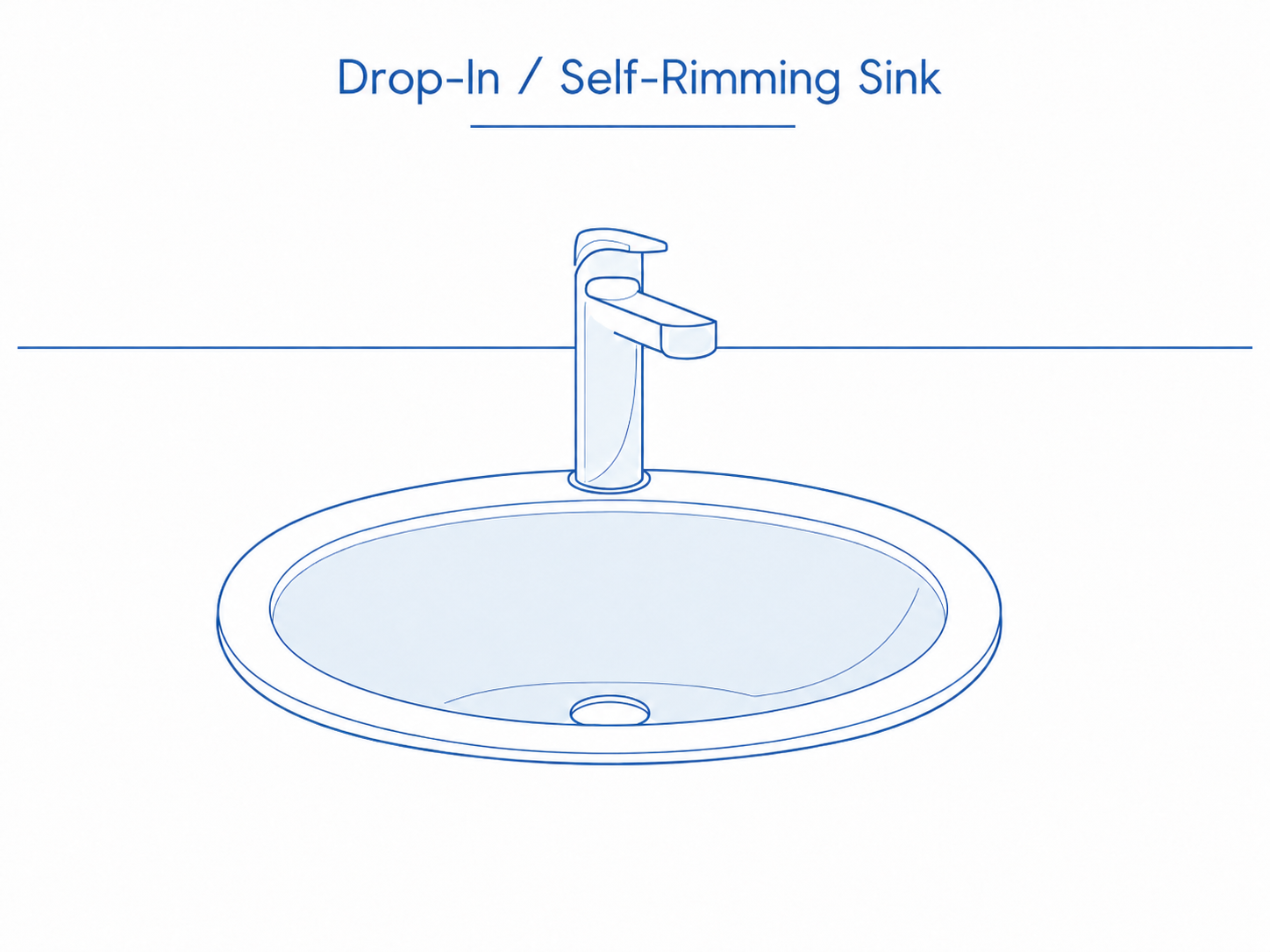
Drop-In Sink
Classic · Most CommonMaterials — Vitreous china and porcelain most commonly; stainless steel, glass, cast iron, and solid surface also widely available. Compatible with laminate, tile, solid surface, and stone alike.
Best For — Budget-conscious renovations, rentals, secondary and family bathrooms, and retrofits where the countertop cannot be modified.
Advantages
- Lowest installation cost and complexity of any type
- Compatible with virtually any countertop material
- Easy to replace without disturbing the counter
Limitations
- The visible rim creates a seam that collects grime
- It interrupts the counter's visual continuity
- The rim seal requires periodic maintenance and re-caulking
Unit Price
$75–$500
Installed
$200–$700
3. Vessel Sink
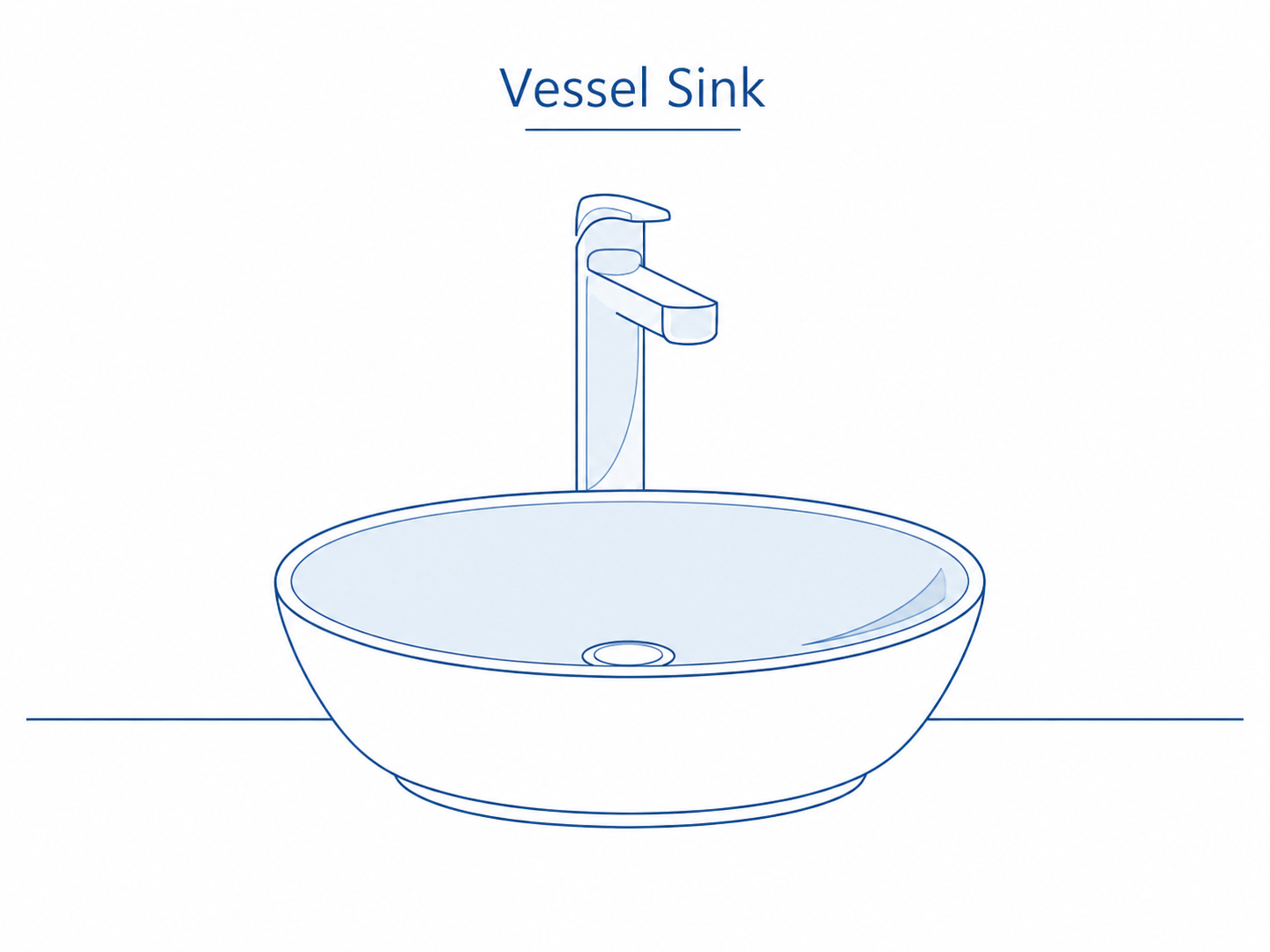
A vessel sink sits entirely above the countertop, resembling a basin or bowl rather than a recessed fixture — a direct descendant of the freestanding wash basin that preceded built-in plumbing. Installation requires only a small drain cutout and a bead of silicone at the base, making it one of the simplest fixtures to install or later replace. Most vessel basins have no overflow channel, which means they must be paired with a no-overflow grid or push-style drain rather than a standard pop-up.
Vessel Sink
Statement · PolarizingMaterials — The widest material range of any type: tempered glass, ceramic, natural stone, hammered copper, concrete, marble, and sealed or petrified wood.
Best For — Powder rooms and design-forward primary ensuites where the sink is intended as a focal point.
Advantages
- Functions as a sculptural centerpiece with near-unlimited shapes and materials
- Simple to install and to swap out later
- Exposes more of the countertop surface
Limitations
- Vanity height must be reduced or the finished rim sits uncomfortably high
- Splashing at the base is more pronounced than with recessed types
- Requires a tall-body or wall-mounted faucet to clear the rim
Unit Price
$100–$1,000+
Installed
$200–$1,500
4. Wall-Mounted Sink
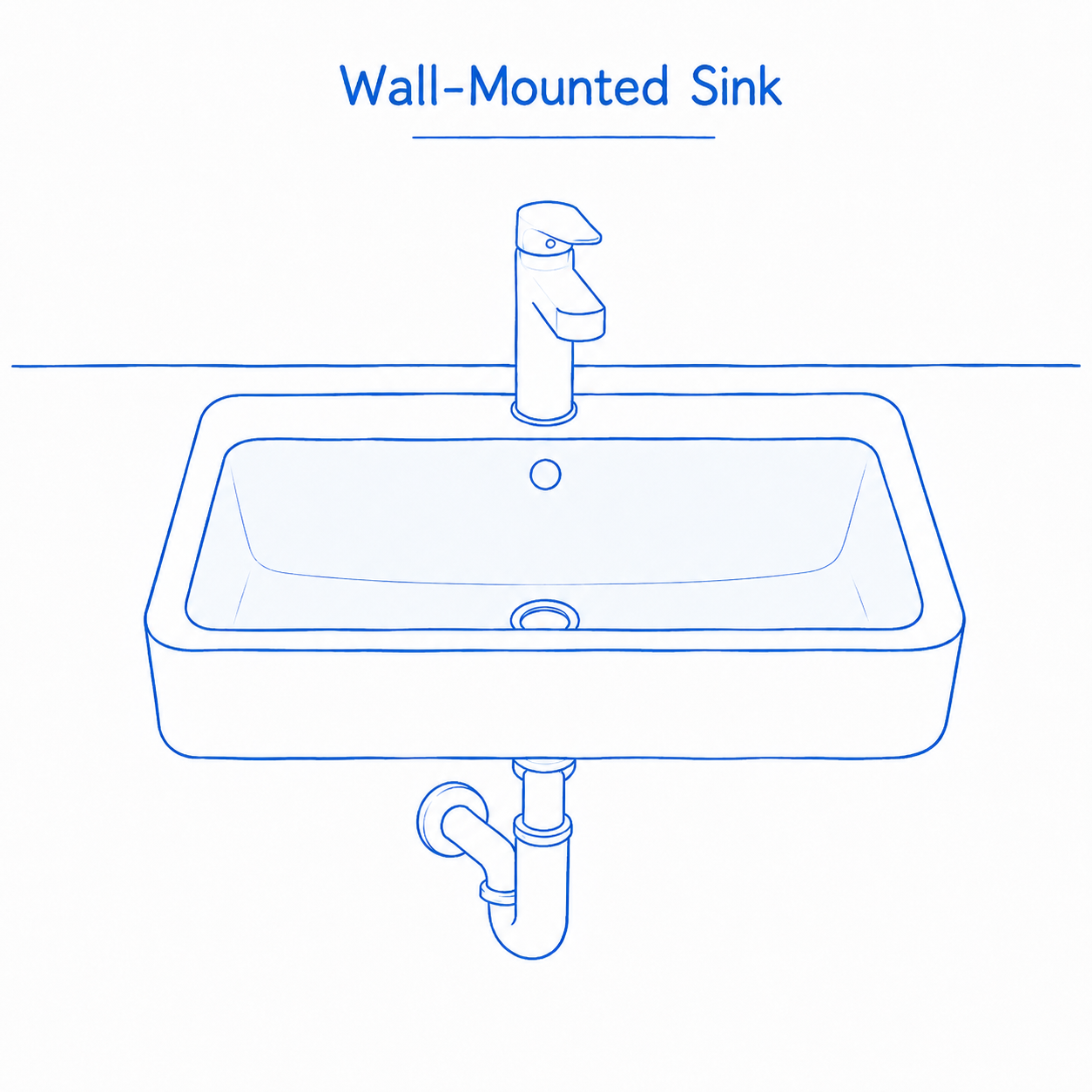
A wall-mounted sink — called a wall-hung lavatory in commercial and code documents — is cantilevered directly from the wall, with no vanity, pedestal, or supporting legs beneath it. The supply and waste plumbing are typically concealed within the wall, though exposed pipework is sometimes left intentionally visible in industrial or vintage-inspired interiors. Because the fixture is independent of any cabinetry, its mounting height is not fixed by furniture dimensions — it is set during rough-in and can be adjusted to suit the intended users.
Wall-Mounted Sink
Rising · MinimalistMaterials — Vitreous china and fireclay as standard; enameled cast iron for durability; solid surface, stone, and concrete also used. Plumbing is typically concealed in the wall.
Best For — Small bathrooms, powder rooms, guest baths, and accessible or ADA-compliant layouts.
Advantages
- Frees floor area and simplifies cleaning beneath the fixture
- Mounting height can be customized for the intended user
- Reads as minimal and architectural
Limitations
- Requires structural blocking within the wall, specified before drywall
- Offers no integrated storage or counter surface
- Concealed plumbing adds labor cost
Unit Price
$200–$1,000
Installed
$400–$1,600
5. Pedestal Sink
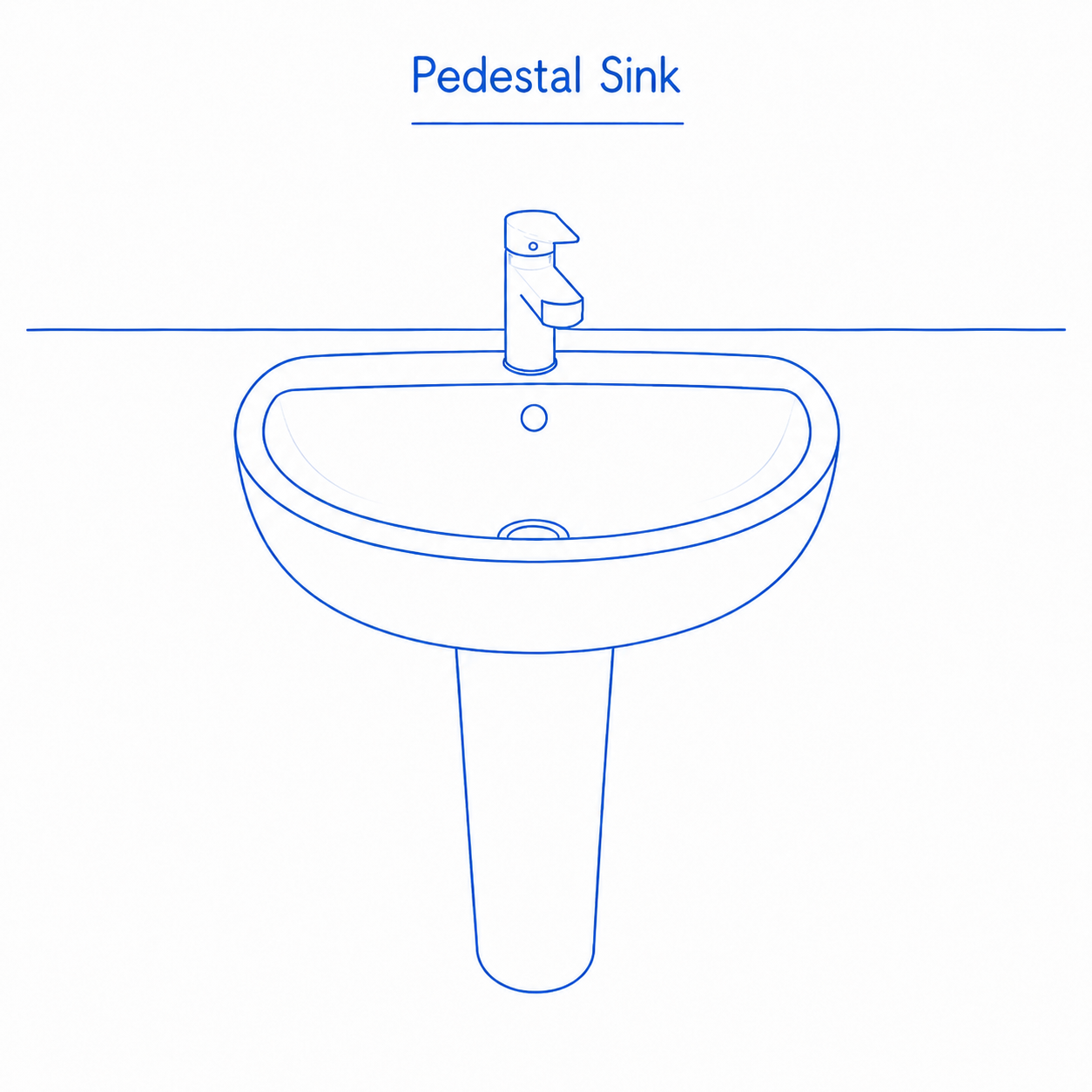
A pedestal sink — frequently specified as a “pedestal lavatory” on fixture schedules — pairs a wall-mounted basin with a slender freestanding column that conceals the supply lines and trap below. It is a two-piece composition — basin and pedestal — rather than a single molded unit, and it requires no supporting cabinetry of any kind.
Pedestal Sink
Classic · TraditionalMaterials — Predominantly vitreous china and porcelain; fireclay and cast iron in period and antique pieces. A two-piece basin-and-column composition requiring no cabinetry.
Best For — Powder rooms, small bathrooms, and traditional or period-style interiors.
Advantages
- Compact, classic silhouette that makes small rooms feel less crowded
- No cabinetry purchase or installation required
- Slender footprint suits tight floor plans
Limitations
- Provides no storage and minimal counter surface
- Fully concealed plumbing sometimes requires relocating supply and waste lines
- Limited to a specific traditional design vocabulary
Unit Price
$200–$800
Installed
$300–$1,200
6. Console Sink
A console sink combines a basin — often with an integral counter shelf — on a stand of two or four legs, typically metal, occasionally with a towel bar or small shelf built into the frame. It occupies a middle ground between the enclosed solidity of a vanity cabinet and the bare minimalism of a pedestal.
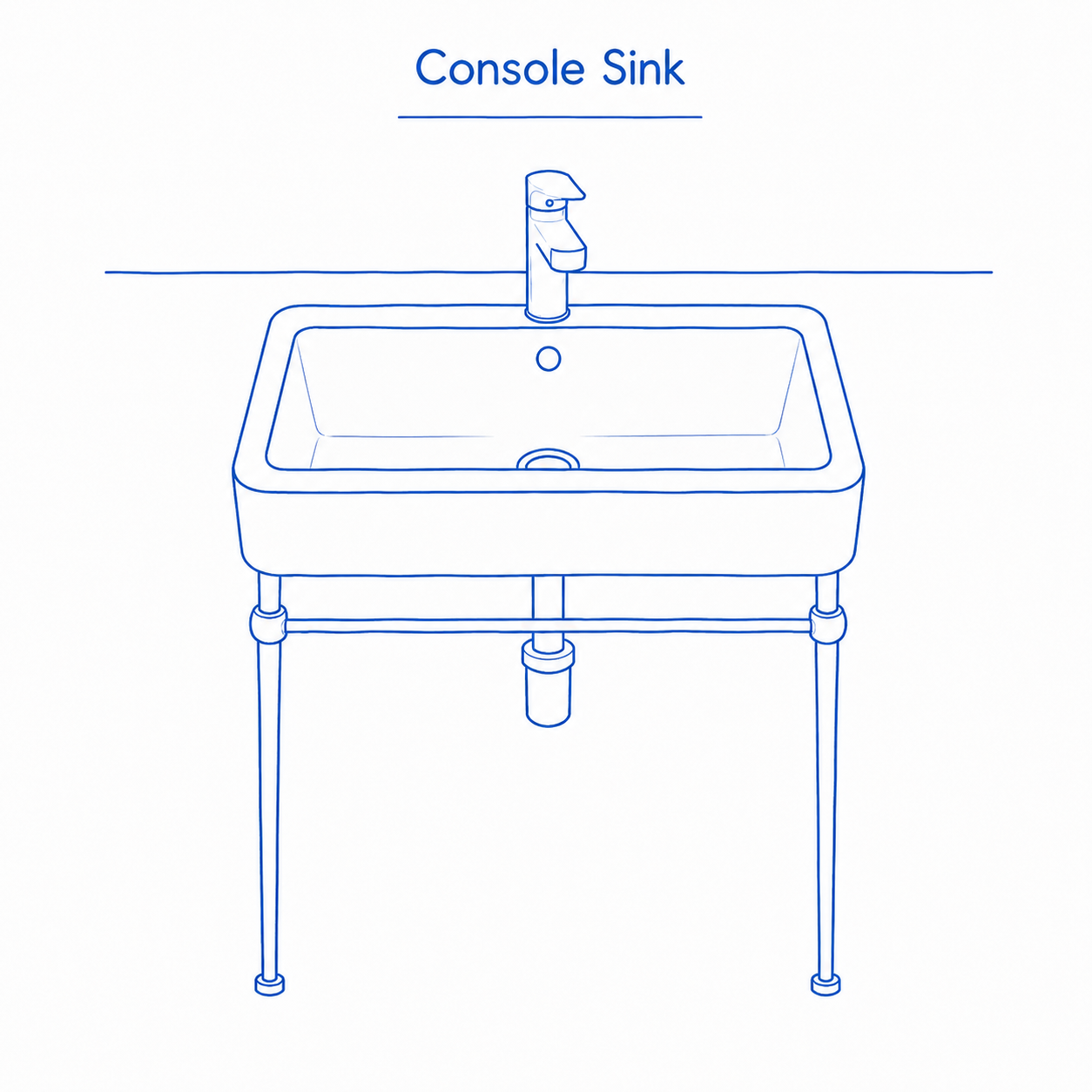
Console Sink
Classic · NicheMaterials — Basin generally vitreous china or fireclay; legs finished in brass, chrome, stainless steel, or ceramic. Often includes an integral counter shelf or towel bar.
Best For — Half baths, guest bathrooms, and transitional or traditional primary baths wanting an open, furniture-like fixture.
Advantages
- Reads as airy and architectural rather than utilitarian
- Provides limited but usable counter and towel-bar space
- Leg finish offers a decorative opportunity
Limitations
- Offers no enclosed storage
- Plumbing remains exposed beneath the basin
- Generally the most expensive type relative to its function
Unit Price
$200–$1,500
Installed
up to $2,000
7. Integrated / Molded Sink
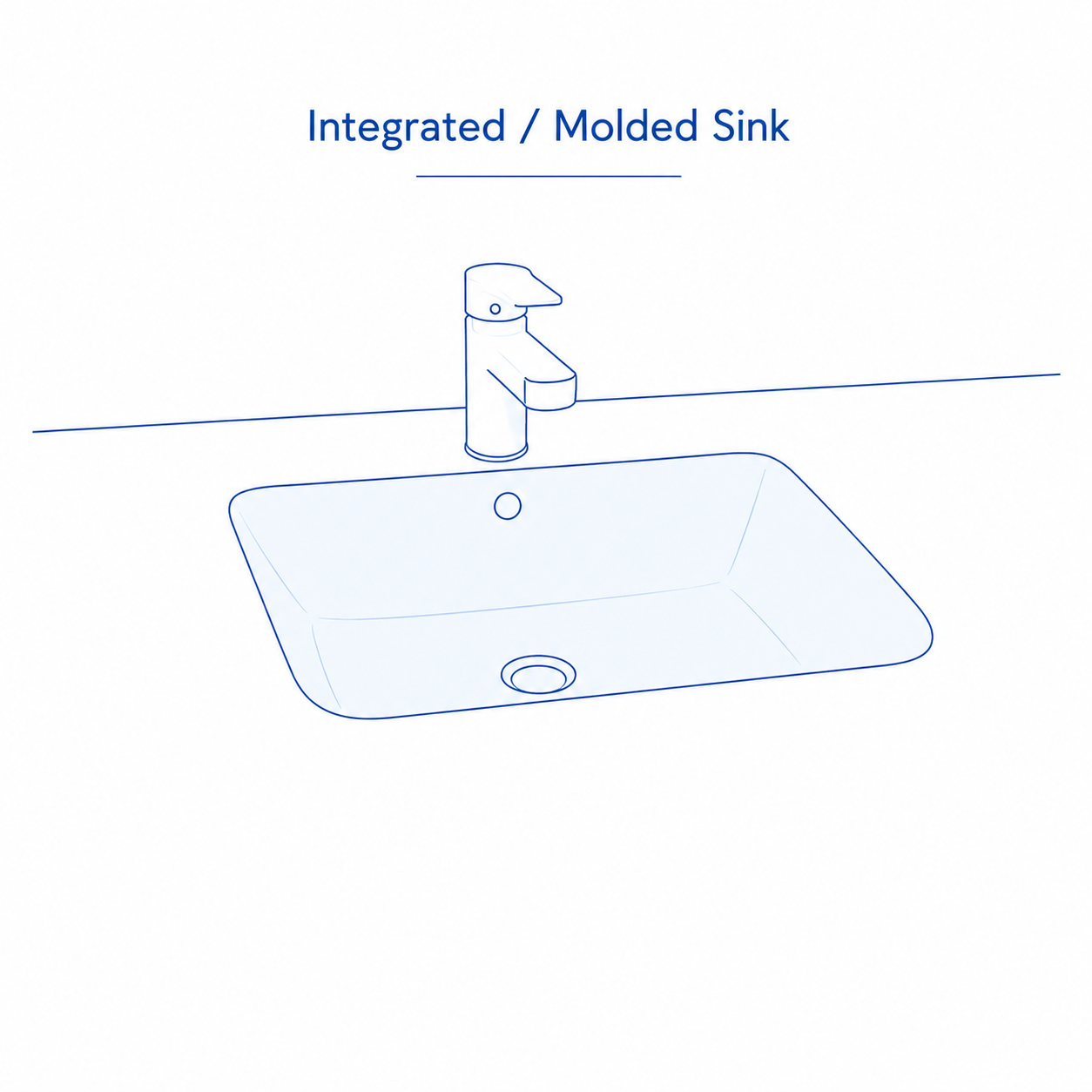
An integrated, or molded, sink is fabricated as a single continuous piece with the countertop, eliminating any seam or joint between basin and surface. This is most often achieved in solid surface material — acrylic-mineral composites such as Corian, originally developed by DuPont chemist Donald Slocum in 1967 and first sold commercially in 1971 — though cultured marble, custom quartz, porcelain, and concrete are also used.
Integrated / Molded Sink
Rising · SeamlessMaterials — Most often solid surface (acrylic-mineral composite); cultured marble, custom quartz, porcelain, and poured concrete also specified. Basin and counter are one continuous piece.
Best For — Contemporary primary bathrooms, and commercial, hospitality, and healthcare settings where seamless hygiene matters.
Advantages
- No joint for grime or bacteria to collect in — exceptionally easy to clean
- Solid surface is non-porous, repairable, and lightly sandable
- Reads as monolithic and architectural
Limitations
- Solid surface is not heat-resistant and can scorch
- Damage beyond sanding means replacing the whole top, not just the basin
- Requires fabrication as a single unit
Unit Price
+$100–$300 / basin
Installed
$420–$1,560 top
8. Trough Sink
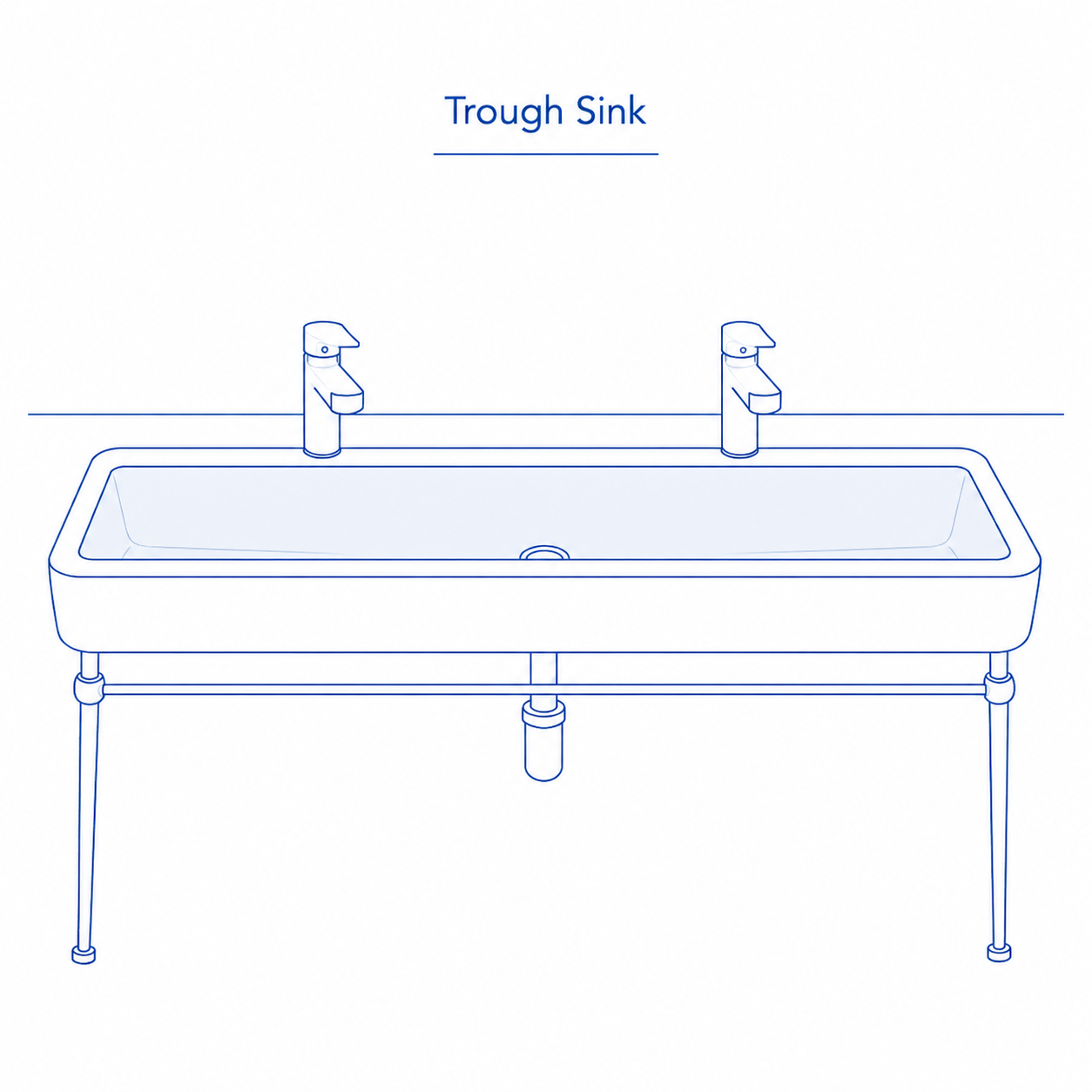
A trough sink is an elongated, continuous basin designed to serve more than one user at a time, typically fitted with two faucets spaced along its length. It can be mounted as a wall-hung, undermount, drop-in, or vessel fixture, and is used in both shared residential bathrooms and high-traffic commercial settings.
Trough Sink
Rising · Shared UseMaterials — Concrete composites, fireclay, stainless steel, solid surface, cast iron, and engineered resin. Mountable as wall-hung, undermount, drop-in, or vessel.
Best For — Shared primary or family bathrooms, and commercial, hospitality, or institutional restrooms.
Advantages
- Allows two users to wash at once without doubling the basins
- Presents a strong, continuous architectural line
- The unbroken surface is straightforward to clean
Limitations
- Often shallower than a standard basin, which increases splash
- Requires a wider wall or vanity run and frequent custom fabrication
- Two faucets and two drains add material and installation cost
Unit Price
$500–$1,500+
Installed
varies by run
9. Corner Sink
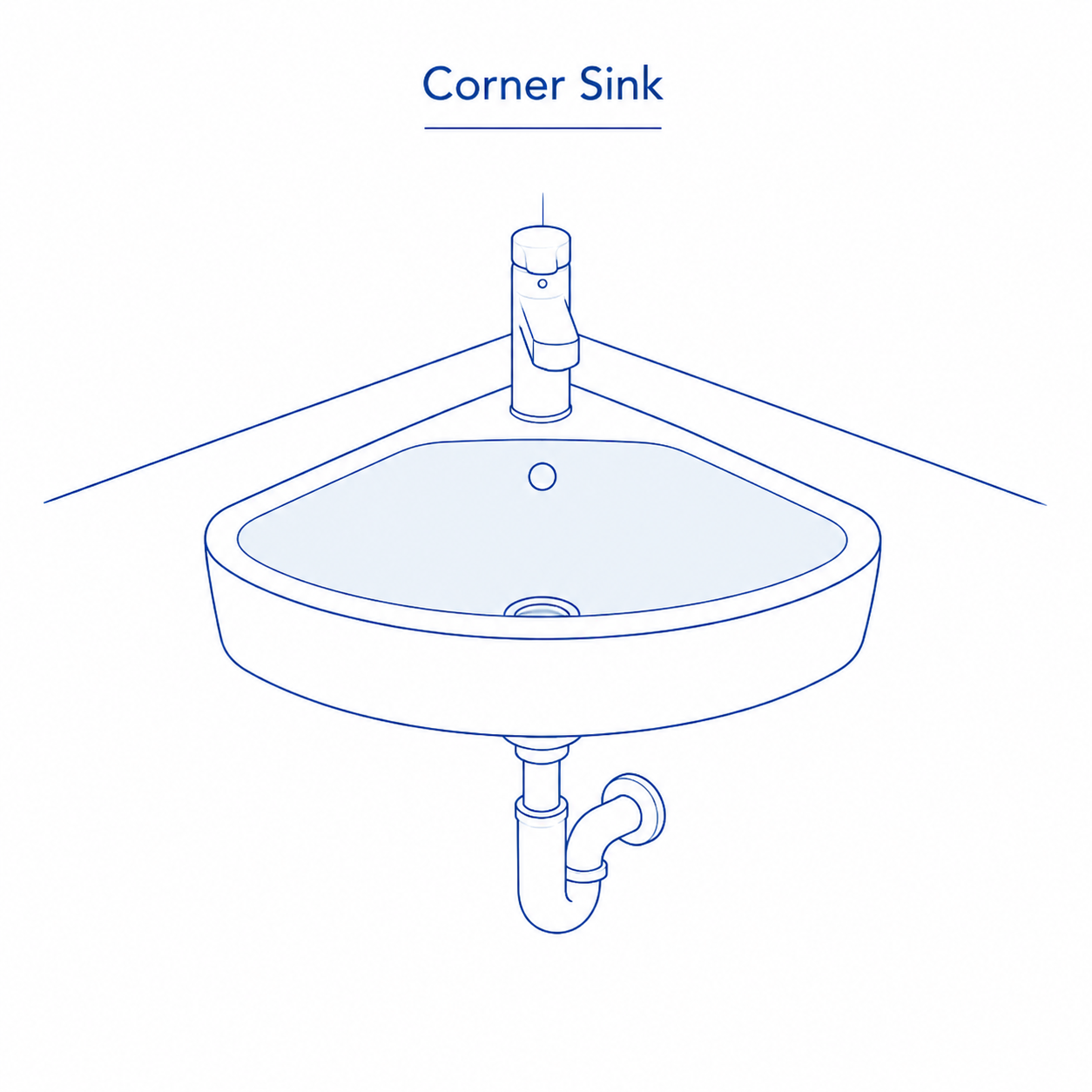
A corner sink is shaped — typically a quarter-circle or triangular basin — to fit directly into the intersection of two walls, conserving floor area that would otherwise go unused. It is available in drop-in, undermount, wall-mounted, and pedestal configurations.
Corner Sink
Utilitarian · Space-SavingMaterials — Vitreous china most common; stainless steel, ceramic, and composite also available. Quarter-circle or triangular basin in drop-in, undermount, wall-mounted, or pedestal form.
Best For — Very small half baths, under-stair conversions, and any space where a rectangular footprint will not fit.
Advantages
- Converts an unused corner into functional space
- Improves circulation in a constrained room
- Available across multiple mounting methods and finishes
Limitations
- Offers minimal counter or elbow room
- Out-of-square wall corners complicate a clean installation
- Specialty geometry can raise unit cost
Unit Price
$100–$600
Installed
$200–$800
10. Farmhouse / Apron-Front Sink
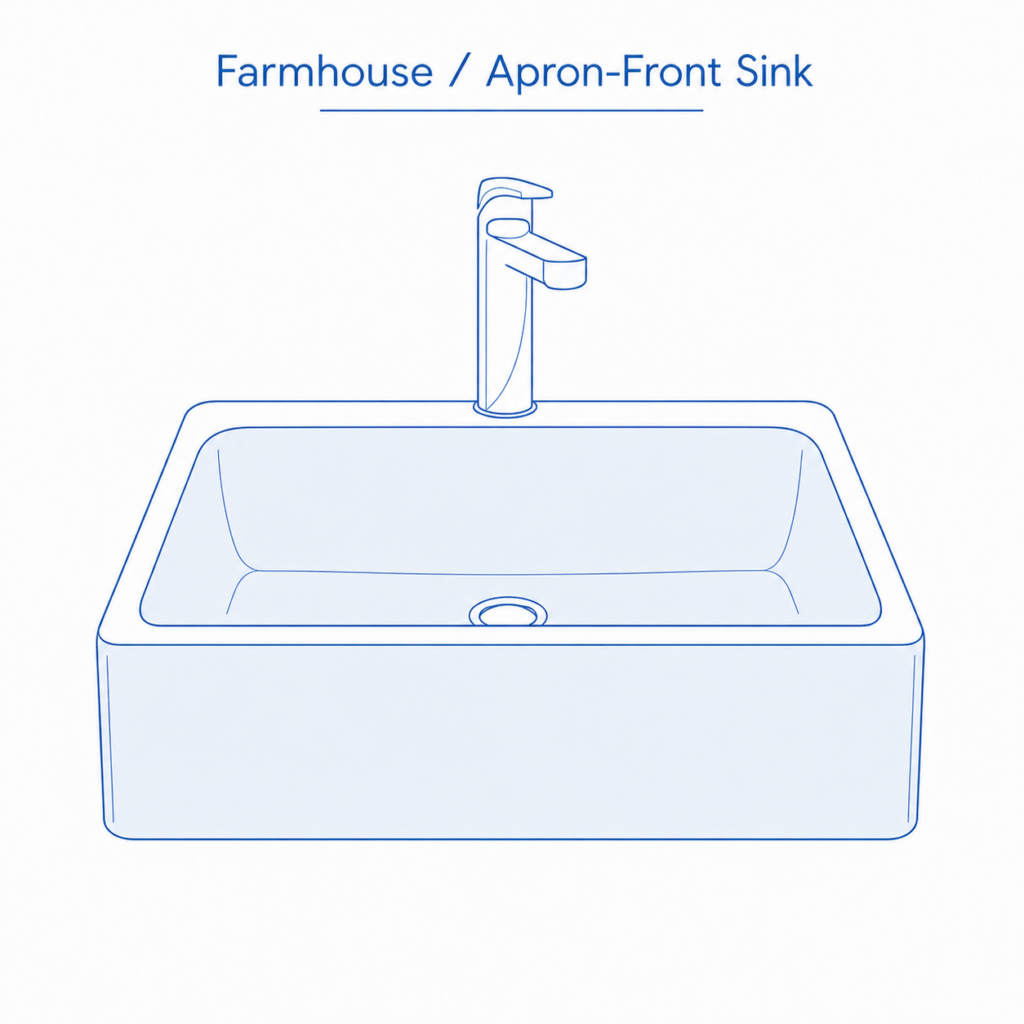
Originally a kitchen fixture, the farmhouse or apron-front sink has been adapted for bathroom use as a deep basin with an exposed, finished front panel that projects slightly beyond the cabinetry face. It can be installed as either an undermount or a drop-in fixture and requires a specially sized base cabinet, since the apron front replaces a portion of the cabinet’s standard face.
Farmhouse / Apron-Front Sink
Classic · RusticMaterials — Fireclay by far the most common, prized for its thick glaze; enameled cast iron, copper, stone composite, and stainless steel also used. Needs a specially sized base cabinet.
Best For — Farmhouse, rustic, cottage, and transitional bathrooms, especially adjacent to mudrooms or utility spaces.
Advantages
- Strong rustic or heirloom character with a genuinely useful deep basin
- Fireclay is non-porous and resists scratching and staining
- Enameled cast iron can be reglazed to a new color later
Limitations
- Considerably heavier than a standard basin — requires reinforced cabinetry
- Fireclay can develop cosmetic hairline crazing on the underside
- The aesthetic is tied to a specific design vocabulary
Unit Price
$400–$1,400+
Installed
varies by cabinet
11. Semi-Recessed Sink
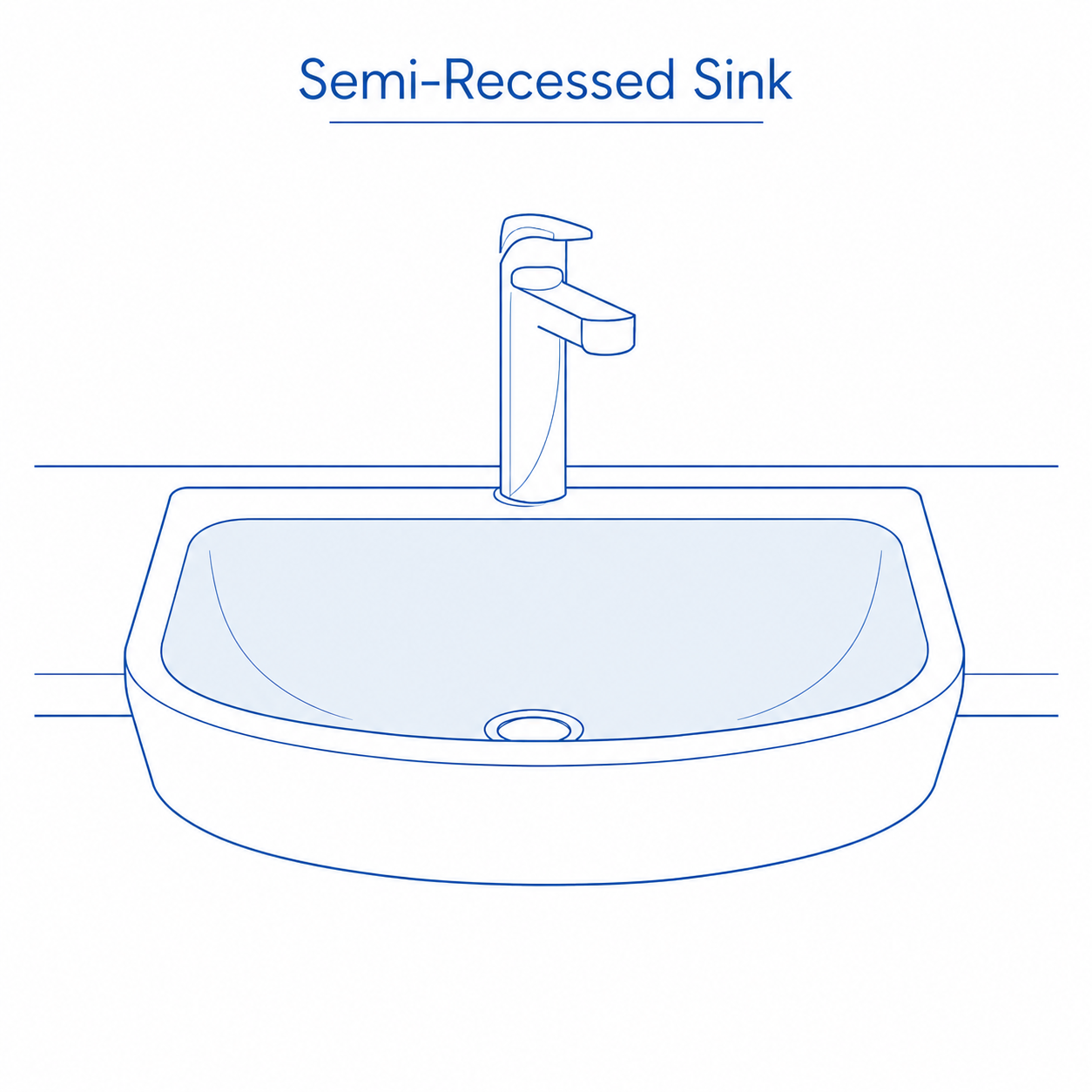
A semi-recessed sink is a hybrid configuration in which roughly one-quarter to one-third of the basin is set into the countertop while the remainder projects forward beyond the counter’s front edge. This combines some of the visual presence of a vessel sink with the stability and reduced height of a recessed fixture, and it allows for shallower vanity depths — in some specifications as narrow as 300mm — than a full vessel installation would require.
Semi-Recessed Sink
Rising · CompactMaterials — Ceramic and porcelain most common; solid surface, stone, and glass also used. Roughly one-quarter to one-third of the basin sets into the counter; the rest projects forward.
Best For — Compact bathrooms, ensuites, and cloakrooms where vanity depth is constrained but a vessel look is wanted.
Advantages
- Conserves vanity depth and floor space relative to a full vessel
- Brings the basin closer to the user, easing access
- Lower overall rim height than a comparable vessel sink
Limitations
- Requires precise countertop cutting and professional fitting
- The projecting front edge is more exposed to impact
- Narrower material range than fully recessed types
Unit Price
Mid-range ceramic
Installed
varies by material
Shape as a Secondary Design Variable
Installation type determines how a sink mounts; shape determines how it reads and performs. Round and oval basins are corner-free, easy to clean, and well suited to traditional and transitional bathrooms and to counters with limited width. Rectangular basins are the prevailing choice in contemporary design, offering more usable basin area along a counter run. Square basins read as minimal and symmetrical and are often specified for compact corner or powder-room applications. Single-bowl configurations remain standard for individual use; double-bowl or trough configurations are reserved for shared and high-traffic settings.
Materials in Depth
The material question behind every bathroom sink — or lavatory sink, in fixture-schedule language — ultimately reduces to a trade-off between cost, durability, and maintenance, largely independent of installation type.
Vitreous china is produced from clay, feldspar, and quartz, formed and then fired at approximately 2,200°F (1,200°C) to produce a hard, non-porous, easily sanitized surface. It remains the most widely used bathroom sink material on the strength of its combination of durability and affordability, though it can chip or crack under a hard, concentrated impact.
Fireclay is fired at comparably high temperatures with a thicker body and heavier glaze than standard vitreous china, giving it greater resistance to scratching and thermal stress. In bathroom, as opposed to kitchen, applications, the practical distinction between fireclay and vitreous china is narrower than marketing materials sometimes suggest — much of fireclay’s added durability comes from wall thickness and glaze depth rather than a fundamentally different ceramic chemistry. It carries a price premium and, owing to its weight, may call for additional cabinet or wall reinforcement.
Tempered glass is hard, non-porous, and stain-resistant, and is widely used for vessel basins where color and form are design priorities; it is more vulnerable to impact damage than ceramic and shows water spotting more readily.
Natural stone — marble, granite, travertine, and onyx among them — offers unique veining and a genuine sense of material luxury, but it is porous and requires periodic sealing and pH-neutral cleaning; acidic cleaners, including vinegar and lemon-based products, will etch the surface.
Concrete is fully customizable in form and color and reads as industrial-modern, but it requires resealing on a cycle of roughly three to five years for lavatory applications and can develop hairline cracking or chipping over time; fiber-reinforced composites such as Native Trails’ NativeStone reduce both weight and crack risk relative to plain poured concrete.
Copper and brass, sometimes described in the trade as “living metals,” develop a patina over time and have inherent antimicrobial properties; they should be cleaned only with mild soap, since acidic or abrasive cleaners will strip the developing patina.
Stainless steel is durable, hygienic, and resistant to odor and bacterial growth, more commonly specified in kitchens but available for bathroom use where an industrial or utilitarian aesthetic is intended.
Enameled cast iron consists of vitreous enamel fused to an iron substrate, producing an extremely durable, non-porous, stain-resistant surface; it is correspondingly heavy and requires adequate structural support, particularly in wall-mounted applications, but it can be reglazed to change color later in its service life.
Solid surface materials are roughly two-thirds mineral filler and one-third acrylic polymer binder, producing a non-porous, seamless, repairable surface that can be molded directly into an integrated countertop-and-basin assembly; its principal limitation is sensitivity to heat and to abrasive damage.
Faucet Types and Sink Pairing
Faucet selection is constrained directly by the sink or countertop’s pre-drilled hole configuration, making this one of the most common coordination errors in fixture specification if measured incorrectly.
Single-hole faucets use one deck hole, with the lever and spout integrated into a single body. They are the standard choice for undermount sinks, where the counter rather than the sink is drilled, vessel sinks fitted with a tall-body faucet, and compact or minimalist vanities generally.
Centerset faucets use three holes spaced 4 inches center-to-center, with handles and spout mounted on a single base plate. This remains the most common residential configuration, particularly for standard production vanities.
Widespread faucets use three separate components — two handles and a spout — spaced 8 inches or more apart, installed independently into the counter or sink deck. These read as more architectural and upscale and are typically reserved for larger vanities.
Wall-mounted faucets require no deck holes at all; the valve body is set into the wall during rough-in. This configuration has gained ground through 2025–2026 specifically because it preserves usable counter depth and is frequently the only practical option for vessel and trough sinks, where a deck-mounted faucet would need to clear a tall basin rim.
A single-hole faucet can typically be adapted to a three-hole deck using a cover plate, but a widespread faucet cannot be fitted to a 4-inch centerset cutout without modifying the countertop. Center-to-center spread should always be confirmed before ordering.
Countertop Compatibility
Each installation type imposes its own countertop requirement. Undermount sinks require a solid, non-porous material — stone, quartz, or solid surface — with a polished exposed edge; drop-in sinks are compatible with any countertop material, including laminate and tile, making them the most flexible category; vessel sinks need a waterproof surface and a correspondingly lower vanity height to keep the finished rim at a comfortable level; integrated sinks are inseparable from the countertop material itself, typically solid surface, quartz, or cultured marble; and pedestal, console, and wall-mounted sinks require no countertop at all, shifting the design consideration to the surrounding wall finish and any concealed or exposed plumbing.
Accessibility and Dimensional Standards
Bathroom sink height and clearance are governed by two overlapping bodies of reference: statutory accessibility codes, and the general architectural ergonomic data long compiled in works such as Ernst Neufert’s Architects’ Data — the standard European reference for spatial and anthropometric planning, first published in 1936 and now in its 41st German edition. It is worth noting that accessibility codes almost never use the consumer term “bathroom sink” at all — the ADA Standards for Accessible Design refer exclusively to the “lavatory,” which is the term that will appear on any compliance drawing, inspection report, or fixture schedule referencing this section.
For unrestricted ergonomic comfort, architectural reference data consistently places the basin rim at 800–850mm, roughly 31½–33½ inches, above finished floor level for adult use, with a recommended clear floor space of approximately 700mm in front of the fixture and roughly 800mm of side-to-side elbow clearance for a single basin. These figures are broadly consistent across European, UK, and Australian residential building guidance, and they sit just below the upper limit set by U.S. accessibility law.
For ADA-compliant lavatory sink installations in the United States, the U.S. Access Board’s ADA Standards for Accessible Design specify a maximum counter or rim height of 34 inches above the finished floor, measured at the completed assembly rather than the bare fixture. Knee clearance beneath the sink must be at least 27 inches high, with a knee and toe space of at least 30 inches wide and 17 to 25 inches deep, and a clear floor space of 30 by 48 inches must be maintained in front of the fixture, unobstructed. Faucet hardware must be operable with one hand and without tight grasping, pinching, or twisting of the wrist, requiring no more than 5 pounds of force to activate — a standard that effectively rules out traditional dual-handle hardware in favor of lever, push, or sensor-activated controls. Exposed supply and drain pipes beneath an accessible lavatory must be insulated or otherwise configured to protect against contact burns, and the drain is typically set toward the rear or offset to keep the trap clear of the required knee space.
Wall-mounted sinks offer the most direct path to ADA compliance, since mounting height is independent of any vanity dimension and the open space beneath the basin satisfies knee-clearance requirements without modification. Vessel sinks are the most difficult type to bring into compliance, since their added basin height routinely pushes the finished rim above the 34-inch threshold once a functional vanity height is accounted for.
Plumbing and Rough-In Considerations
Drop-in, undermount, and integrated sinks share a conventional under-counter trap routed to either a wall or floor outlet, with the countertop itself serving as the structural host for the fixture. Vessel sinks require only a drain cutout in the counter and, in the absence of an overflow channel, must be paired with a no-overflow grid or push-style drain rather than a standard pop-up assembly. Wall-mounted, console, and pedestal sinks require structural blocking within the wall cavity — specified before the wall is closed — along with either concealed or intentionally exposed supply and waste lines; pedestal and console installations sometimes require relocating existing rough-in to achieve a clean, fully concealed result. Trough sinks demand a wider rough-in overall and frequently require two separate drain and supply sets to serve the two faucets typically installed along their length. As a general standard, the lavatory rough-in — the plumber’s term for this entire sequence — sizes the tubular drain at 1¼ inches, with the choice between pop-up and grid or no-overflow drains determined by whether the basin itself includes an overflow channel.
Water Efficiency
Faucet flow rate is governed in the United States by the EPA’s WaterSense program, which currently caps WaterSense-labeled bathroom faucets at a maximum flow of 1.5 gallons per minute at 60 psi, with a minimum flow of 0.8 gpm at 20 psi to maintain functional performance. According to the EPA, “a high-efficiency bathroom sink faucet flowing at 1.5 gpm can reduce flow rate by 32 percent over a traditional faucet with a maximum flow rate of 2.2 gpm,” and “a faucet flowing at 1.0 gpm can reduce flow rate by 45 percent.” The agency further states that “replacing old, inefficient faucets and aerators with WaterSense labeled models can save the average family 700 gallons of water per year, equal to the amount of water needed to take 45 showers.”
A draft Version 2.0 of the WaterSense specification under EPA review would lower the maximum allowable flow to 1.2 gpm; California, Hawaii, Oregon, and Washington have already adopted state-level regulations requiring private lavatory faucets to meet that 1.2 gpm threshold or lower. Specifiers working across multiple U.S. jurisdictions should confirm current state requirements rather than relying on the federal WaterSense baseline alone, particularly for multifamily and commercial projects subject to code review.
Overflow Versus No-Overflow Basins
A basin with an overflow channel includes a small secondary opening below the rim that routes excess water to the drain if the basin is left filling unattended — a meaningful safety margin in households with young children, and the standard configuration for most ceramic and porcelain drop-in and undermount sinks. A no-overflow basin omits this feature entirely, producing a cleaner, simpler surface that is easier to maintain and is now standard on the great majority of vessel sinks and on many stone, metal, and solid-surface basins. The drain assembly must match the basin type: an overflow basin requires a standard pop-up drain to function as designed, while a no-overflow basin requires a grid or push-style drain, since a conventional pop-up would leave no path for water to escape if the stopper were inadvertently left closed.
Design Trends
Manufacturer and design-industry commentary converges on a single overarching shift: the bathroom sink is increasingly treated as a design statement rather than a purely functional fixture. TOTO USA’s Bill Strang has summarized the shift directly: “sinks and faucets are increasingly treated as design statements rather than purely functional fixtures. Sculptural basins, distinctive colors and expressive finishes are becoming focal points.”
Several concrete trends follow from that shift. Sculptural, organic basin forms — carved from single blocks of stone, deep rounded volumes, thin floating rims in travertine — are positioning the sink as an object in its own right rather than a background element. Finish preferences are also moving decisively away from polished chrome: according to the National Kitchen and Bath Association’s 2026 Bath Trends Report, matte finishes were preferred by 54 percent of respondents, brushed by 51 percent, and satin by 46 percent, compared with only 39 percent favoring a traditional polished finish. The same report found that wood-faced vanities, at 62 percent, have overtaken painted vanities, at 53 percent, as biophilic design priorities gain ground across bathroom specification generally.
Wellness-oriented design is a parallel and related driver. The 2025 U.S. Houzz Bathroom Trends Study, surveying 1,737 U.S. homeowners who had completed a bathroom renovation, found that “more than a third of renovated bathrooms, 36 percent, include wellness-oriented features, led by upgraded lighting, 30 percent, soaking tubs or spa baths, 18 percent, and water features, 13 percent” — a context in which the sink and vanity composition is increasingly specified as part of a broader spa-like sequence rather than as an isolated fixture.
In stylistic terms, Japandi, organic modernism, biophilic design, and a renewed Art Deco sensibility — fluted vanity fronts, emerald and brass detailing — are the movements most frequently associated with current sink and vanity specification. In commercial and institutional settings, the governing trends are different in character: trough and integrated sinks, touchless or sensor-activated faucets, and durable, ADA-compliant wall-mounted fixtures continue to dominate specification for reasons of hygiene, traffic volume, and code compliance rather than aesthetic statement.
Choosing the Right Bathroom Sink or Lavatory Sink
For a primary or ensuite bathroom, an undermount or integrated sink paired with a solid-surface, quartz, or stone counter remains the most durable and best-resolved contemporary choice; where two users share the space regularly, a trough configuration or double undermount basin reduces morning congestion more effectively than two separate vanities. For powder rooms and guest baths, a vessel, pedestal, console, or wall-mounted sink offers the strongest opportunity for a design statement, since these rooms tolerate the reduced storage that each of those types implies. For small bathrooms, half baths, and under-stair conversions, wall-mounted, corner, and semi-recessed sinks resolve the floor-area constraint most directly, with wall-mounted sinks additionally offering the simplest route to ADA compliance through adjustable mounting height and inherent knee clearance. For ADA, aging-in-place, and commercial specification generally, a wall-mounted or ADA-depth undermount lavatory with a rear-set drain, insulated exposed plumbing, and a lever, push, or sensor-activated faucet rated at 5 pounds of force or less should be the default starting point, verified against the 34-inch maximum rim height and 30-by-48-inch clear floor space requirements before finalizing the layout. For budget-constrained or rental projects, a drop-in vitreous china sink with a centerset faucet remains the most economical and most easily replaceable specification available.
Three coordination checks are worth confirming before any order is placed: that the countertop material is compatible with the chosen installation type, since laminate and tile cannot accept an undermount; that the faucet’s hole count and spread match the sink or counter deck exactly, since a widespread faucet cannot be retrofitted into a centerset cutout; and that the drain type — pop-up or no-overflow grid — matches whether the basin itself includes an overflow channel. Whether the project documents call it a bathroom sink or a lavatory sink, the underlying specification logic is identical: installation type first, material second, and accessibility and plumbing constraints checked against both before the order is placed.

