

Natural stone in a bathroom is a specification problem before it is a style choice. Twelve stones account for nearly every natural-stone bathroom surface specified today — marble, travertine, limestone, granite, slate, quartzite, onyx, sandstone, basalt, soapstone, dolomite, and serpentine — and they behave very differently once water, bare feet, and cleaning chemistry enter the room. The differences are measurable. Water absorption is tested to ASTM C97, compressive strength to ASTM C170, slip resistance to ANSI A326.3 in the United States and DIN 51130/51097 in Europe, and freeze-thaw durability to EN 12371. This guide covers all twelve stones with their verified properties, the slip standards that govern wet floors, the sealing and etching realities, the installation requirements from the TCNA Handbook and the Natural Stone Institute, and the embodied-carbon case for stone. Every figure is a range, because stone is a natural material — and every range is sourced.
Natural Stone Comparison Table
| Stone | Family | Water Absorption (typ.) | Etches on Acid? | Wet-Floor Fit | Typical Material Cost* |
|---|---|---|---|---|---|
| Marble | Metamorphic, calcite | ~0.1–0.5% | Yes | Honed or tumbled only | $10–$50/sq ft |
| Travertine | Sedimentary limestone | ~0.5–2.5% filled | Yes | Good, honed/tumbled | $5–$30/sq ft |
| Limestone | Sedimentary, calcite | ~0.3–3% (varies widely) | Yes | Dense varieties good | $5–$35/sq ft |
| Granite | Igneous, silicate | ~0.05–0.4% | No | Good, avoid polished | $5–$40/sq ft |
| Slate | Metamorphic, foliated | ~0.1–0.4% | No | Excellent, natural cleft | $5–$25/sq ft |
| Quartzite | Metamorphic, quartz | ~0.1–0.5% | No | Excellent | $15–$60/sq ft |
| Onyx | Banded calcite | ~0.1–0.3% | Yes, readily | Walls and features only | $40–$150+/sq ft |
| Sandstone | Sedimentary, silicate | ~1–8% | No | Risky; dense types only | $5–$20/sq ft |
| Basalt | Igneous, silicate | ~0.5–2% | No | Good, even tone | $10–$40/sq ft |
| Soapstone | Metamorphic, talc | Near zero | No — acid-immune | Good; soft surface | $20–$70/sq ft |
| Dolomite | Sedimentary, dolostone | ~0.2–1% | Yes, slower than marble | Honed, with care | $10–$50/sq ft |
| Serpentine | Metamorphic, silicate | ~0.1–0.6% | No | Good; setting caveat | $15–$60/sq ft |
*Material-only, typical U.S. retail ranges at the time of writing; installation commonly adds 50–150 percent, and regional variation is wide. Treat the bands as relative positioning, not quotes.
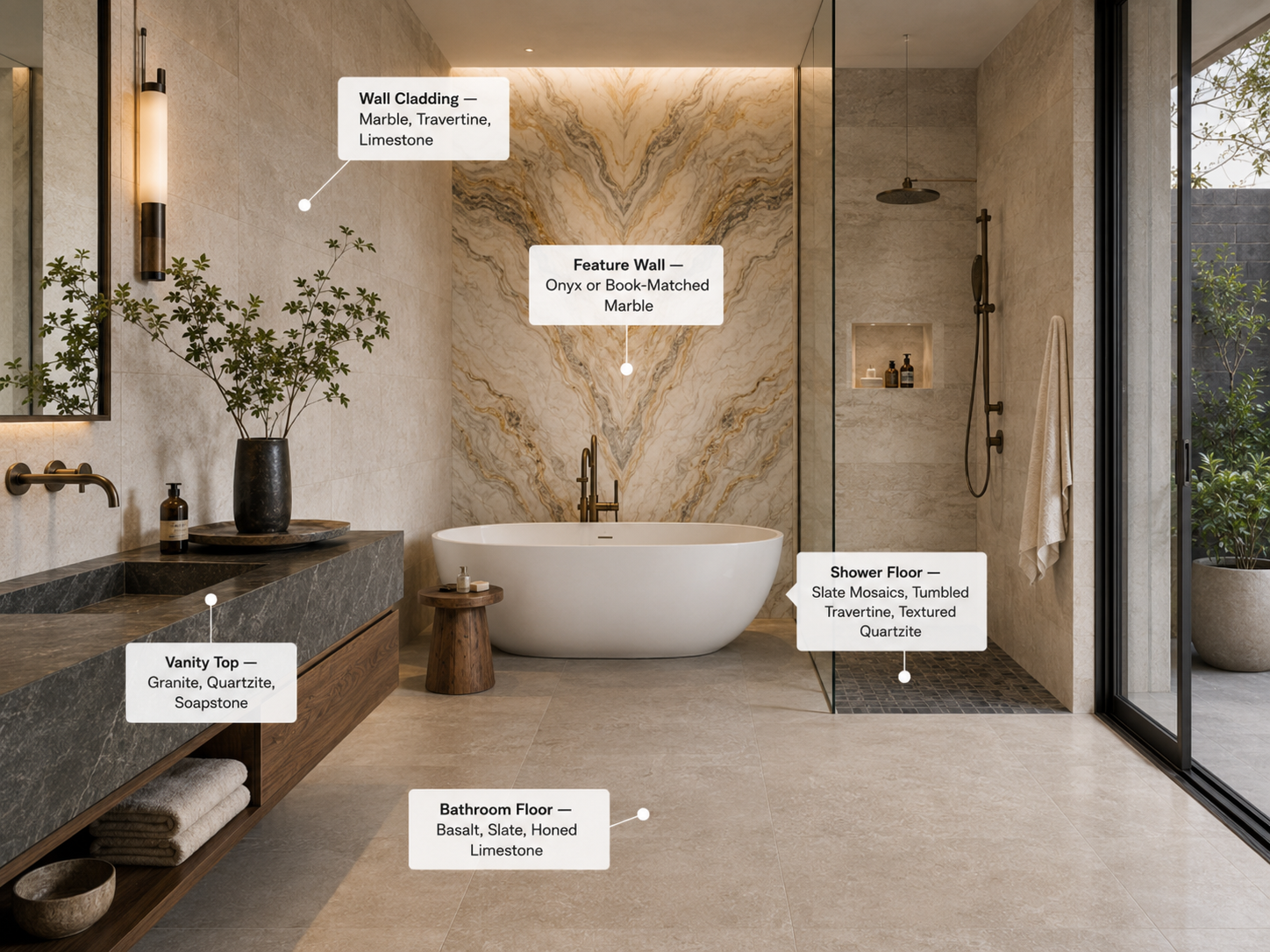
How to Read a Stone Specification
Four numbers describe most of what a bathroom asks of a stone. Water absorption (ASTM C97 in the U.S., EN 13755 in Europe) predicts staining risk, sealing frequency, and — critically — frost performance for any stone continuing outdoors: absorption above roughly 0.5 percent warrants careful evaluation for severe freeze-thaw exposure. Compressive strength (ASTM C170) matters less in a bathroom than vendors imply; nearly every dimension stone exceeds residential floor demands. Abrasion resistance (ASTM C1353 or the EN equivalent) predicts how a finish wears in traffic. And slip resistance — covered in full below — is the number that governs safety, and the one most often missing from a supplier’s datasheet. Ask for it. The Natural Stone Institute’s Dimension Stone Design Manual is the professional baseline for all four, and a supplier who cannot produce test values is offering opinion, not specification.
The 12 Types of Natural Stone for Bathrooms
1. Marble
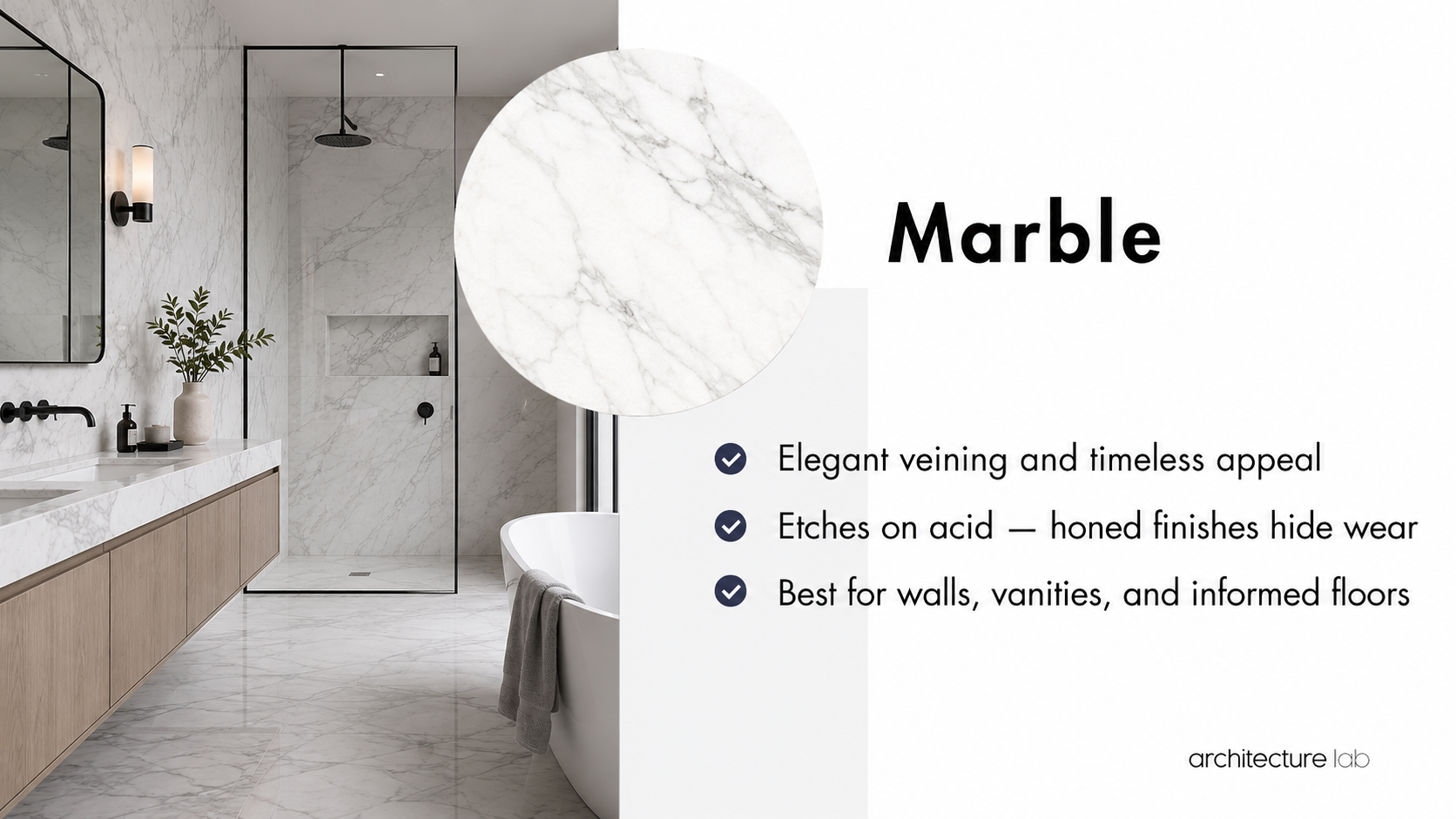
Marble is metamorphosed limestone — calcite recrystallized under heat and pressure into the dense, veined, light-transmitting stone that has defined luxury bathrooms since Rome. Its numbers are strong: water absorption typically ~0.1–0.5 percent, thermal conductivity of roughly 2.0–2.9 W/m·K that makes it one of the best stones over underfloor heating. Its chemistry is the caveat. Marble is calcium carbonate, and every acid — lemon, vinegar, wine, most bathroom cleaners — dissolves its surface on contact, leaving a dull etch mark. Sealing does not prevent this; sealers slow staining (absorption), not etching (chemical reaction). The professional answer is finish selection: a honed surface does not resist etching any better than a polished one, but it hides etching, which is why fabricators overwhelmingly steer bathroom marble toward honed.
Marble
Metamorphic · CarbonateKey Properties — Water absorption ~0.1–0.5%; thermal conductivity 2.0–2.9 W/m·K — among the best stones over underfloor heating.
Best For — Vanities, walls, floors, and shower walls in projects with informed owners.
Advantages
- Classic veined depth no engineered surface matches
- Excellent performer over radiant floor heating
- Strong absorption numbers for a carbonate stone
Limitations
- Etching is a certainty, not a risk — and sealing does not prevent it
- Polished floors are among the worst wet-slip performers in this guide
- Demands pH-neutral care and a honed finish to hide wear
Material Cost
$10–$50/sq ft
Wet-Floor Fit
Honed or tumbled only
2. Travertine
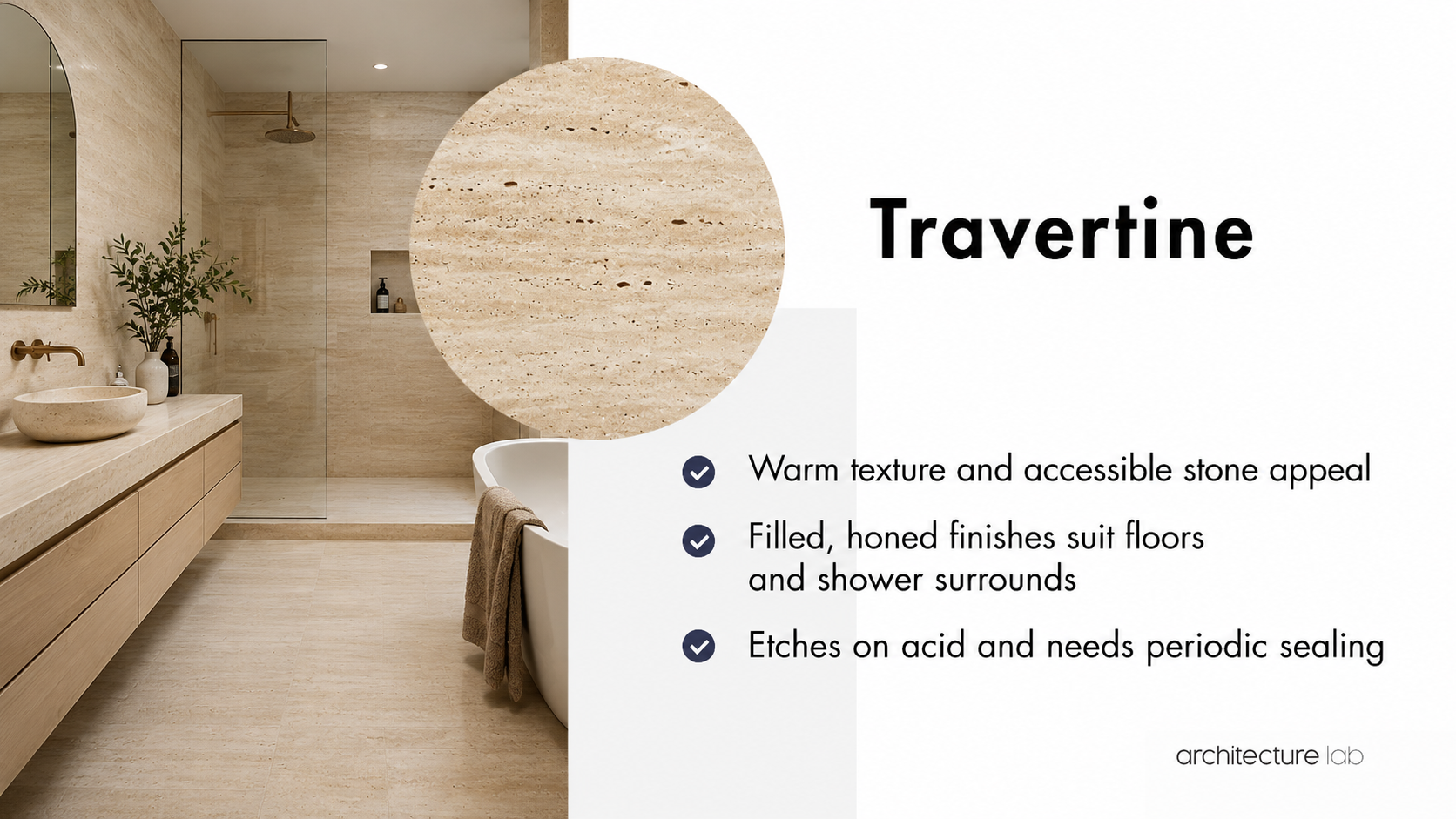
Travertine is limestone precipitated from mineral springs — CO₂ degassing from supersaturated water leaves calcium carbonate behind, along with the stone’s signature voids. Rome has quarried it at Tivoli for more than two thousand years; the Colosseum’s shell is the durability test no laboratory can run. For bathrooms, the void question is the specification: filled travertine (voids filled with resin or cement, then honed) is the standard interior floor product; unfilled reads rustic and traps soap and grime in wet areas. Honed and tumbled finishes give travertine better wet grip than polished marble, which is why it remains a default for full stone bathrooms and shower surrounds. It is carbonate, so it etches and needs the same pH-neutral care as marble, and its absorption — roughly 0.5–2.5 percent filled, higher unfilled — puts it on a regular sealing cycle.
Travertine
Sedimentary · CarbonateKey Properties — Absorption ~0.5–2.5% filled; spring-deposited limestone with signature voids, filled or left open.
Best For — Floors, walls, shower surrounds, and indoor-outdoor schemes in mild climates.
Advantages
- Better wet grip honed or tumbled than polished marble
- Two-thousand-year service record — the Colosseum is the test
- The accessible entry price to a full stone bathroom
Limitations
- Etches like all carbonates; needs the same pH-neutral care
- Voids can telegraph through fills over decades
- Verify EN 12371 freeze-thaw data before cold-climate exterior use
Material Cost
$5–$30/sq ft
Wet-Floor Fit
Good — honed or tumbled
3. Limestone
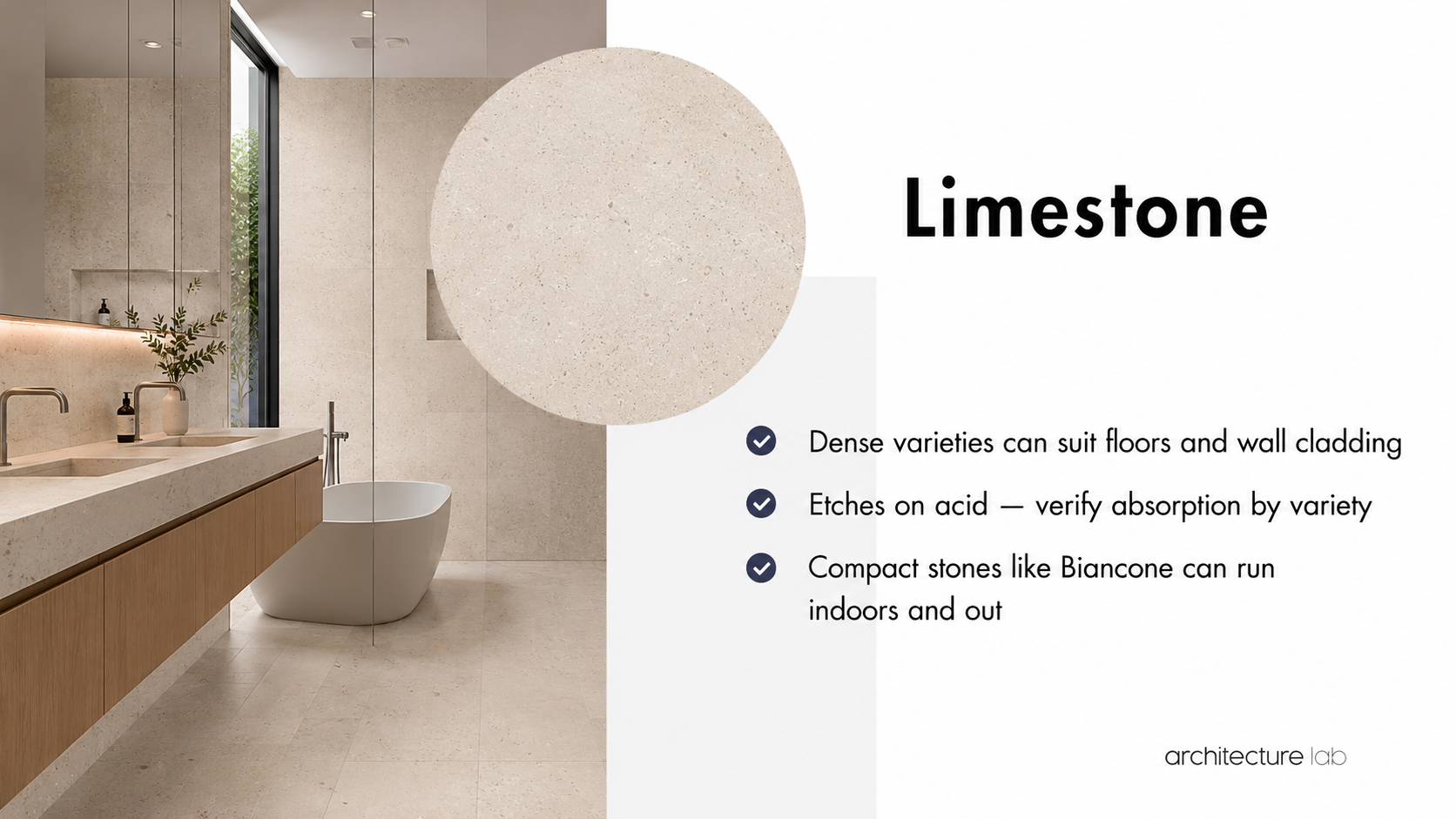
Limestone is the broadest category in this guide, spanning soft, chalky stones that have no business in a bathroom and compact varieties that outperform travertine and rival marble. The specification rule: judge the variety, never the label, and demand the test values. At the performance end sit the compact limestones, and the benchmark example is Pietra di Trani from Puglia, on Italy’s Adriatic coast — petrographically a limestone of roughly 98 percent calcium carbonate, sold commercially as a marble. Its published figures (laboratory data from the Università di Pisa and Politecnico di Torino, corroborated by a peer-reviewed mercury-porosimetry study) read like a wet-area brief: water absorption of 0.30–0.84 percent depending on variety, open porosity near 4 percent, compressive strength of roughly 189–191 MPa, and essentially no strength loss after freeze cycling — genuine frost resistance, rare among carbonates. The same stone has clad Trani Cathedral since construction began in 1099, a nine-century service record, and quarries around the town still cut stone for flooring and wall covering with Biancone, typical Italian stone of this compact class. Its varieties run from the ivory Biancone to the warmer Bronzetto, in finishes from polished to bush-hammered, which is why one limestone can serve a honed bathroom floor and a textured pool surround in the same project.
Limestone
Sedimentary · CarbonateKey Properties — Compact varieties: absorption 0.30–0.84%, compressive strength ~189–191 MPa, genuine frost resistance (Pietra di Trani lab data).
Best For — Floors, cladding, shower surrounds, carved basins, and indoor-outdoor continuity.
Advantages
- Compact varieties outperform travertine and rival marble
- Frost resistance rare among carbonates — verified for Trani
- One stone serves honed interiors and textured pool surrounds
Limitations
- Still carbonate — it etches and needs pH-neutral care
- Soft, chalky varieties belong nowhere near a shower
- Judge the variety and demand test values; the label alone says little
Material Cost
$5–$35/sq ft
Wet-Floor Fit
Dense varieties good
4. Granite
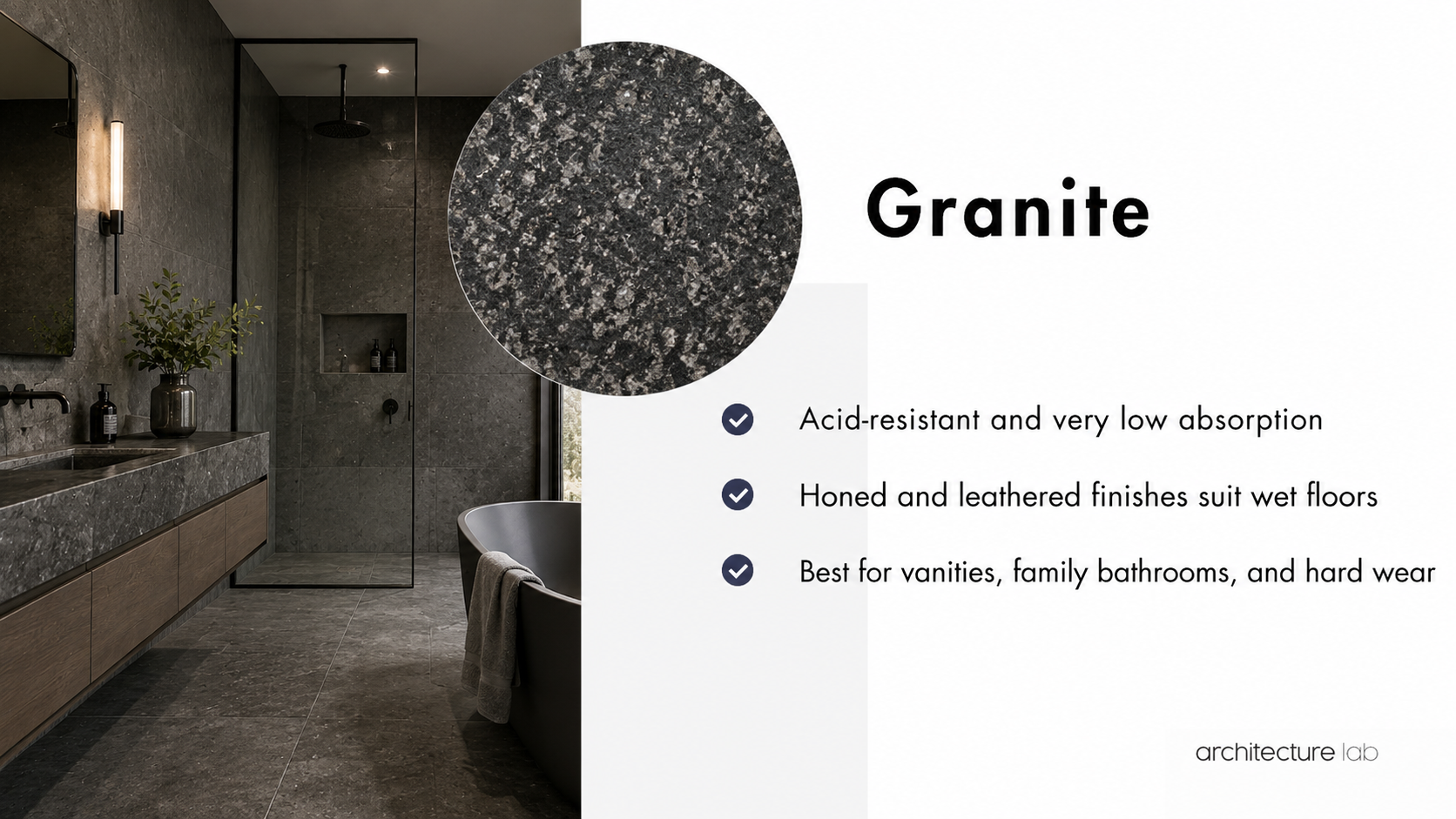
Granite is igneous, silicate, and chemically indifferent to everything a bathroom throws at it. It does not etch — vinegar, cosmetics, and acidic cleaners leave it unmoved — its absorption runs as low as 0.05–0.4 percent, and its hardness shrugs off decades of traffic. That chemistry makes it the least demanding natural stone in this guide to live with, and the honest reason it lost fashion ground is aesthetic, not technical: the speckled granites of the 1990s dated, while the current market favors veined stones. Two specification notes restore it: honed and leathered granites read contemporary and hide water spots that polish reveals, and polished granite floors are dangerously slick wet — the finish, not the stone, is the slip variable.
Granite
Igneous · SilicateKey Properties — Absorption ~0.05–0.4%; chemically indifferent to acids — it does not etch.
Best For — Vanity tops, floors, thresholds, and hard-use family bathrooms.
Advantages
- No etching — vinegar, cosmetics, and cleaners leave it unmoved
- Among the best value-per-durability ratios in stone
- Honed and leathered finishes read contemporary and hide water spots
Limitations
- Polished floors are dangerously slick when wet
- Dated style associations from the speckled 1990s varieties
- Color range runs darker than the carbonates
Material Cost
$5–$40/sq ft
Wet-Floor Fit
Good — avoid polished
5. Slate
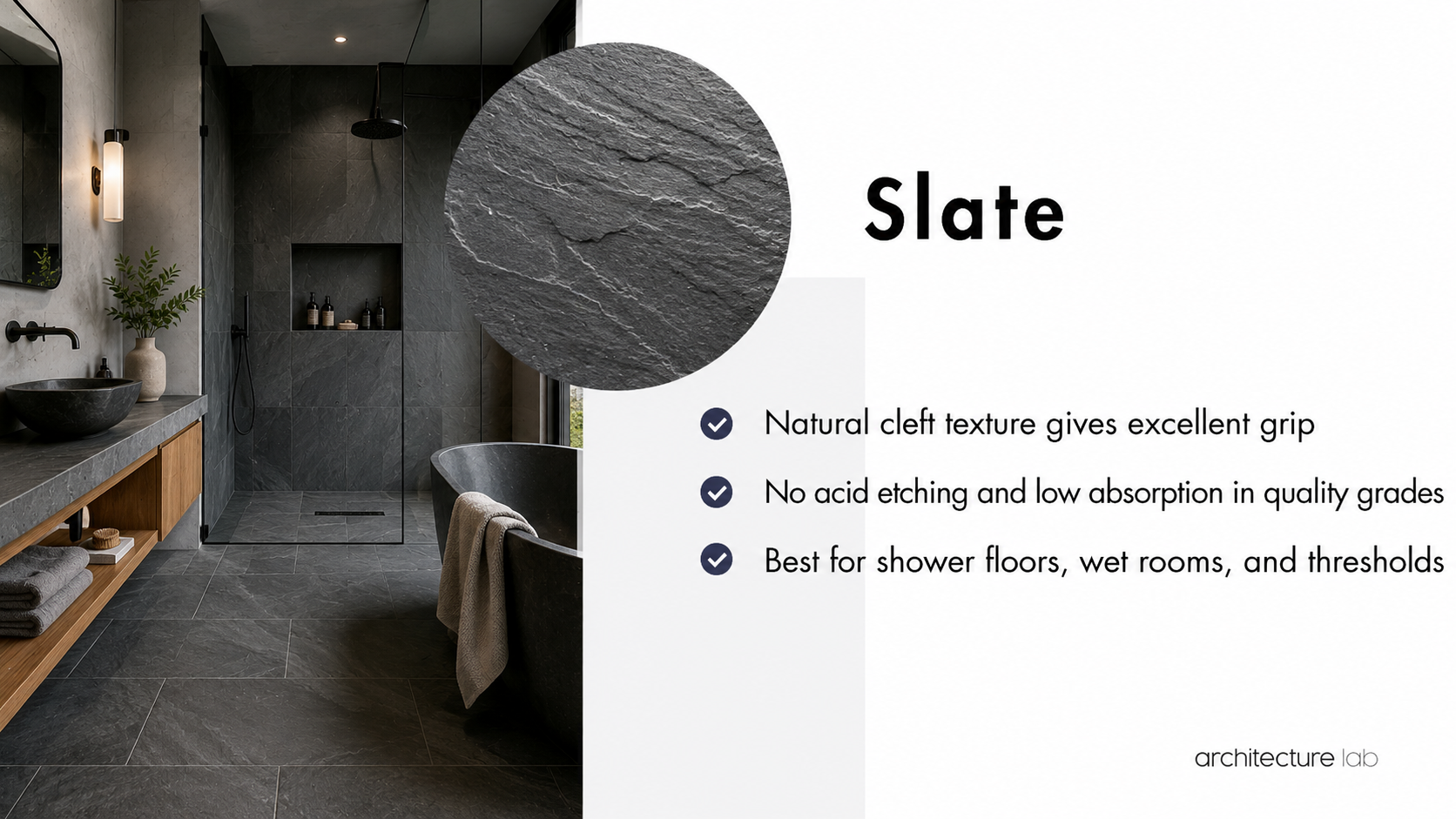
Slate is fine-grained metamorphic stone that splits along its foliation into naturally textured sheets — and that natural-cleft surface is the built-in slip resistance every other stone has to earn through finishing. Absorption for quality slate runs roughly 0.1–0.4 percent, it is silicate (no etching), and its grip when wet makes it a standing answer for shower floors and bathroom floors in one material. The caveats are grade-dependent: lesser slates spall and shed layers in wet service, and natural-cleft thickness varies enough that floors need experienced setting or calibrated (machine-ground) stock. Colors run charcoal, green, plum, and rust — a palette, not a single grey.
Slate
Metamorphic · SilicateKey Properties — Absorption ~0.1–0.4% for quality grades; splits along its foliation into naturally textured sheets.
Best For — Shower floors, bathroom floors, wet rooms, and indoor-outdoor thresholds.
Advantages
- Natural-cleft texture is built-in slip resistance
- Silicate chemistry — no etching
- A real palette: charcoal, green, plum, and rust
Limitations
- Grade variability — buy only from suppliers who publish test data
- Cleft thickness varies; floors need experienced setting or calibrated stock
- Textured surface holds soap film and wants regular rinsing
Material Cost
$5–$25/sq ft
Wet-Floor Fit
Excellent — natural cleft
6. Quartzite
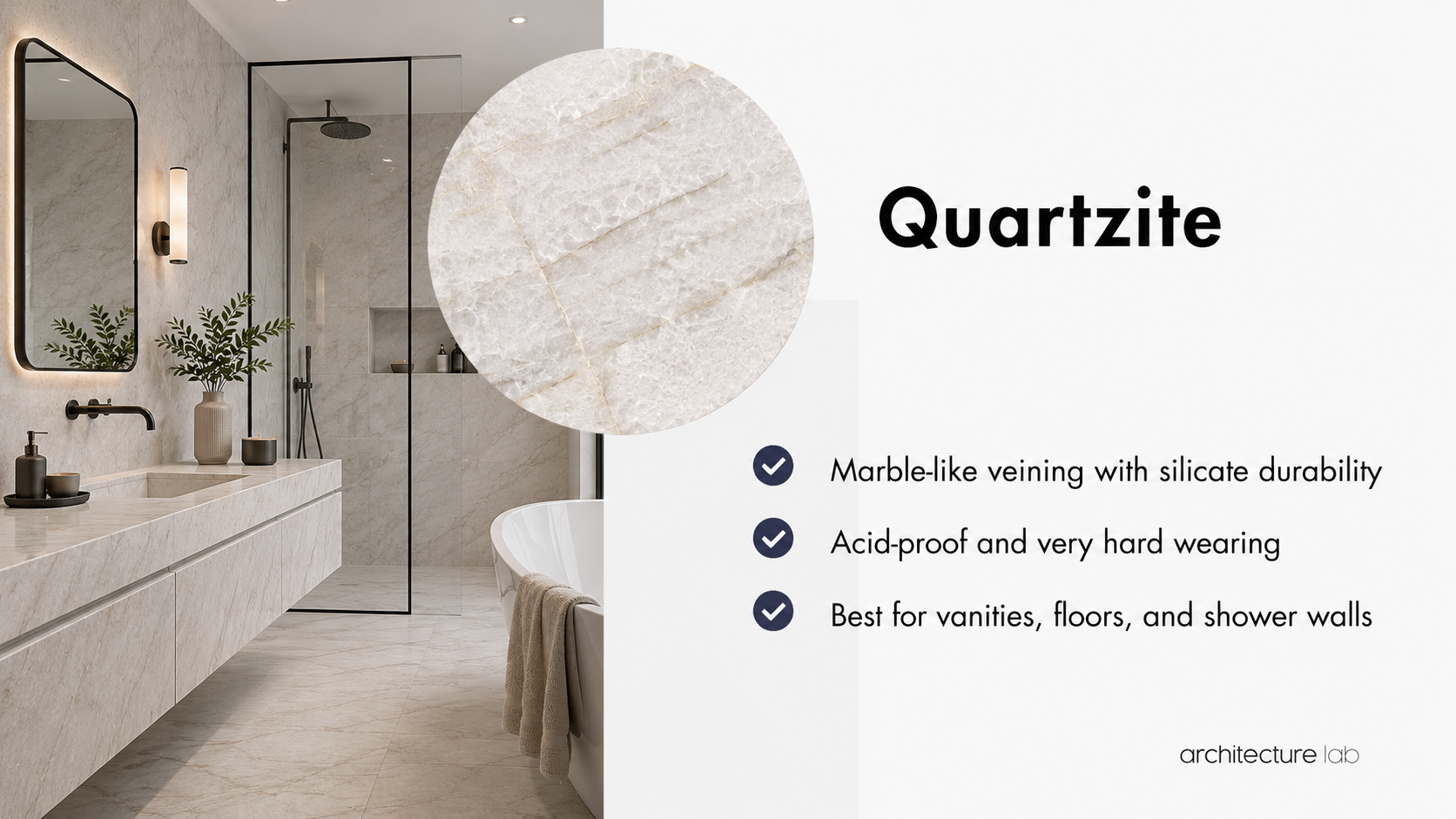
Quartzite is sandstone metamorphosed until its quartz grains fuse — the result is harder than granite (Mohs ~7), acid-proof, and, in true varieties, nearly as impervious as porcelain, with absorption around 0.1–0.5 percent. It has become the professional’s answer to “marble looks, granite behavior”: stones like Taj Mahal and White Macaubas carry marble’s veining with none of its chemistry. The specification trap is labeling. The trade routinely sells “soft quartzite,” which is usually dolomitic marble mislabeled — it etches, and the buyer discovers the difference with the first splash of vinegar. The field test is simple and worth demanding: true quartzite is unscratched by a steel blade and unmarked by acid; insist on the test or the ASTM data before paying quartzite prices.
Quartzite
Metamorphic · SilicateKey Properties — Harder than granite (Mohs ~7); absorption ~0.1–0.5%; acid-proof.
Best For — Vanity tops, floors, and shower walls — marble aesthetics in hard service.
Advantages
- Marble's veining with none of marble's chemistry
- Nearly as impervious as porcelain in true varieties
- The most durable wet-area natural floor in this guide
Limitations
- Premium pricing, driven by slow quarrying and fabrication
- Pervasive mislabeling — 'soft quartzite' is usually dolomitic marble
- Demand the scratch-and-acid test or ASTM data before paying quartzite prices
Material Cost
$15–$60/sq ft
Wet-Floor Fit
Excellent
7. Onyx
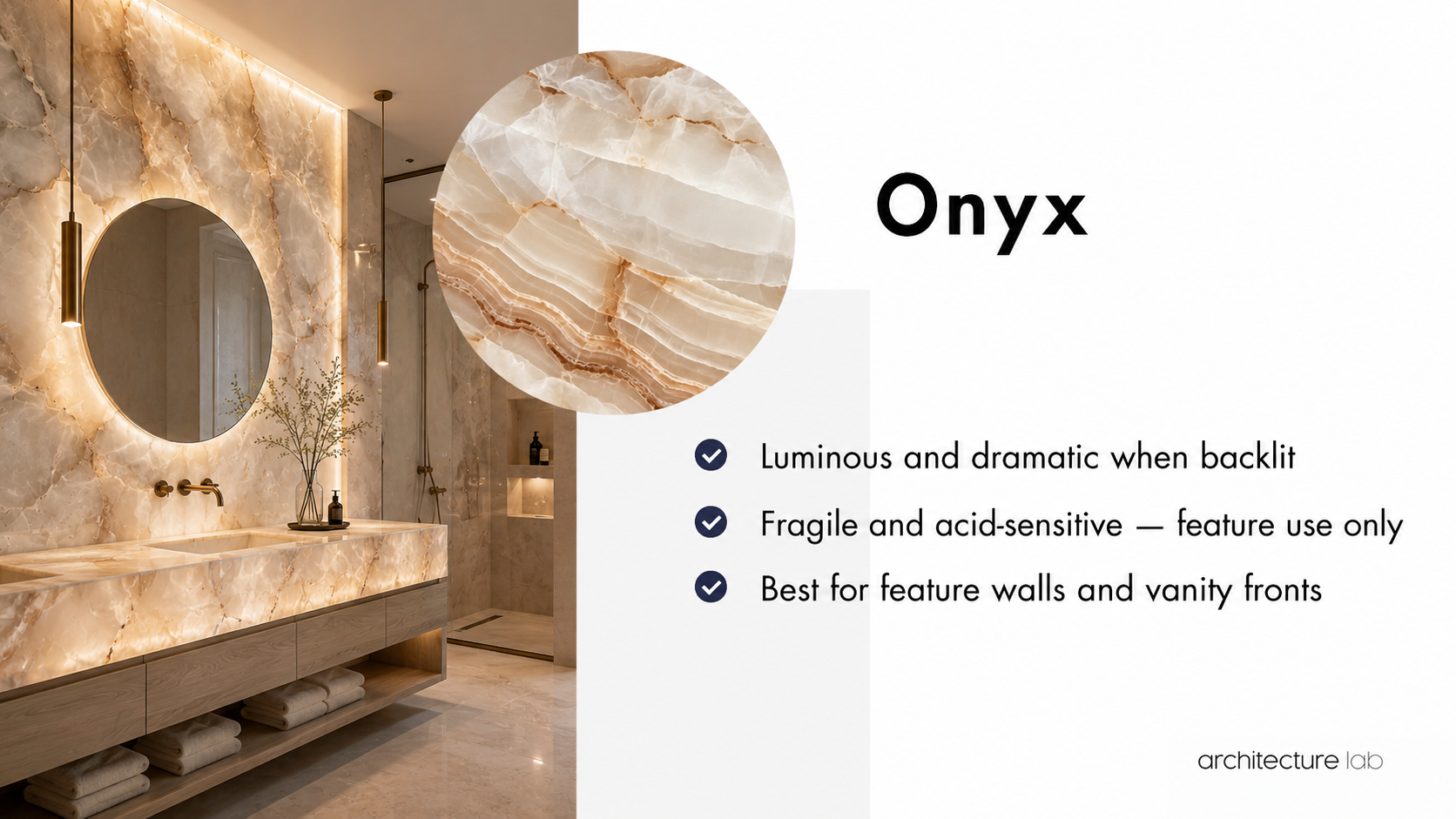
Onyx — banded, translucent calcite deposited in caves and springs — is the most theatrical stone in this guide and the least practical. Backlit, a book-matched onyx wall or vanity front is architecture’s closest thing to stained glass. Structurally and chemically it is the opposite of robust: brittle, often resin-backed for handling, and it etches more readily than marble. It has no business on a floor outside the lightest-traffic powder room, and every wet application needs meticulous sealing and gentle chemistry. Specify it as what it is — a luminous feature material — and it delivers something no other stone can.
Onyx
Banded Calcite · FeatureKey Properties — Translucent banded calcite; brittle, commonly resin-backed for handling.
Best For — Backlit feature walls, vanity fronts, and powder-room statements.
Advantages
- The only stone that glows — architecture's closest thing to stained glass
- Book-matched slabs deliver unmatched drama
- Transforms under integrated lighting
Limitations
- Etches more readily than marble
- Brittle and fragile — near-total unsuitability for floors and shower pans
- The most expensive entry in this guide, before the lighting
Material Cost
$40–$150+/sq ft
Wet-Floor Fit
Walls and features only
8. Sandstone
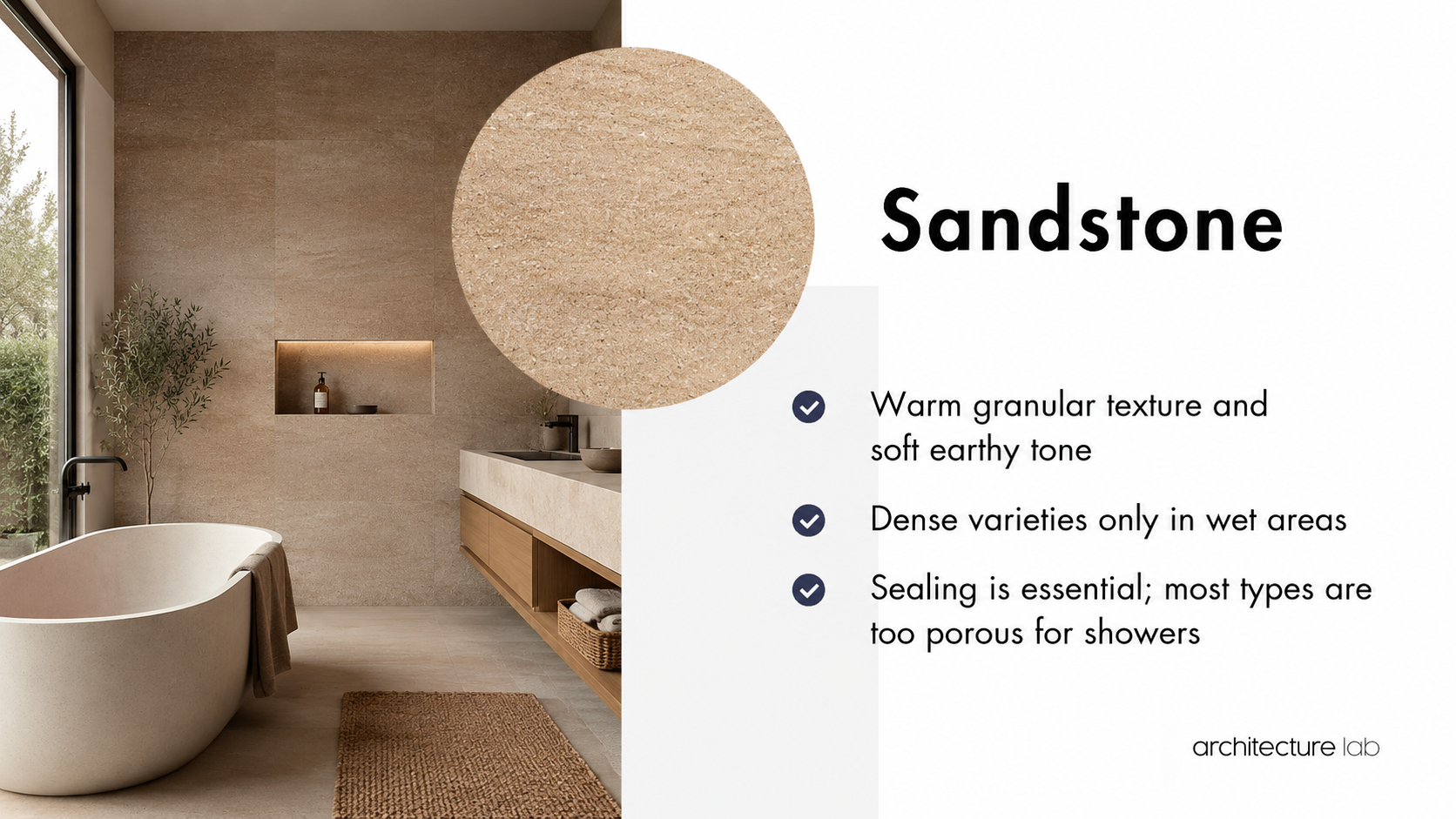
Sandstone is cemented silica sand — warm, granular, naturally grippy, and, for most varieties, too porous for a wet room. Absorption commonly runs 1–8 percent, which in a shower means saturation, in a freeze means spalling, and on a vanity means staining through most sealers. The exceptions are the dense, tightly cemented types — bluestone among them — which serve honorably in bathrooms and, with verified freeze-thaw data to EN 12371, outdoors. Its chemistry is silicate, so etching is not the issue; water uptake is.
Sandstone
Sedimentary · SilicateKey Properties — Absorption commonly 1–8%; dense, tightly cemented types (bluestone) are the exceptions that serve.
Best For — Dense varieties on floors and walls in dry-leaning schemes; textured exterior continuity in mild climates.
Advantages
- Warm, granular, naturally grippy surface
- Silicate chemistry — etching is not the issue
- Budget-friendly entry point among natural stones
Limitations
- Porosity rules out most varieties for showers
- Freeze exposure risks spalling without verified EN 12371 data
- Demands disciplined sealing everywhere else
Material Cost
$5–$20/sq ft
Wet-Floor Fit
Dense types only
9. Basalt
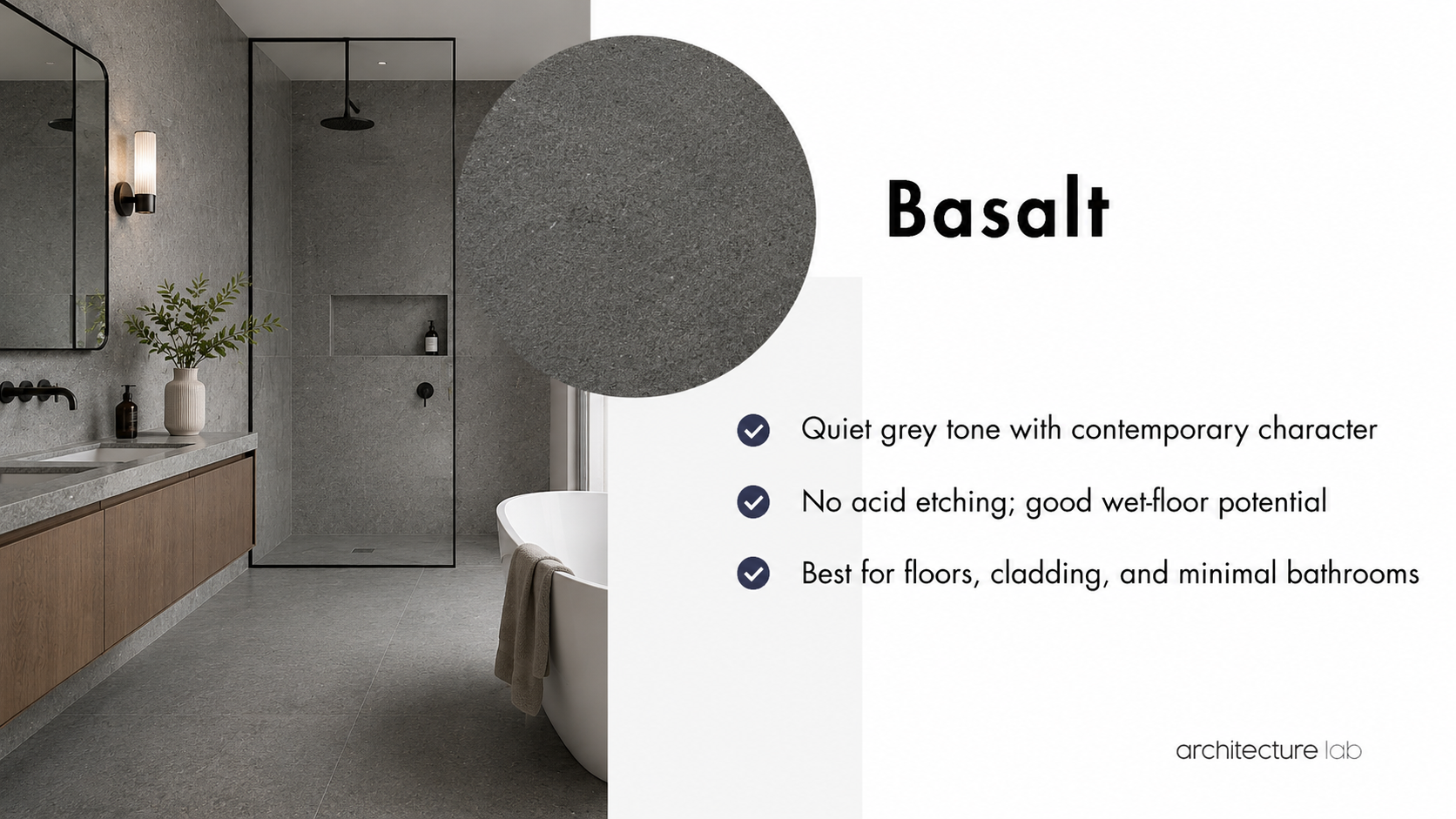
Basalt — quarried lava, sold under names like Basaltina and pietra lavica — is the quiet professional of this list. Even-toned grey with minimal veining, silicate (no etching), absorption in the region of 0.5–2 percent depending on vesicularity, and a matte, contemporary character that flatters both minimal and classical rooms. Rome paved with it; contemporary architects specify it precisely because it does not perform for attention. Honed basalt floors, flamed or brushed basalt in wet zones, and basalt cladding deliver uniform color at a moderate price. Verify the specific quarry’s absorption — vesicular (bubbled) basalts drink more than dense ones.
Basalt
Igneous · SilicateKey Properties — Absorption ~0.5–2% depending on vesicularity; even-toned grey quarried lava (Basaltina, pietra lavica).
Best For — Floors, cladding, wet rooms, and projects wanting stone presence without stone drama.
Advantages
- Uniform, matte, contemporary character — no etching
- Rome paved with it; the durability case is historical
- Moderate price for the performance delivered
Limitations
- Limited palette — greys to near-black
- Vesicular (bubbled) grades drink more and need sealing discipline
- Verify the specific quarry's absorption before specifying
Material Cost
$10–$40/sq ft
Wet-Floor Fit
Good — even tone
10. Soapstone
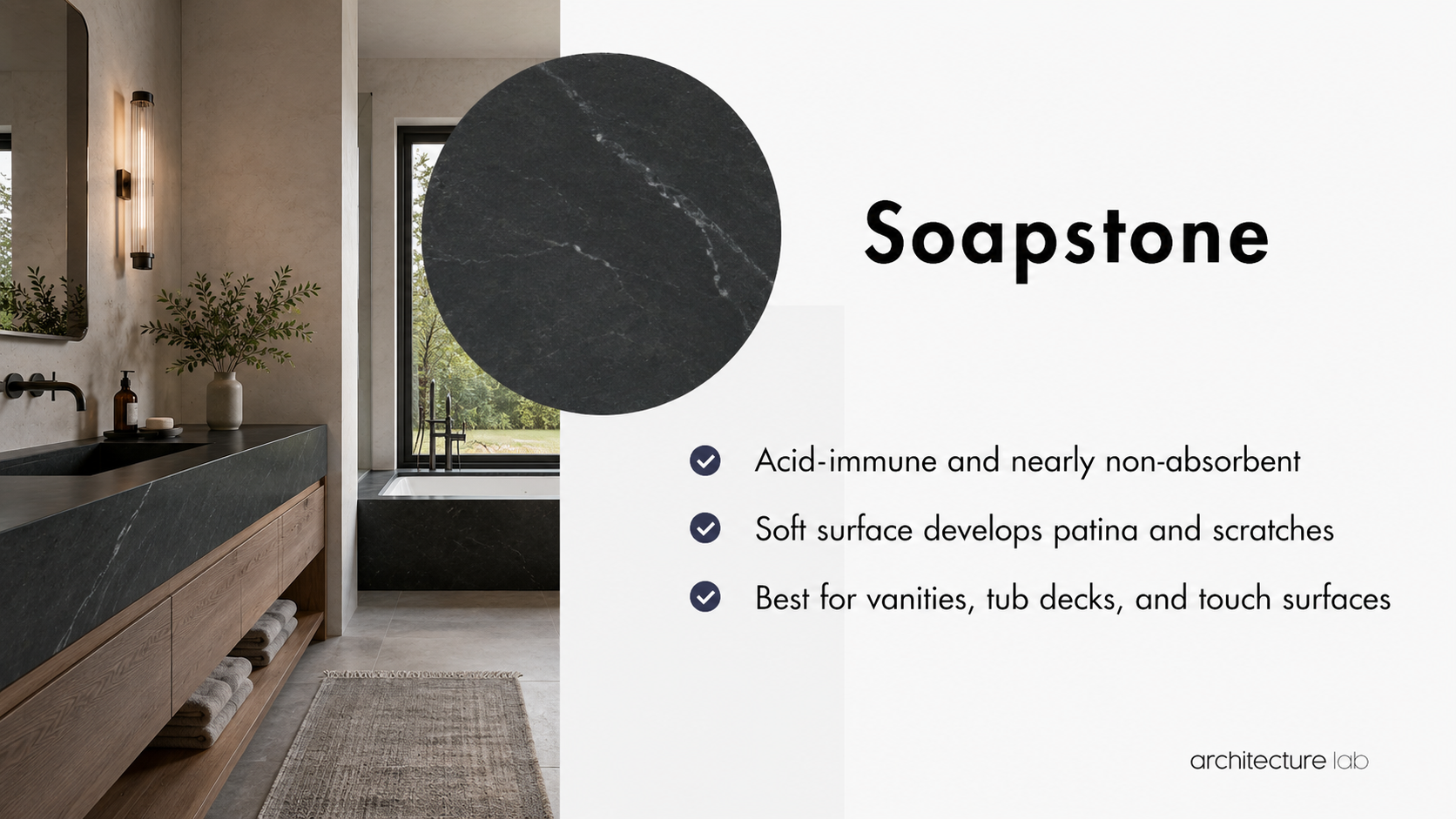
Soapstone is talc-rich metamorphic stone with a property no other natural stone in this guide offers: chemical immunity. Acids do not etch it; its density is so high that absorption approaches zero, and it needs no sealer — ever. The trade-off is softness. Talc is the softest mineral on the Mohs scale, and soapstone scratches with fingernail-adjacent ease; the culture around the stone accepts this, treating scratches as patina and buffing them out or oiling them in. Untreated it wears pale grey; mineral oil or wax deepens it to charcoal-green. Its warmth to the touch — high thermal mass, low conductivity shock — makes it uniquely pleasant for tub surrounds and vanity tops.
Soapstone
Metamorphic · TalcKey Properties — Absorption approaches zero; chemically immune — acids do not etch it; needs no sealer, ever.
Best For — Vanity tops, tub decks and surrounds, sills — touch surfaces in low-abrasion service.
Advantages
- The only chemistry-proof carbonate alternative: no etching, no staining
- No sealing regime, ever
- Warm to the touch — uniquely pleasant for tub surrounds
Limitations
- Scratches with fingernail-adjacent ease — talc is the softest mineral
- Darkening cycle demands either commitment or oiling maintenance
- Limited grey-green palette
Material Cost
$20–$70/sq ft
Wet-Floor Fit
Good — soft surface
11. Dolomite
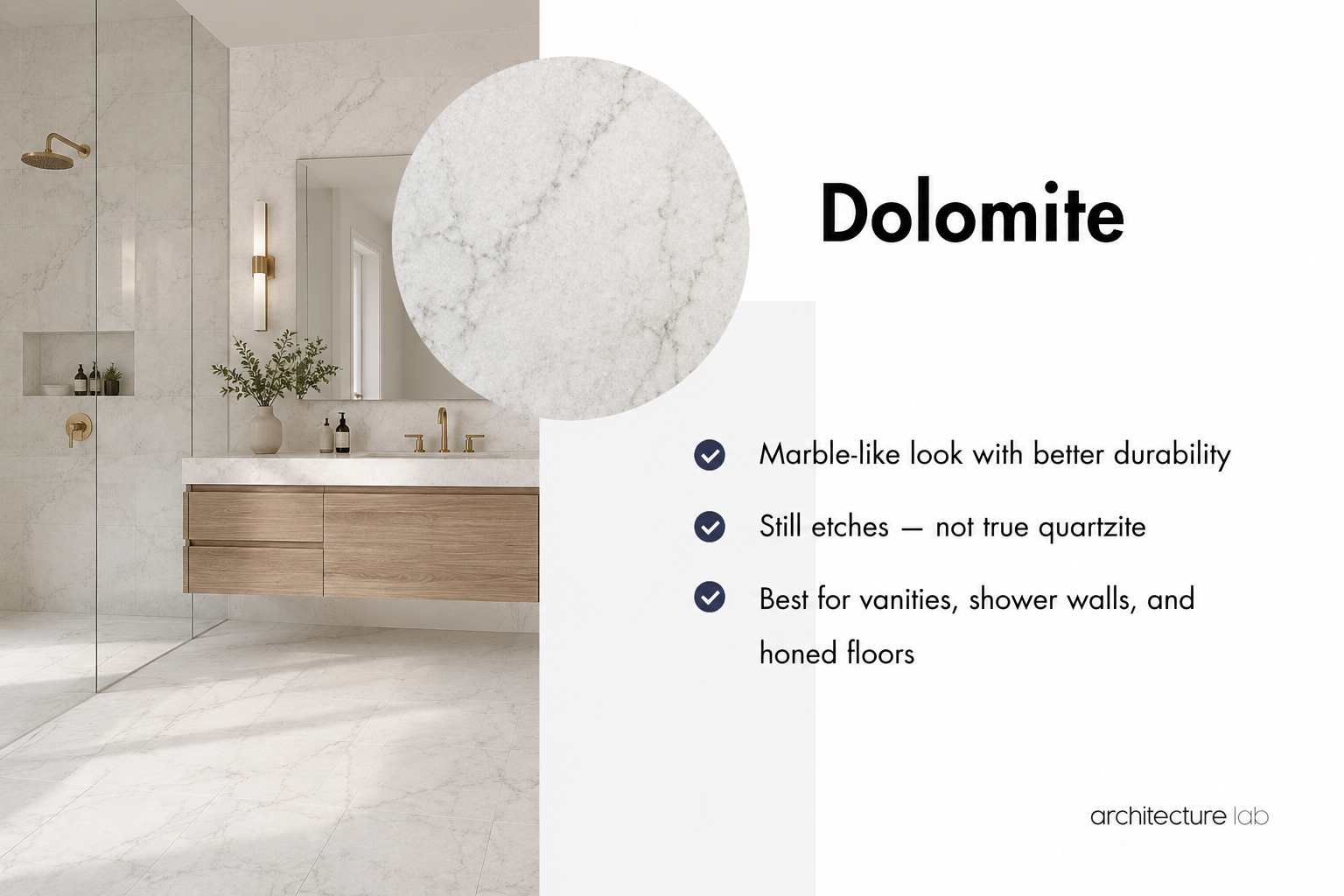
Dolomite — dolostone, in the trade often “super white” and its cousins — sits genuinely between marble and quartzite, and is chronically sold as the latter. It is calcium magnesium carbonate: harder and slower to etch than marble, but it does etch, and it is not the acid-proof quartzite its price tag sometimes implies. Specified honestly — a marble-look stone with a meaningful durability upgrade over true marble, at a discount to true quartzite — it is one of the best-value vanity and wall stones available. Specified as quartzite, it is a complaint waiting to happen. Honed for floors, sealed on schedule, cleaned pH-neutral.
Dolomite
Sedimentary · CarbonateKey Properties — Calcium-magnesium carbonate — harder and slower to etch than marble, but it does etch.
Best For — Vanity tops, shower walls, and floors in honed finish — marble aesthetics with a firmer constitution.
Advantages
- Meaningful durability upgrade over true marble
- Marble looks at a discount to true quartzite
- One of the best-value vanity and wall stones available
Limitations
- It etches — slower than marble, but it etches
- Chronically mislabeled and sold as quartzite
- The same carbonate care regime as marble applies
Material Cost
$10–$50/sq ft
Wet-Floor Fit
Honed, with care
12. Serpentine
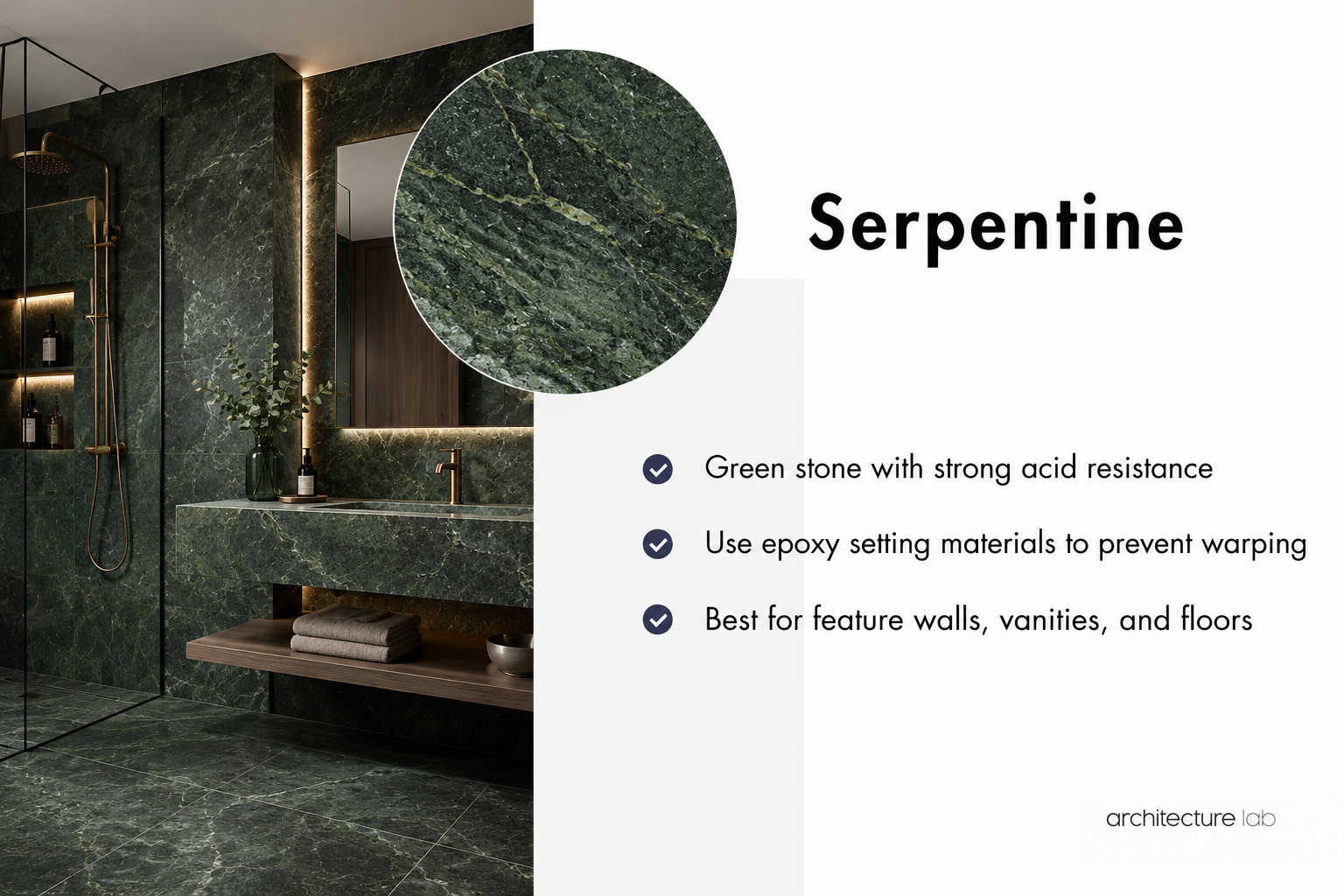
Serpentine — the “green marbles” of the trade, from Verde Alpi to Rainforest varieties — is not marble at all. It is a magnesium-silicate stone, which means the acid problem that defines true marble largely does not apply: serpentine resists etching and takes bathroom chemistry far more calmly than its appearance suggests. Its known vice is fabrication-specific and worth naming: many serpentines are moisture-sensitive during setting and can warp or curl with water-based adhesives, so the TCNA-aligned practice is epoxy or other non-water-based setting materials, verified with the supplier before installation. Done correctly, a serpentine floor or wall delivers deep green drama with better wet-area chemistry than any true marble.
Serpentine
Metamorphic · SilicateKey Properties — Magnesium-silicate 'green marble' that is not marble — it resists the etching that defines true marble.
Best For — Feature walls, vanities, and floors — green-stone statements in wet rooms.
Advantages
- Deep green drama no true marble matches
- Resists etching; takes bathroom chemistry calmly
- Better wet-area chemistry than its appearance suggests
Limitations
- Epoxy or non-water-based setting is non-negotiable — thinset causes warping
- Quality varies significantly by quarry
- Verify slip data for polished faces before floors
Material Cost
$15–$60/sq ft
Wet-Floor Fit
Good — setting caveat
Honorable mentions. Terrazzo delivers stone’s aesthetic in an engineered, slip-tunable matrix, but it is a composite, not a natural stone. Pebble and river-rock mosaics are a format rather than a stone type — excellent shower-floor grip, demanding grout maintenance. And engineered quartz, stone’s chief competitor at the vanity, is the benchmark the sustainability section below is measured against.
Slip Resistance: DCOF, R-Ratings, and Barefoot Classes
Slip is the specification most bathroom stone is sold without, and the standards exist on both sides of the Atlantic.
In the United States, the governing measure is the wet dynamic coefficient of friction under ANSI A326.3 (Tile Council of North America), referenced by ANSI A137.1 and the IBC: hard flooring for level interior spaces expected to be walked on wet requires a wet DCOF of 0.42 or greater. The 2021 revision tiers the categories upward — 0.50 for Interior Wet Plus (barefoot areas: shower floors, pool decks) and 0.55 for Exterior Wet. The standard itself carries the caveat every specifier should repeat: it “does not predict the likelihood a person will or will not slip.” A 0.42 is a floor, not a guarantee — showers, slopes, and soap warrant more.
In Europe, shod slip is rated R9–R13 under DIN 51130 (ramp test), with R10–R11 the practical target for bathroom and shower floors, and barefoot wet areas are rated A, B, or C under DIN 51097 — B for pool surrounds, C for showers and continuously wet zones. The two systems are not convertible; a stone tested to one tells you nothing certified about the other, and advertised R-values without certificates deserve skepticism.
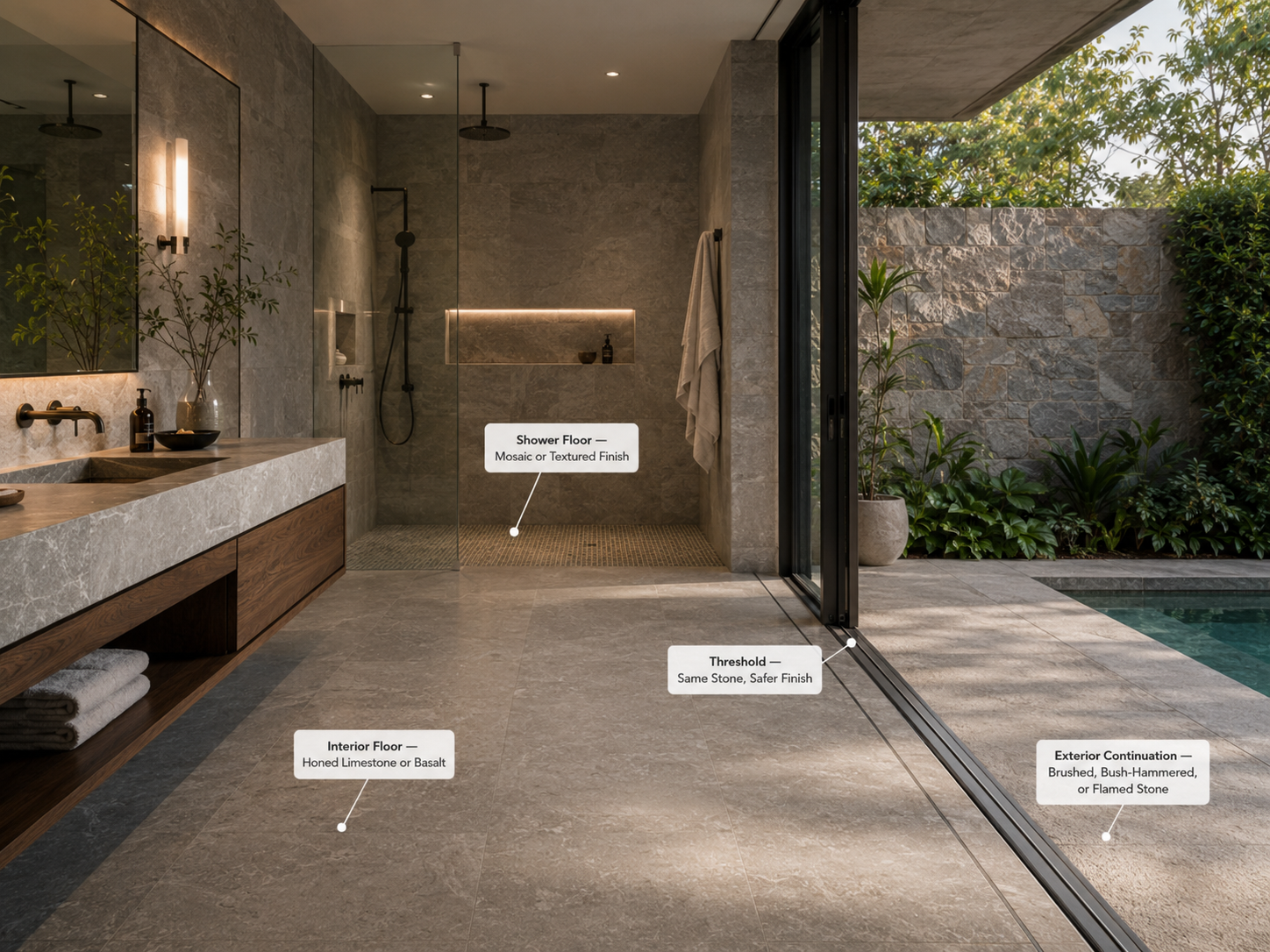
The practical lever is finish, not stone. Polished anything underperforms wet; honed improves; tumbled, brushed, sandblasted, flamed, and bush-hammered finishes — and small-format mosaics, whose grout joints act as grip — raise real-world performance. The trade-off is honest: rougher surfaces grip better and clean harder.
| Zone | U.S. target (ANSI A326.3) | European target |
|---|---|---|
| Bathroom floor | DCOF ≥ 0.42 wet | R10 (DIN 51130) |
| Shower floor | DCOF ≥ 0.50 (Interior Wet Plus) | R10–R11 + Class C (DIN 51097) |
| Pool surround / exterior | DCOF ≥ 0.55 | R11+ + Class B–C |
Sealing, Etching & Maintenance
Two failure modes are conflated in nearly every consumer conversation, and separating them is the core of honest stone specification. Staining is absorption — liquid entering the pore network and leaving color. Penetrating (impregnating) sealers address it by filling pores below the surface; they are maintenance items, reapplied when a 15-minute water-drop test darkens the stone. Etching is chemistry — acid dissolving calcium carbonate on contact — and no penetrating sealer prevents it, because the reaction happens at the surface regardless of what fills the pores. Every carbonate stone in this guide (marble, travertine, limestone, onyx, dolomite) etches; every silicate (granite, slate, quartzite, sandstone, basalt, serpentine) and soapstone does not. Honed finishes hide etching rather than resisting it — which is a legitimate strategy, correctly described. The care regime that follows is short: pH-neutral stone cleaners only, never vinegar or citrus, sealing on the water-test schedule, and silicone — not grout — at every change of plane.
Installation: Waterproofing, Deflection, and Setting
Stone’s weight and stiffness impose requirements ceramic does not, and the professional references are explicit. On wood-framed floors, the TCNA Handbook and Natural Stone Institute guidance limit deflection to L/720 for natural stone — twice as stiff as the L/360 permitted for ceramic tile — under the standard concentrated-load check; a floor that carries porcelain happily can crack stone. Adhered stone wall veneer is generally kept under 15 lb/ft² (73 kg/m²); heavier assemblies need mechanical anchorage. Wet areas are membrane territory, and the work should begin with a clear moisture diagnosis before any finish stone is specified: bonded waterproofing to ANSI A118.10 (or EN 14891 in Europe), detailed per the TCNA shower methods, with the pan sloped at least ¼ inch per foot (2 percent) to the drain and the assembly flood-tested for 24 hours per IPC 417.5.2 before any stone is set. Setting materials matter twice over: white thinset under pale and translucent stones (grey shadows through marble and onyx), and non-water-based epoxy systems for moisture-sensitive stones like serpentine and some green marbles. Porous stones are sealed once before grouting — grout haze locks into unsealed pores — and again after.
Sustainability & Embodied Carbon
The environmental argument for natural stone is now quantified, and it is stronger than the marketing that used to carry it. Industry-wide Environmental Product Declarations published through the Natural Stone Institute put natural-stone countertops at 46.8 kg CO₂e/m² against 102.6 kg CO₂e/m² for engineered quartz — a 54 percent reduction in cradle-to-gate embodied carbon. For flooring, a University of Stuttgart study commissioned by the German Natural Stone Association (DNV) found the life-cycle footprint of a natural stone tile roughly 84 percent lower than a large-format ceramic tile. The honest caveats belong in the same paragraph: these figures originate with stone-industry EPDs and an industry-commissioned study — though the independent Arup review of stone’s embodied carbon for IStructE supports the direction — and transport is the variable that can erode the advantage: a stone shipped across the world carries a different footprint than one quarried regionally. The unquantified half of the case is service life: stone routinely serves 75–100+ years and is reusable at end of life, a lifespan argument no replacement-cycle material matches. What the sustainability case does not include: “hypoallergenic,” “antibacterial,” and “maintenance-free” are marketing claims without evidential support, and this guide declines to repeat them.
Specification Summary by Application
For floors, the short list is honed compact limestone, basalt, slate, and granite — verified to DCOF ≥ 0.42 wet, on a structure meeting L/720. For shower floors, mosaics or textured finishes (tumbled, cleft, flamed) at DCOF ≥ 0.50 / Class C, over an A118.10 membrane and a flood-tested pan. For vanities, quartzite and granite for indifference, soapstone for chemistry-proof warmth, marble and dolomite for beauty with an accepted care contract. For feature walls, onyx backlit, serpentine set in epoxy, book-matched marble. For indoor-outdoor continuity, one frost-verified stone (EN 12371; absorption ideally below ~0.5 percent) in two finishes — honed within, textured without. And for every entry above: demand the test data. The difference between a stone that serves for a century and one that fails in five years is rarely the stone. It is the specification.
What is the best natural stone for a bathroom floor?
Honed compact limestone, basalt, slate, and granite lead on the combination of wet-slip performance, absorption, and wear. The governing check is the same for all: a wet DCOF of at least 0.42 per ANSI A326.3 (R10 under DIN 51130 in Europe) for the general floor, higher for the shower, verified by test certificate rather than catalog adjective.
Does sealing stop marble from etching?
No. Sealers slow staining by filling the stone’s pores; etching is a surface chemical reaction between acid and calcium carbonate that happens regardless of sealer. The realistic strategies are finish (honed hides etch marks), habits (pH-neutral cleaners, prompt wipe-ups), or choosing a silicate stone — granite, quartzite, slate, basalt, serpentine — that cannot etch at all.
Is quartzite really acid-proof?
True quartzite is — it is metamorphosed quartz, chemically unrelated to marble. But the trade’s “soft quartzites” are frequently dolomitic marbles that etch like any carbonate. The field checks are a steel-blade scratch test and a drop of acid on a sample; the paper check is ASTM absorption and hardness data. Insist on one of them before paying quartzite prices.
Can the same stone run from the bathroom to the pool deck?
Yes, and it is one of stone’s genuine advantages — with two changes at the threshold. The finish must change (honed inside; brushed, flamed, or bush-hammered outside, meeting DCOF ≥ 0.55 or DIN Class B–C), and the stone must carry verified freeze-thaw performance to EN 12371 in cold climates, with absorption ideally below roughly 0.5 percent. Compact limestones and basalts are the classic candidates.
Is natural stone actually sustainable?
On embodied carbon, the published data favors it: 54 percent below engineered quartz per the Natural Stone Institute’s EPDs, and roughly 84 percent below large-format ceramic tile per the University of Stuttgart study — with the honest caveats that the figures are industry-published and long-distance transport erodes the margin. The strongest part of the case is the least contested: a century of service life and full reusability, against surfaces specified for replacement cycles.
Resources
- Tile Council of North America – ANSI A326.3, ANSI A137.1, and the TCNA Handbook for Ceramic, Glass, and Stone Tile Installation
- Natural Stone Institute – Dimension Stone Design Manual; industry-wide Environmental Product Declarations
- ASTM International – C97 (absorption and density), C170 (compressive strength), C1353 (abrasion)
- DIN – 51130 (ramp test, R-ratings) and 51097 (barefoot wet areas, Classes A–C)
- CEN – EN 12371 (freeze-thaw), EN 13755 (water absorption), EN 14891 (liquid-applied waterproofing)
- International Code Council – International Plumbing Code, Section 417.5.2 (shower pan flood testing)
- Arup / Institution of Structural Engineers – “Embodied Carbon: Stone” report
- University of Stuttgart / Deutscher Naturwerkstein-Verband – Life Cycle Assessment of Floor Coverings
- Università di Pisa and Politecnico di Torino – published technical datasheets for Pietra di Trani varieties
- Architecture Lab – Stone, tile, and bathroom specification archive

