

In the winter of 1950, Louis Kahn arrived at the American Academy in Rome as a fifty-year-old architect without a masterpiece. He had built public housing in Philadelphia, collaborated on forgettable International Style boxes, and spent decades in a version of competent obscurity. Then, over the following months — traveling from Rome to Egypt and then to Greece, filling sketchbooks with charcoal drawings of ruins he had first visited as a younger man — something happened that turned him into one of the most consequential architects of the century.
What happened was Mediterranean light.
He was especially affected by the way the Mediterranean light played upon the haunting, silent, and monumental forms. The pyramids at Giza were, he discovered, not simply massive geometric shapes. His pastel drawings of the pyramids were alive, their pure geometries and earth-tone colors transformed by the sunlight. The drawings reveal that Kahn saw the pyramids not only as enormous masses, timeless and eternal, but also as vehicles of light — reflectors of the sun’s rays. The ruins of Rome were not ruins at all. They were instruments of a particular quality of light, calibrated by the very fact of their incompleteness — roofs gone, walls open to the sky — so that the sun could do what architects had originally intended, and what the centuries had since made more extreme.
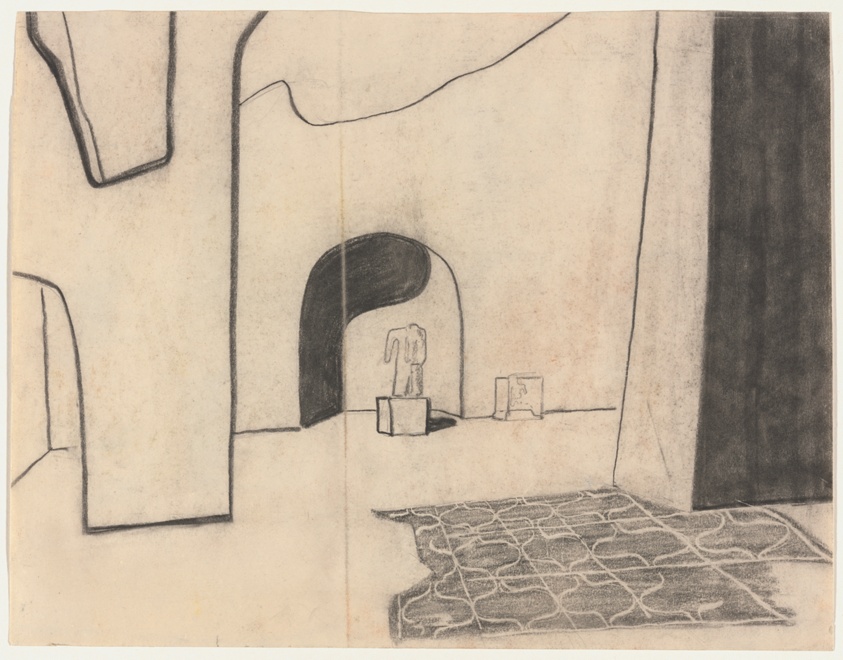
The three months that Kahn spent in Rome were really intense. He did not, as the story is sometimes told, arrive with a grand theory already formed. He arrived with a career that had run out of ideas, and he found his ideas in the ruins. He came back from Rome and Egypt and Greece a different architect — one who would never again build with lightweight steel construction, who decided instead, from that time forward, that he would not build with light and thin materials but would instead make his architecture out of heavy and thick materials — the structural mass out of which was constructed the great architecture of Rome, Greece, and Egypt, which he had recently so movingly experienced.
The decision sounds like it is about structure. It was about light. Heavy material — concrete, brick, thick walls — could be carved open, precisely and deliberately, to admit only the light a room needed, in only the way a room needed it. Thin materials, glass curtain walls, the whole tradition of the machine-made International Style box, gave the architect no power over light. It simply came in, everywhere, equally, without ceremony. Louis Kahn had looked at the oculus of the Pantheon — his favorite building, described in his own writing as a room dedicated to all religions, made meaningful by a single aperture at the top of its dome — and understood what architecture had known and what modernism had forgotten: that the relationship between a building and its light has to be designed.
That insight belonged to a moment, in the years around 1950, when several of the greatest architects alive were all arriving at the same discovery by different routes.
Le Corbusier had written the sentence, years earlier, that defined what all of them were reaching for. “Architecture,” he declared in his 1923 manifesto Vers une Architecture, “is the masterly, correct and magnificent play of masses brought together in light.” Our eyes are made to see forms in light; light and shade reveal these forms; cubes, cones, spheres, cylinders, or pyramids are the great primary forms which light reveals to advantage. It was the most quoted sentence in modern architecture. But it described a relationship with light that was largely visual, largely compositional — the sunlit white cube in the green field, the pure geometric form revealed by its shadows. It was not yet the idea of light as a spiritual or experiential material in its own right.
That idea arrived for Le Corbusier on a hillside in eastern France in the spring of 1950 — the same year Kahn was in Rome.
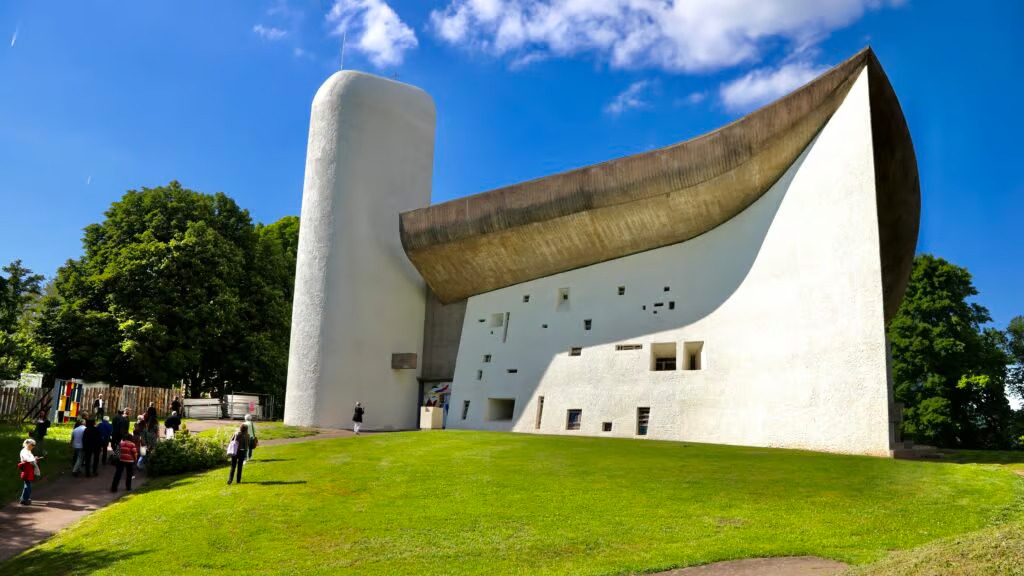
The story of how Le Corbusier came to build the Chapel of Notre-Dame du Haut at Ronchamp is, by now, well established in its outline. The previous chapel was destroyed by bombardment in September 1944 during the liberation of Ronchamp from German occupation. Le Corbusier initially refused, calling the Catholic Church “a dead institution.” A reformist Dominican priest, Father Marie-Alain Couturier, had championed his selection, arguing the Church needed contemporary architecture to remain spiritually relevant. But when Father Couturier brought him to Ronchamp in 1950, he was struck by what he called the site’s irresistible genius loci — the “four horizons” visible from the hilltop, the landscape of distant Vosges and Jura mountains, and centuries of accumulated spiritual significance.
He descended from that hill with a commission and a site note, dated June 4, 1950, in which he recorded the four cardinal horizons visible from its summit: to the east, the Ballons d’Alsace; to the south, the cliffs; to the west, the plain of the Saône; to the north, a small valley and a village. What happened in his mind between that day and the building that was finally consecrated on June 25, 1955, constitutes one of the most remarkable transformations in modern architecture. The man who had spent thirty years arguing for the white rationalist machine — the Purist villa, the Unité d’Habitation, the Modulor man — built, on that hill, something that seemed to belong to no tradition at all: a curved concrete chapel whose thick south wall is pierced with dozens of deep, irregular apertures of varying sizes and colors, set at different angles so that each one catches a different quality of light at a different moment of the day. The roof, a vast concrete shell inspired by a crab shell Le Corbusier had found on Long Island years before, is lifted free of the walls on a series of small pillars, leaving a continuous horizontal slot through which a band of light enters the interior at the junction of wall and ceiling, turning the surface above it silver.
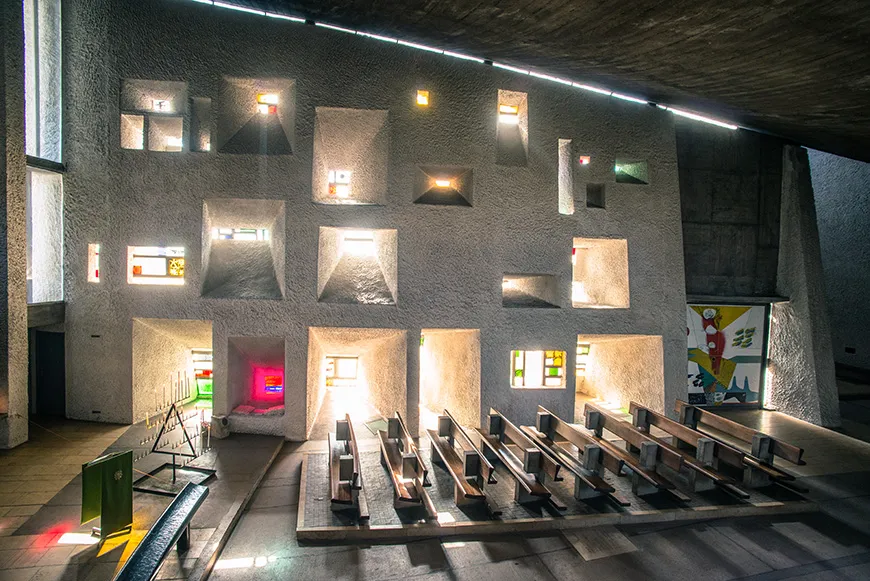
At the ceremony of consecration, Le Corbusier read a letter he had prepared. He had wanted “to create a place of silence, prayer, peace and inner joy”; his approach had been “motivated” by an appreciation of the sacredness of the site. It was a statement from an agnostic architect — an agnostic architect who was steeped in spirituality — about what architecture was capable of when it stopped competing with experience and instead set out to deepen it. Inside Ronchamp, the walls are thick enough to be rooms themselves. The apertures are tunnels through which the light travels into the interior, arriving not as brightness but as color — as presence. In the summer, when the south wall catches the afternoon sun, the interior transforms on an hourly schedule, as different apertures activate, different combinations of amber and blue and white falling across the floor, so that the building is not the same room for an hour together.
What Le Corbusier had done, without quite having the vocabulary for it, was discover that a building could be a light instrument — not in the passive sense of a building that receives light, but in the active sense of a machine designed to transform it.
While Le Corbusier was finding this on a hilltop in France, a Finnish architect had arrived at a similar conclusion years earlier, for entirely different reasons, in a very different climate.
Alvar Aalto designed the Viipuri Library in the late 1920s and completed it in 1935, in what was then Finland’s second city. The problem he was solving was not spiritual but practical, and it was specific to the Nordic latitudes: how do you build a reading room that provides adequate light for study without the two conditions that make Nordic light so difficult to control — the darkness of winter, and the direct low-angle sun of the brief summer, which produced ferocious glare and uneven shadows across the reading surfaces?
His answer was an invention: the conical skylight. Aiming to fill the reading rooms with diffuse light, he invented a conical skylight that would funnel in daylight without allowing direct, shadow-producing solar rays. Relying on the generative grid that organizes the reading rooms, he systematically perforated the roof with two-meter light wells, giving the roof its trademark futuristic appearance.
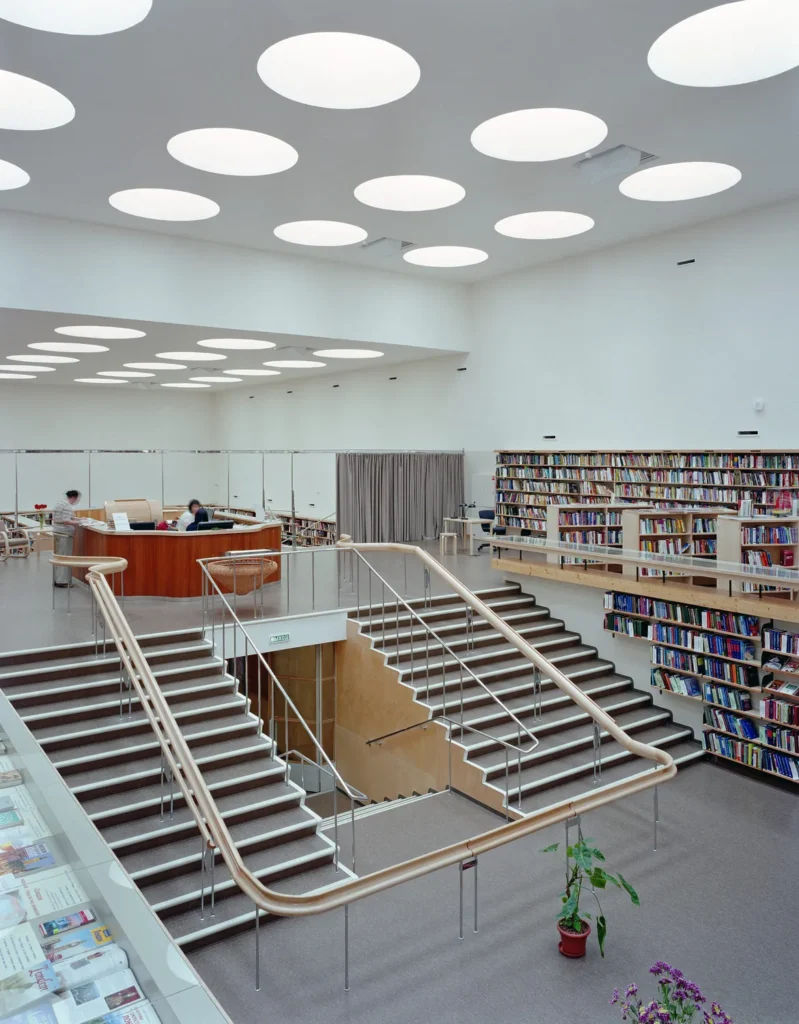
Natural light enters through 57 round skylights. No direct sunlight enters; it is reflected in thousands of lines of reflection as a result of the conical shape, like a funnel, of the skylight. The light that arrived in the reading room was thus light that had already been scattered — that had lost its directionality, its capacity to cast shadow — and arrived instead as an even, cool illumination distributed without hierarchy across every surface. A reader could carry a book to any corner of the room without encountering glare or shadow. The light was, in essence, weather-proof: it changed in intensity but not in quality between summer and winter, between morning and afternoon. It was the northern version of the same problem Kahn would later solve in Texas, using a different geometry to similar effect.
What Aalto was doing — and what his successors would do more self-consciously — was treating light as a design problem with a specific engineering solution, arrived at by working backward from the exact visual experience he wanted to produce in the building’s users. The form of the roof — those 57 circular cones rising from the flat surface, giving the building its extraordinary alien appearance from the air — was entirely generated by this requirement. The architecture followed the light.
No architect of the twentieth century stated the primacy of light with more philosophical force than Kahn — and no building demonstrates it more completely than the Kimbell Art Museum in Fort Worth, Texas, which he completed in 1972, the last year of his life.
The commission had begun six years earlier, when the Kimbell’s first director, Richard Brown, issued a Pre-Architectural Program — a statement of requirements that would guide the architect’s work. The document stated, with a directness unusual in institutional building briefs, that “natural light should play a vital part in illumination.” Kahn had been chosen over Marcel Breuer, Pier Luigi Nervi, and others partly on the strength of that alignment: he was the architect most likely to take seriously what the museum wanted from light.
Kahn envisioned a museum with “the luminosity of silver,” illuminated by “natural light, the only acceptable light for a work of art, with all the moods of an individual day.” The problem was not a simple one. Natural light in Texas is not natural light in Rome. It is intense, angular, relentless, capable of bleaching color from a canvas within a single afternoon if admitted without control. Every museum that had tried to use natural light for the display of art had failed in some respect — either admitting too much, or admitting it too directly, or solving the problem of glare only by blocking so much light that the galleries went dim.
Kahn’s solution was the cycloid vault: a structural form he developed with his structural engineer August Komendant, derived from the geometry of a circle rolling on a flat surface. Unlike a semicircular vault, the cycloid’s sides rise gently, creating an interior surface whose curvature receives light and distributes it in a particular way. At the apex of each vault — each one 100 feet long and 20 feet wide — Kahn cut a narrow slot, 15 inches wide, through which the Texas sky is visible. Beneath each slot he suspended a curved aluminum reflector, perforated with small holes. When sunlight enters the slot and strikes the reflector, the reflector bounces it upward onto the concrete vault surface and the holes allow a portion to pass through, scattering as they go. The light that finally descends into the gallery below has been transformed — reflected from the underside of the concrete vault, scattered, diffused, arriving without direction. The sunlight coming through the central slit turns into a silvery glow on the uppermost reaches of the finely textured concrete. The effect is glorious, but it is definitely an effect, a calculated invention to make you feel that light is being shed from an unseen source.
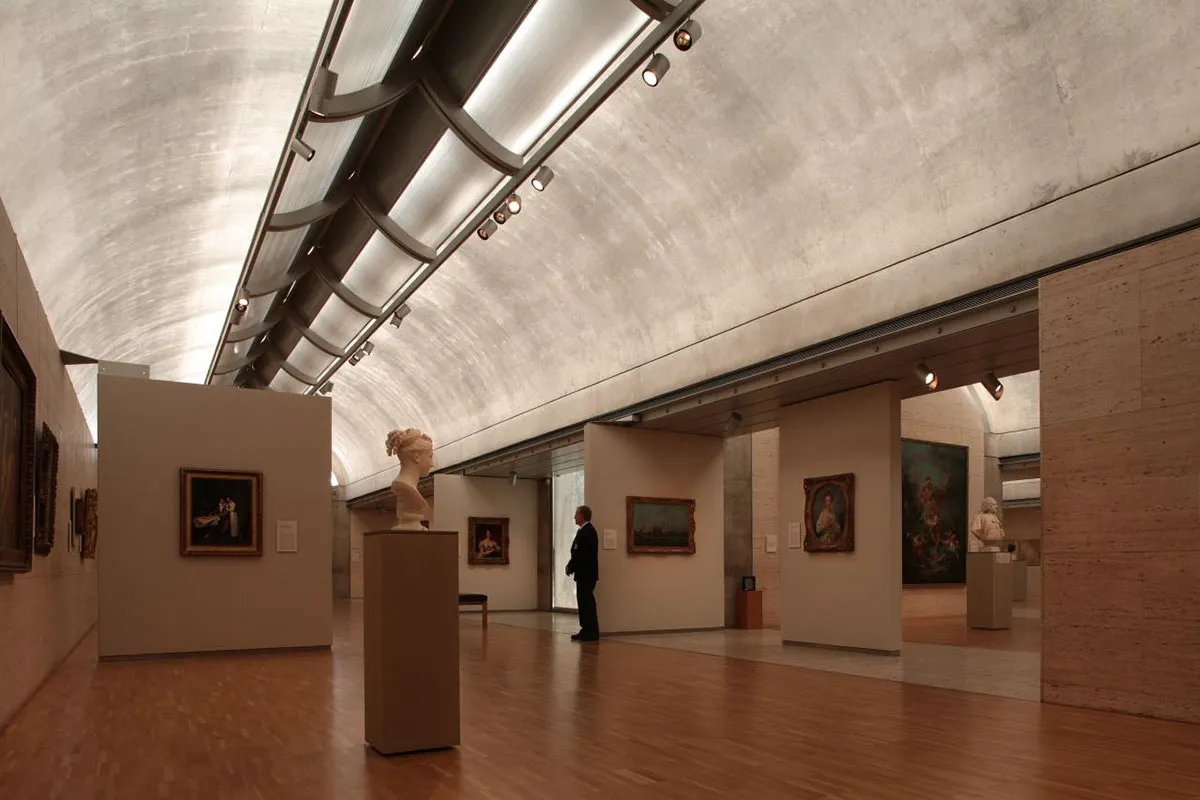
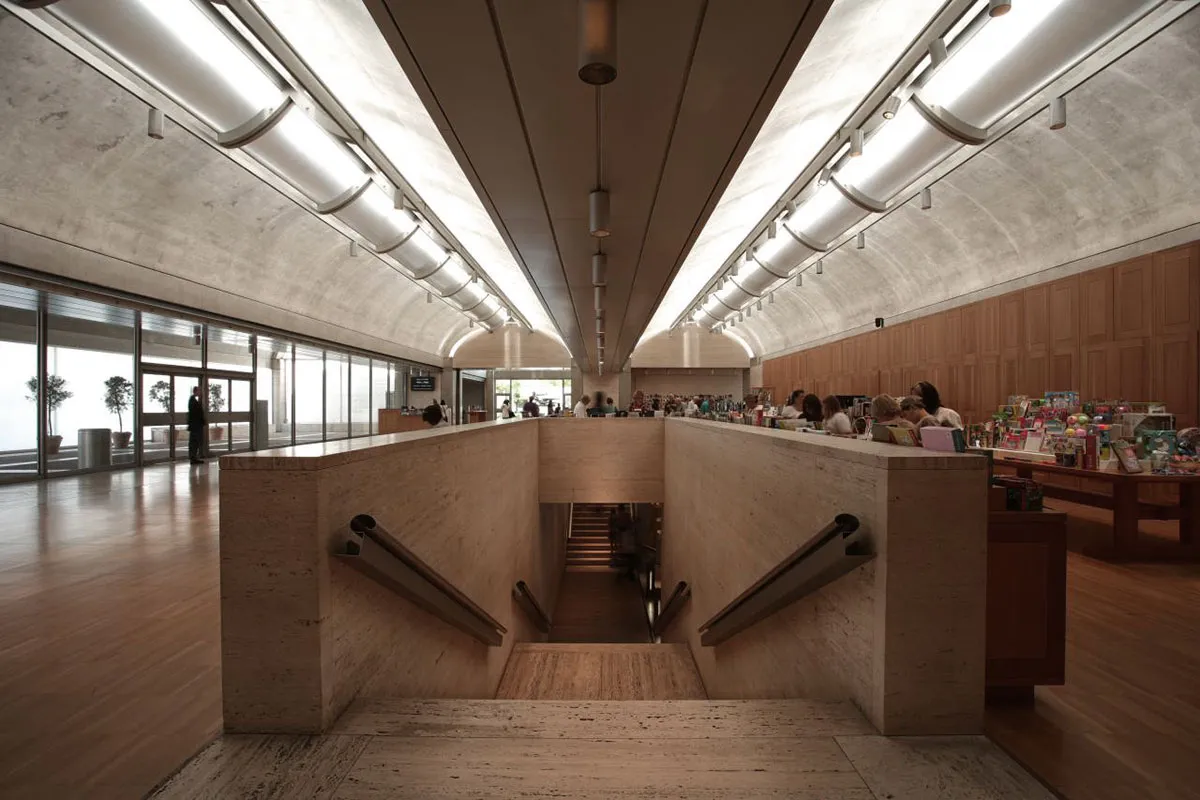
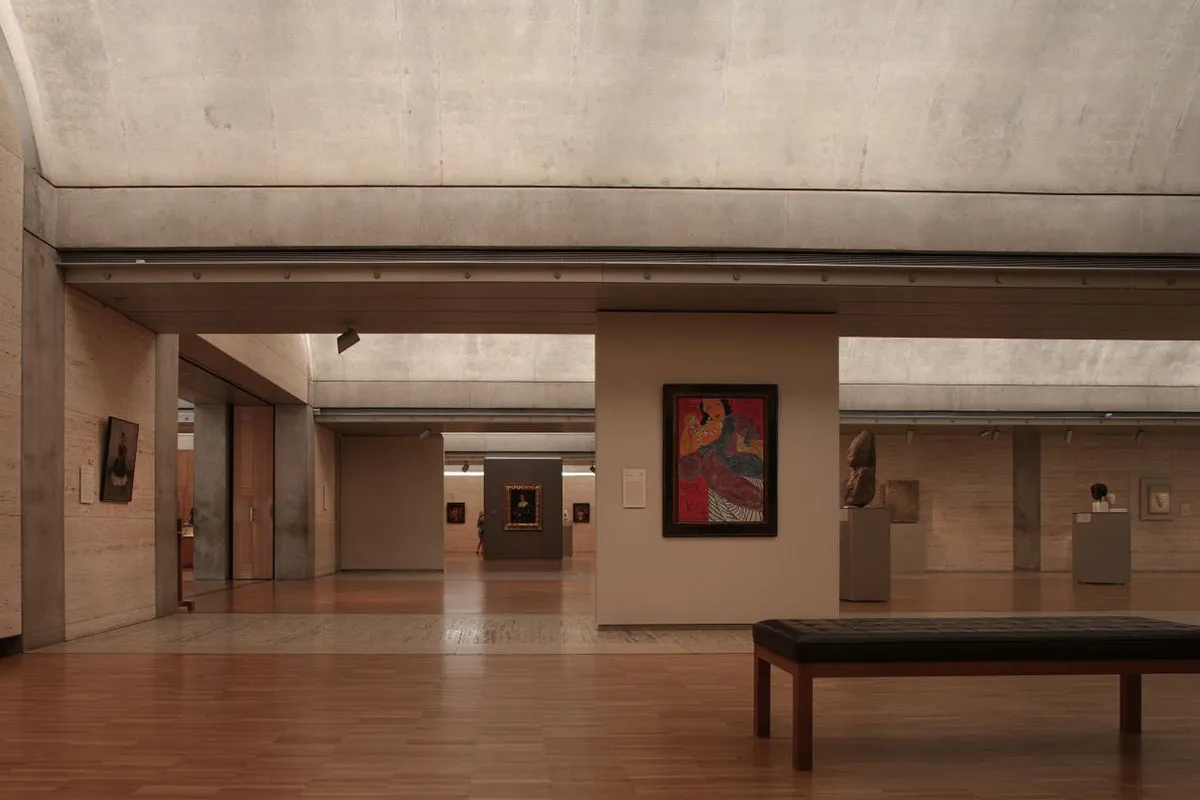
The result, inside the Kimbell, is a light with no apparent origin. Visitors entering the galleries for the first time experience it immediately as a quality of the space rather than as the product of any visible system. The color temperature — reportedly in the range of 3,500 to 3,800 Kelvin — is widely described by lighting designers as the “sweet spot” for viewing color: warm enough to feel natural, cool enough to reveal color accurately. And it changes. As a cloud passes outside, the light inside the Kimbell dims and brightens. As the afternoon advances, the character of the illumination shifts. The museum, Kahn said, “has as many moods as there are moments in time, and never will there be a single day like the other.”
The Kimbell was Kahn’s last completed building. He died of a heart attack in March 1974, alone in a men’s bathroom at Penn Station in New York, returning from a building site in Bangladesh. The building he had put the most of himself into — the one where the question he had been asking since he stood in the ruins of Rome in 1950 finally received its most complete answer — was two years old.
There is one more Kahn story, from the years immediately before the Kimbell, that belongs alongside it — a story not about a building but about a conversation.
The Salk Institute for Biological Studies, which Kahn completed in La Jolla, California, in 1965, had been designed from the start around a central courtyard between two mirror-image laboratory blocks. For two years, Kahn made studies of what trees to plant there, unable to reach a decision. He could not decide, partly because of the diversity of advice regarding what flora would survive the exposure and winds of the Pacific.
He had met the Mexican architect Luis Barragán the previous year, and had seen his work in an exhibition at MoMA. In early 1966, he invited Barragán to the site. Barragán walked into the courtyard, looked at Kahn’s drawings of trees, and told him “not to add one leaf, nor plant, not one flower, nor dirt. Instead, make it a plaza with a single water feature. If you make a plaza, you will have another facade to the sky.”
Kahn, Barragán later said, was so struck by the idea that he could not help adding to it immediately, saying, “then we would get all those mosaics for nothing,” pointing to the Pacific Ocean. The courtyard was stripped of everything, paved in Italian travertine, bisected by a narrow channel of water that runs from the buildings to the horizon and connects — visually, endlessly — to the Pacific.
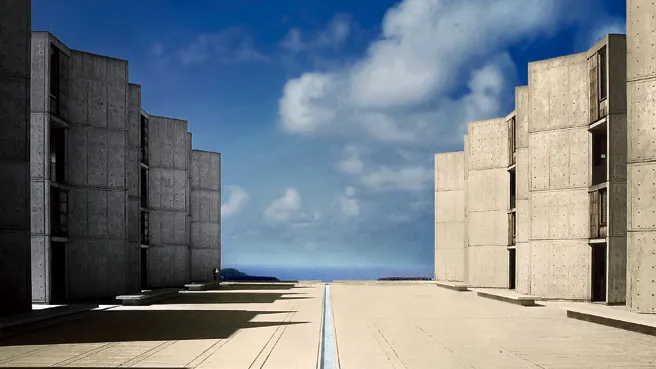
The phrase “a facade to the sky” is one of the most precise statements about light in the entire literature of architecture. It describes not a building but an absence: a vertical plane of open air, bounded by stone, through which the sky above La Jolla is framed and concentrated. Barragán and Kahn were, between them, making a room with no roof — a room whose ceiling is the sky, and whose light changes with every hour of the day. From the courtyard of the Salk Institute, as the sun moves from east to west, the shadows cast by Kahn’s concrete walls rotate across the travertine floor with the precision of a sundial. Scientists have reported sudden insights and unexpected emotions standing in that space. The courtyard is not an architectural amenity. It is, as Barragán said, a facade — an architectural surface whose material is light.
In 1989, in the Japanese suburb of Ibaraki, twenty-five kilometers from Osaka, a small concrete church was completed. It measured 113 square meters. It had no stained glass, no decorated surfaces, no visible religious imagery, no natural materials of any kind. Its walls were bare reinforced concrete. Its floor was plain concrete. Its pews were concrete blocks with boards laid across them. The budget for the entire building was so constrained that the architect, Tadao Ando, originally had to leave the floor exposed to the elements rather than glazing the cross opening in the east wall — a modification made only after the congregation protested.
In the east wall, Ando cut a cross. Two intersecting slots, one vertical and one horizontal, through the full thickness of the concrete. Through the vertical slot, approximately two meters tall and perhaps thirty centimeters wide, the morning sun enters and falls across the floor of the church. The cross is not made of stone or wood or glass. It is made of light.
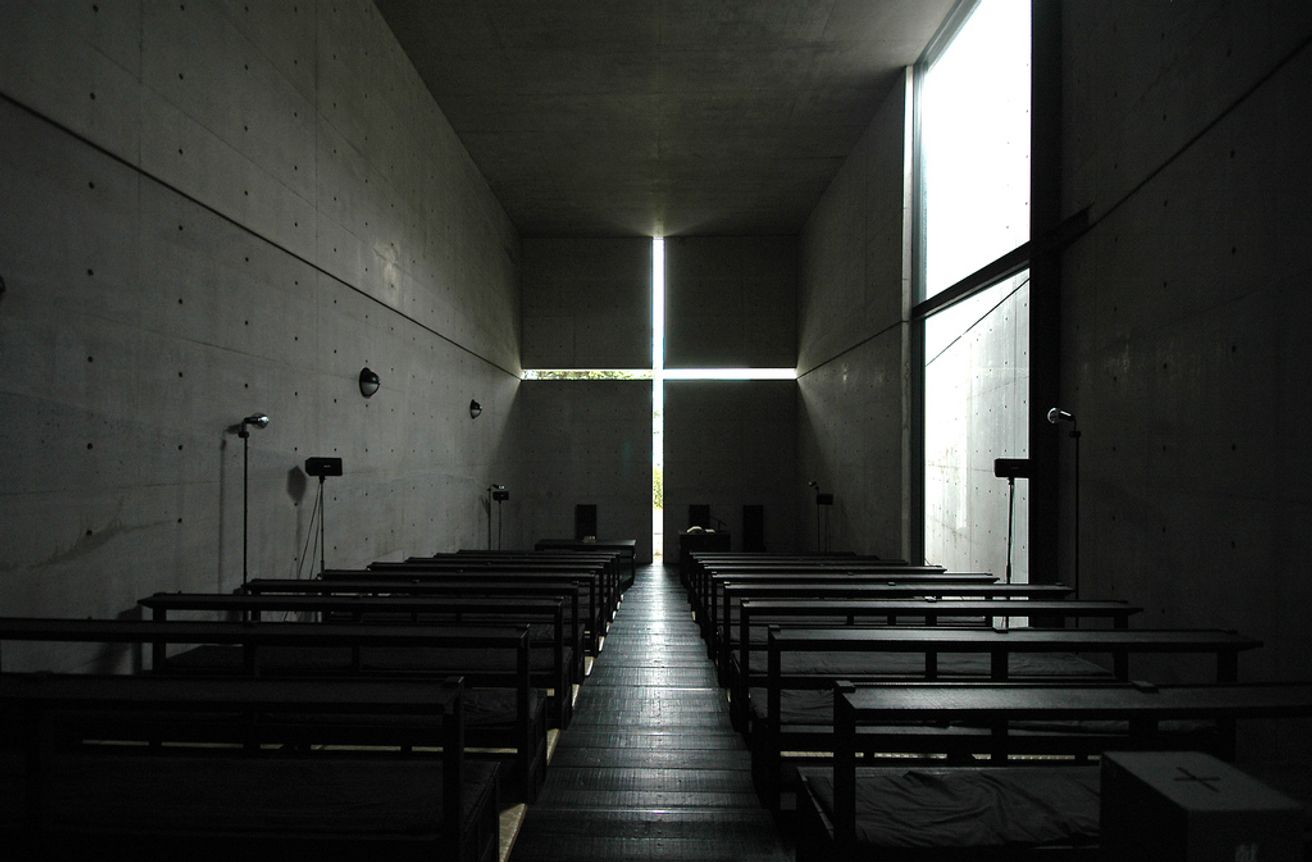
Ando had been studying the architects who preceded him for decades. He had read Kahn. He had visited Le Corbusier’s buildings in person. He had absorbed, through the Japanese architectural tradition, a conception of space in which what is absent is as important as what is present — the concept of ma, of meaningful void, of the interval between things. When he encountered the Western modernist masters’ engagement with light, he recognized something that Japanese space had always known and that Western architecture had been slowly rediscovering: that darkness is a design material, not a problem.
“In all my works, light is an important controlling factor,” Ando said. “I create enclosed spaces mainly by means of thick concrete walls. The primary reason is to create a place for the individual, a zone for oneself within society.” The darkness of Ando’s interiors is deliberate. It makes the light that enters them into an event. A visitor entering the Church of the Light, on a morning when the sun is striking the east wall, experiences the cross not as an aperture but as a presence — a body of light occupying the room, shifting with the motion of the sun, arriving and receding with the seasons. The interior does not illuminate a religious symbol. It produces one, every morning, from the movement of the earth around the sun.
What Ando had understood, and expressed with greater economy than anyone before him, is that light is only perceptible in relation to the darkness it displaces. The great failure of most buildings that attempt to be “light-filled” is exactly this: they are uniformly bright, and uniform brightness is not light — it is the absence of darkness, which is something different. Light, as a spatial experience, requires contrast, shadow, the specific directionality that says not just there is light here but it comes from there, at that angle, at this hour.
The story comes full circle, in a suburb of Houston, with a commission defined by a single requirement. Dominique de Menil, the French-born collector who had assembled one of the finest private art collections in America, had a clear and unusual demand for the museum she was building to house it. Director Walter Hopps recalled her exact words: “I told him I wanted to be able to turn the sun on and off.”
She had chosen Renzo Piano, the Italian architect who had made his name with the extrovert mechanical spectacle of the Centre Pompidou in Paris, to design the Menil Collection in Houston’s Montrose neighborhood, completed in 1986. It was, in retrospect, an unexpected choice — Piano was known for technology, not for the meditative quality that Menil’s collection required. But what Piano did with Peter Rice, the brilliant Irish engineer from Ove Arup with whom he had worked since the Pompidou, was solve a light problem with an engineering invention that equaled Kahn’s cycloid reflectors in its precision.
To meet Dominique’s insistence that the art be viewed in natural light, Piano and Rice invented a “solar machine” consisting of 300 ferro-cement “leaves” held by a delicate white steel frame. The leaves are curved, shaped so that some direct north light enters the interior, and the curves deflect direct sunlight — it is reflected from the top side of one leaf to the underside of its neighbor. They are manufactured objects — fabricated with the precision of aircraft components — that perform a natural function, separating the Texas sun into its safe and dangerous components and delivering the former to the galleries below while bouncing the latter harmlessly away. Piano’s team built a full-scale mockup of the gallery in their studio to test the design. It proved so pivotal that the fabrication of 1:1 models has been standard practice in the studio ever since.
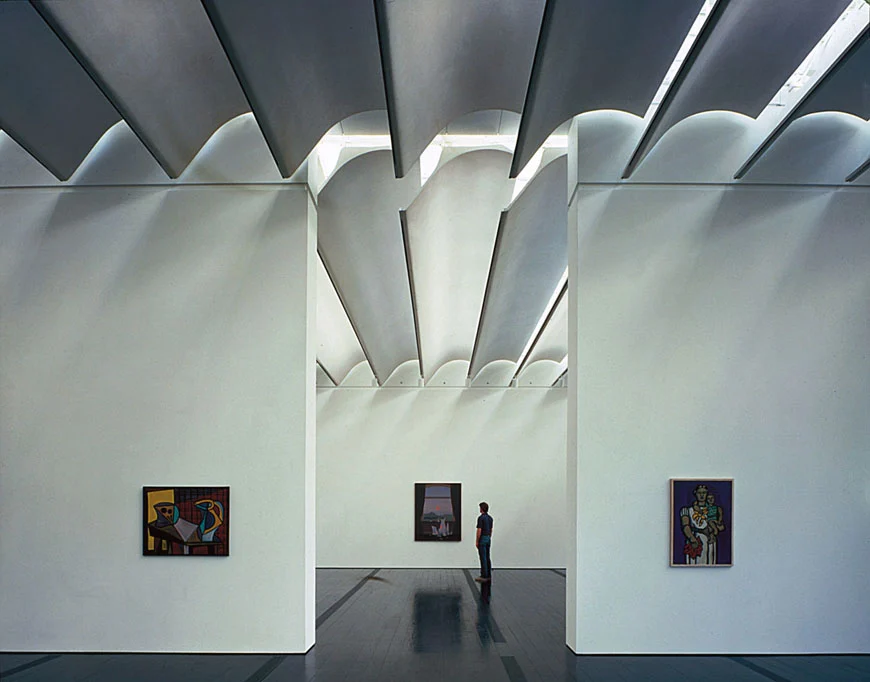
Inside the Menil, as inside the Kimbell, visitors are always aware that the light is alive — that it changes with the weather and the hour, that the particular quality of illumination on any given painting is unrepeatable, that there is no correct moment to see this collection and no incorrect one. The client, Dominique de Menil, insisted that the light be handled in such a way that visitors are alert to its constant changes with time, season, and weather.
What connects these buildings — separated by decades and continents, built from different materials for different programs, by architects with radically different aesthetics — is a shared conviction that light is not a utility to be delivered to a building but a material to be designed, as carefully and specifically as concrete or wood or glass.
The conviction ran against the grain of the twentieth century. Electric light was, for most of the modernist period, seen as a triumph of technology over nature: the ability to build anywhere, orient a building in any direction, keep the windows small or eliminate them entirely, and provide the same reliable illumination regardless of weather, season, or the position of the sun. The International Style glass box, which became the default form of corporate and institutional architecture from the 1950s onward, was in large part a statement about freedom from light — the freedom to fill a building with any quality and quantity of artificial illumination you chose.
Kahn, Le Corbusier, Aalto, Ando, Piano — working in different decades, on different continents, for different clients — were each, in their way, pushing back against this. Not from nostalgia, and not from a rejection of technology. Aalto used the most precise geometry available to him to solve the light problem at Viipuri. Piano and Rice’s ferro-cement leaves are as technically sophisticated as anything in the Pompidou. Kahn’s post-tensioned cycloid vaults pushed the limits of structural engineering. These were not primitive gestures. They were statements that natural light, in all its changeability and complexity, produces something in a building — and in the people inside it — that artificial light cannot replicate. That a room illuminated only by a 15-inch skylight with a perforated aluminum reflector will feel more alive, more present, more deeply itself than a room lit by the most expensive and carefully color-calibrated artificial system.
The reason is biological as much as architectural: natural light is not a single condition but a continuous performance, changing across every hour of every day and every season, tracking the rotation of the earth in ways that every human nervous system has spent hundreds of thousands of years learning to read. To build a building that participates in that performance — that brings the sky into the room, that makes you aware of the quality of the afternoon in a way you would not be on a street — is to give its inhabitants something that cannot be specified, quantified, or reproduced. It is to give them, as Ando once put it, light that only has meaning because it was introduced inside a space cut off from the outside world.
That is not a technical achievement. It is an architectural one — and the difference, which the great modernists spent their careers articulating, has not dated by a day.
Questions About Light As A Building Material
Why Did Louis Kahn And Le Corbusier Return To Heavy Walls To Design Light?
Louis Kahn and Le Corbusier returned to heavy walls because mass gave them control over daylight. Kahn’s encounter with the ruins of Rome, Egypt, and Greece pushed him toward thick materials that could be cut, hollowed, and shaped around light. Le Corbusier used a similar principle at Ronchamp, where the thick south wall turns small apertures into deep chambers of color. In both cases, mass was not the opposite of light. It was the instrument that made light deliberate.
When Is An Aperture More Important Than A Window?
An aperture becomes more important than a window when the architect is designing the behavior of light, not only the presence of glass. At Ronchamp, Le Corbusier’s south-wall openings are angled cuts through thick masonry, each catching daylight differently. At the Church of the Light in Ibaraki, Tadao Ando reduces the aperture to a cross-shaped incision in concrete, where absence becomes the building’s central religious image. The question is not how large the opening is, but what kind of light it produces.
How Did Alvar Aalto And Louis Kahn Make Daylight Useful Without Making It Flat?
Alvar Aalto’s Viipuri Library and Louis Kahn’s Kimbell Art Museum both treat daylight as something that must be edited before it reaches the user. At Viipuri, Aalto’s conical skylights scatter daylight across the reading room, reducing glare and hard shadows. At the Kimbell, Kahn’s roof slots, cycloid vaults, and aluminum reflectors transform the harsh Texas sun into a soft, silvery gallery light. Both buildings show that useful daylight is not maximum daylight. It is daylight that has been shaped before it enters the room.
Why Is Shadow As Important As Light In Architecture?
Shadow gives light direction, weight, and time. Tadao Ando’s Church of the Light would lose most of its force if the interior were evenly bright. The cross matters because the room is dark enough for light to arrive as an event. Louis Kahn understood the same principle at the Salk Institute in La Jolla, where the empty travertine court frames the sky and lets shadows move slowly across the ground. Shadow is not a failure of illumination. It is the condition that allows light to be read.
How Should Artificial Lighting Support Daylight?
Artificial lighting should extend the architectural order of daylight rather than erase it. A room shaped by roof slots, deep apertures, reflected light, or controlled shadow should not automatically become uniformly bright after sunset. Linear fixtures, concealed strips, wall washers, reflectors, and aluminum LED profiles can support the same hierarchy after dark, but they work best when they follow the building’s surfaces, edges, ceilings, and apertures. The strongest artificial lighting does not compete with daylight. It remembers how the room was meant to receive it.
How Can Daylight Lessons Apply Beyond Museums And Chapels?
The Kimbell Art Museum, Ronchamp, Viipuri Library, the Menil Collection, the Salk Institute, and the Church of the Light are exceptional buildings, but their daylight lessons are practical. A house, school, office, library, restaurant, or small chapel can still begin with the same questions: should the room receive diffuse light, top light, side light, reflected light, dramatic light, or controlled darkness? Once that decision is clear, the wall, roof, ceiling, courtyard, or fixture can be designed around the path of light rather than treated as an afterthought.
What Should Architects Study First In A Building Designed Around Light?
Architects should study the route of light before studying the window itself. At the Kimbell Art Museum, daylight enters from above and is redirected before it reaches the galleries. At Viipuri Library, it is scattered through conical skylights. At the Menil Collection in Houston, Renzo Piano and Peter Rice filter daylight through a ceiling system before it reaches the art. At the Salk Institute, Kahn and Luis Barragán frame light through an open court rather than a conventional room. The source matters, but the route matters more. Great light usually arrives after architecture has slowed it down.

